I. BASIS OF CLASSIFICATION
A LEVELS OF ORGANISATION
| LEVEL | DESCRIPTION | EXAMPLES |
|---|---|---|
| Cellular | Cells as loose aggregates; some division of labour | Porifera (Sponges) ⭐ |
| Tissue | Cells performing same function arranged into tissues | Cnidaria & Ctenophora ⭐ |
| Organ | Tissues grouped into organs | Platyhelminthes |
| Organ system | Organs form functional systems | Annelida → Chordata (incl. Aschelminthes) |
B BODY SYMMETRY
| TYPE | DEFINITION | EXAMPLES |
|---|---|---|
| Asymmetrical | No plane divides body into equal halves | Porifera ⭐ |
| Radial | Any plane through central axis → two identical halves | Cnidaria, Ctenophora, adult Echinodermata ⭐ |
| Bilateral | Only one plane → identical left & right halves | Platyhelminthes → Chordata ⭐ |
NEET 2020, 2024, RE-NEET 2026: Echinodermata — adults radially symmetrical; larvae bilaterally symmetrical. Radial symmetry definition — "any plane passing through central axis divides organism into two identical halves" is CORRECT.
Symmetry Types (Radial vs Bilateral)
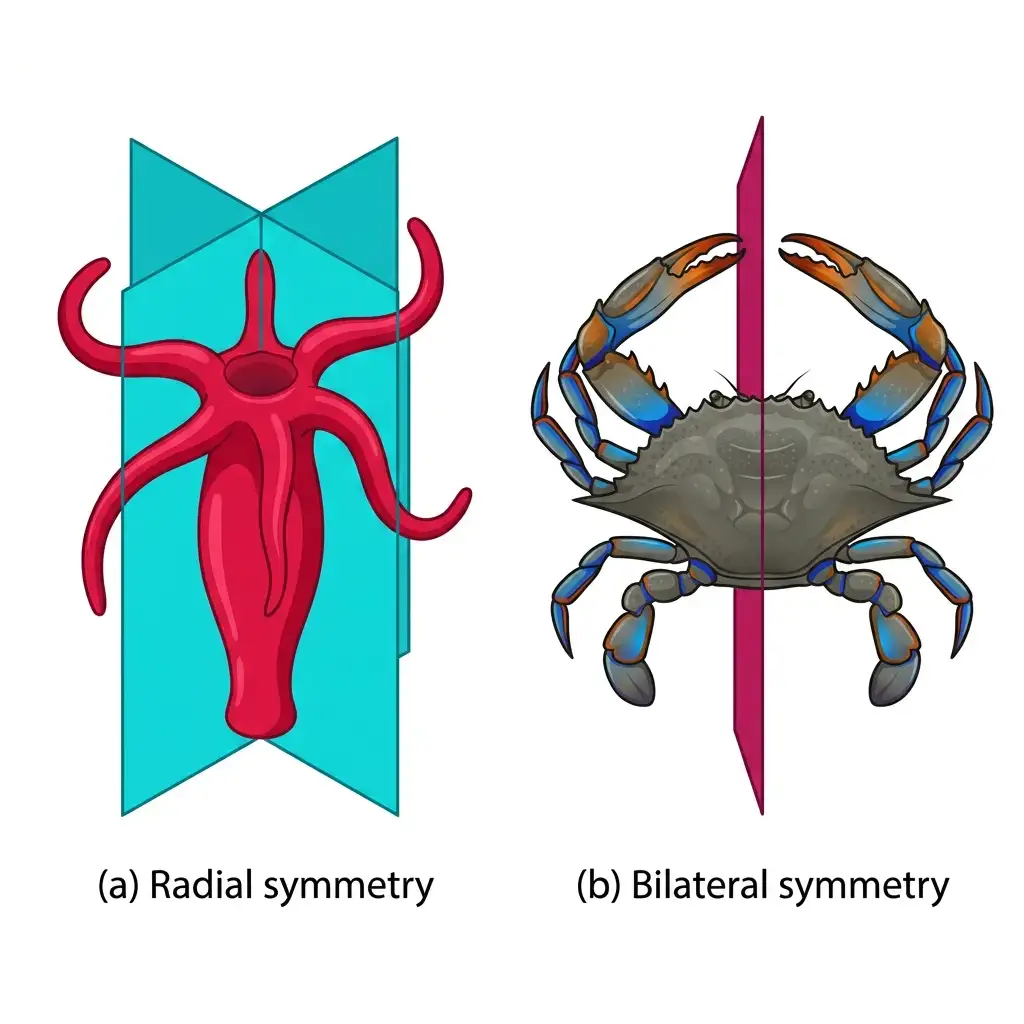
Symmetry in Kingdom Animalia: Compares (a) Radial symmetry with multiple intersecting planes, and (b) Bilateral symmetry with a single vertical dividing plane.
🔬 Detailed Anatomical Description
Symmetry is a primary basis of classification in Kingdom Animalia. (a) Radial Symmetry: Any plane passing through the central axis divides the body into identical halves (e.g. Coelenterates, Ctenophores, Echinoderms); (b) Bilateral Symmetry: Only a single vertical plane divides the body into identical left and right halves (e.g. Annelids, Arthropods, Molluscs). This is a vital diagnostic feature.
C DIPLOBLASTIC vs TRIPLOBLASTIC
| TYPE | GERM LAYERS | BETWEEN LAYERS / EXAMPLES |
|---|---|---|
| Diploblastic | Ectoderm + Endoderm | Mesoglea (undifferentiated) ⭐ | Cnidaria |
| Triploblastic | Ecto + Meso + Endoderm | Mesoderm (true third layer) | Platyhelminthes → Chordata |
Germinal Layers (Diploblastic vs Triploblastic)
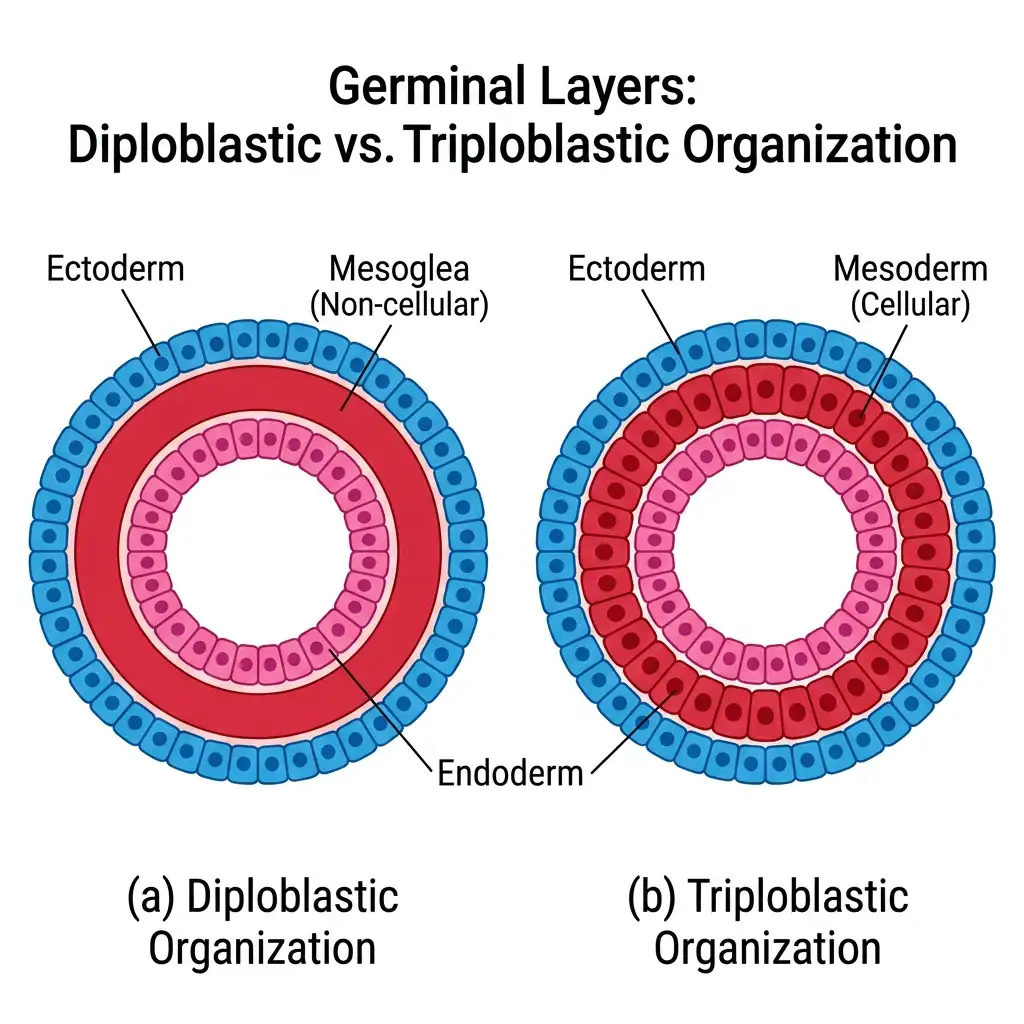
Animal Development - Germinal Layers: Compares (a) Diploblastic with non-cellular Mesoglea and (b) Triploblastic with fully cellular Mesoderm.
🔬 Detailed Anatomical Description
During embryonic development, cells arrange into germinal layers: (1) Diploblastic: Two layers, outer ectoderm and inner endoderm, separated by an acellular, gelatinous mesoglea (e.g. Coelenterates, Ctenophores); (2) Triploblastic: Three layers, where a cellular mesoderm layer develops between the ectoderm and endoderm (e.g. Platyhelminthes to Chordates).
D COELOM (BODY CAVITY)
| TYPE | DESCRIPTION | EXAMPLES |
|---|---|---|
| Acoelomates | Body cavity ABSENT | Platyhelminthes ⭐ |
| Pseudo-coelomates | Cavity present but NOT lined by mesoderm | Aschelminthes ⭐ |
| Coelomates (True coelom) | Cavity LINED by mesoderm | Annelida → Chordata ⭐ |
NEET 2020, 2026 context: Platyhelminthes = bilaterally symmetrical, triploblastic, ACOELOMATE. NEET 2024: Aschelminthes = pseudocoelomate. True coelomates include Annelida → Chordata.
Sectional View of Coelom
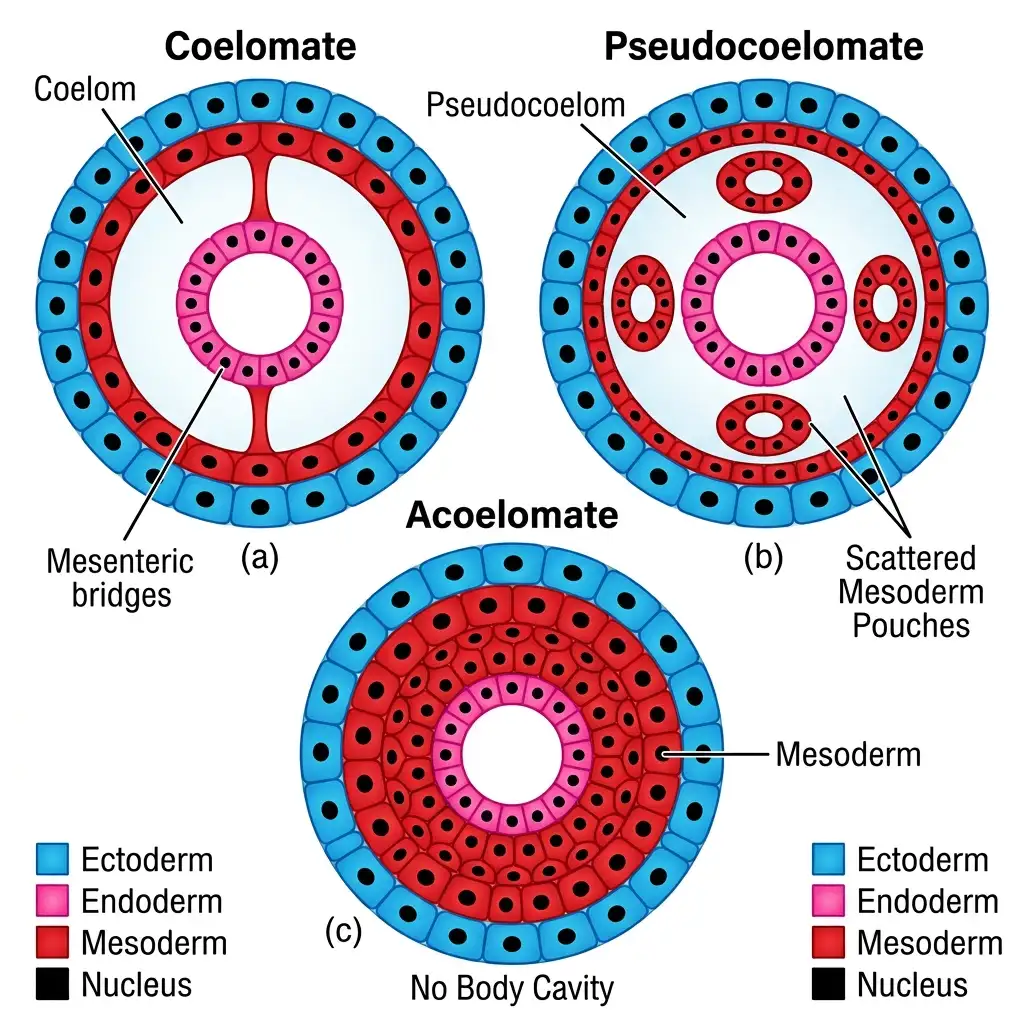
Body Cavity Classification (Coelom): Compares (a) Coelomate (lined with mesoderm), (b) Pseudocoelomate (scattered mesoderm pouches), and (c) Acoelomate (no cavity).
🔬 Detailed Anatomical Description
The body cavity (coelom) between the body wall and gut wall is critical for classification: (a) Coelomate: Possesses a true coelom lined entirely by mesoderm (e.g. Annelids, Arthropods, Chordates); (b) Pseudocoelomate: The cavity is not lined by mesoderm, which is instead scattered in pouches (e.g. Aschelminthes); (c) Acoelomate: The body cavity is absent (e.g. Platyhelminthes).
E SEGMENTATION (METAMERISM)
- Body externally & internally divided into segments with serial repetition of organs = metamerism
- ⭐ Phyla with metamerism: Annelida, Arthropoda, Chordata
F DIGESTIVE SYSTEM
| TYPE | DESCRIPTION | EXAMPLES |
|---|---|---|
| Incomplete (single opening) | Only one opening (mouth = anus) | Platyhelminthes, Cnidaria, Ctenophora |
| Complete (two openings) | Separate mouth & anus | Aschelminthes → Chordata |
G CIRCULATORY SYSTEM
| TYPE | DESCRIPTION | EXAMPLES |
|---|---|---|
| Open | Blood pumped out; directly bathes cells | Arthropoda, Mollusca, Echinodermata, Hemichordata ⭐ |
| Closed | Blood circulated through vessels | Annelida, Chordata ⭐ |
I HEART CHAMBERS — QUICK SUMMARY
| CHAMBERS | EXAMPLES |
|---|---|
| 2-chambered (1A + 1V) | Fishes (Chondrichthyes, Osteichthyes) |
| 3-chambered (2A + 1V) | Amphibians, Reptiles (except Crocodiles) |
| 4-chambered (2A + 2V) | Aves, Mammals, Crocodiles ⭐ |
RE-NEET 2026 + General: Crocodiles are REPTILES but have a 4-chambered heart (exception!). Reptilia class name refers to creeping or crawling locomotion (correct). NOT all have 3-chambered heart.
J THERMOREGULATION
| TYPE | MEANING | EXAMPLES |
|---|---|---|
| Poikilothermous (Cold-blooded) | Cannot regulate body temperature | Fishes, Amphibians, Reptiles |
| Homoiothermous (Warm-blooded) | Maintain constant body temperature | Aves & Mammals ⭐ |
🔑 'FIRSTS': Excretory system first → Platyhelminthes (flame cells) | Circulatory system first → Annelida | Respiratory system first → Arthropoda
II. PHYLUM-BY-PHYLUM — DETAILED NOTES
PHYLUM PORIFERA (SPONGES)
| FEATURE | DETAIL |
|---|---|
| Habitat | Generally marine; Spongilla = freshwater ⭐ |
| Symmetry | Mostly asymmetrical |
| Level | Cellular level |
| Body plan | Meshwork of cells; water canal system ⭐ |
| Water pathway | Ostia → Spongocoel → Osculum |
| Lining cells | Choanocytes / collar cells ⭐⭐ |
| Digestion | Intracellular |
| Skeleton | Spicules or spongin fibres |
| Sexes | Hermaphrodite |
| Fertilisation | Internal |
| Development | Indirect ⭐ |
| Examples | Sycon, Spongilla (freshwater), Euspongia (bath sponge) |
NEET 2023: Porifera — fertilisation is INTERNAL and development is INDIRECT. Water CANAL system = Porifera vs Water VASCULAR system = Echinodermata!
Examples of Porifera (Sponges)
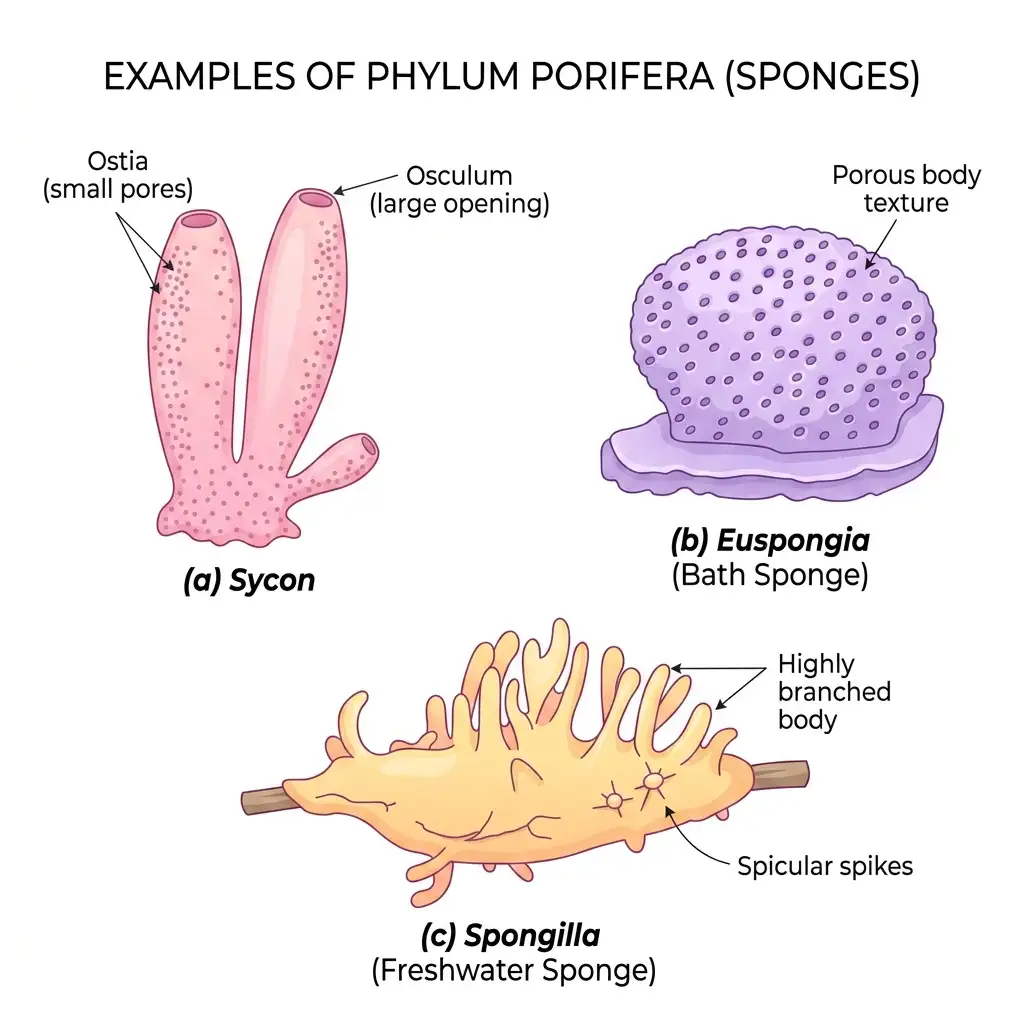
Phylum Porifera Representatives: (a) tubular Sycon, (b) globular porous Euspongia, and (c) irregular spiky Spongilla.
🔬 Detailed Anatomical Description
Phylum Porifera (sponges) contains primitive multicellular, sessile marine organisms. Characterized by a water canal system: water enters via tiny pores (ostia) into a central cavity (spongocoel) and exits via the osculum, lined by flagellated collar cells (choanocytes). Illustrated: (a) Sycon; (b) Euspongia (bath sponge); (c) Spongilla (freshwater sponge).
PHYLUM COELENTERATA (CNIDARIA)
| FEATURE | DETAIL |
|---|---|
| Habitat | Aquatic; mostly marine; Hydra = freshwater |
| Symmetry / Layers | Radial; Diploblastic; Tissue level |
| Special cells | Cnidoblasts / Cnidocytes (contain nematocysts) ⭐⭐ |
| Function | Anchorage, defence, capture of prey |
| Digestion | Extracellular AND intracellular |
| Body forms | Polyp (sessile) & Medusa (free-swimming) |
| Metagenesis | Polyps produce medusae asexually; medusae form polyps sexually (e.g., Obelia) ⭐ |
| Examples | Hydra, Adamsia (Sea anemone), Aurelia (Jellyfish), Obelia, Physalia (Portuguese Man-of-War), Pennatula (Sea-Pen), Gorgonia (Sea-fan), Meandrina (Brain coral) |
Coelenterata Outline body form
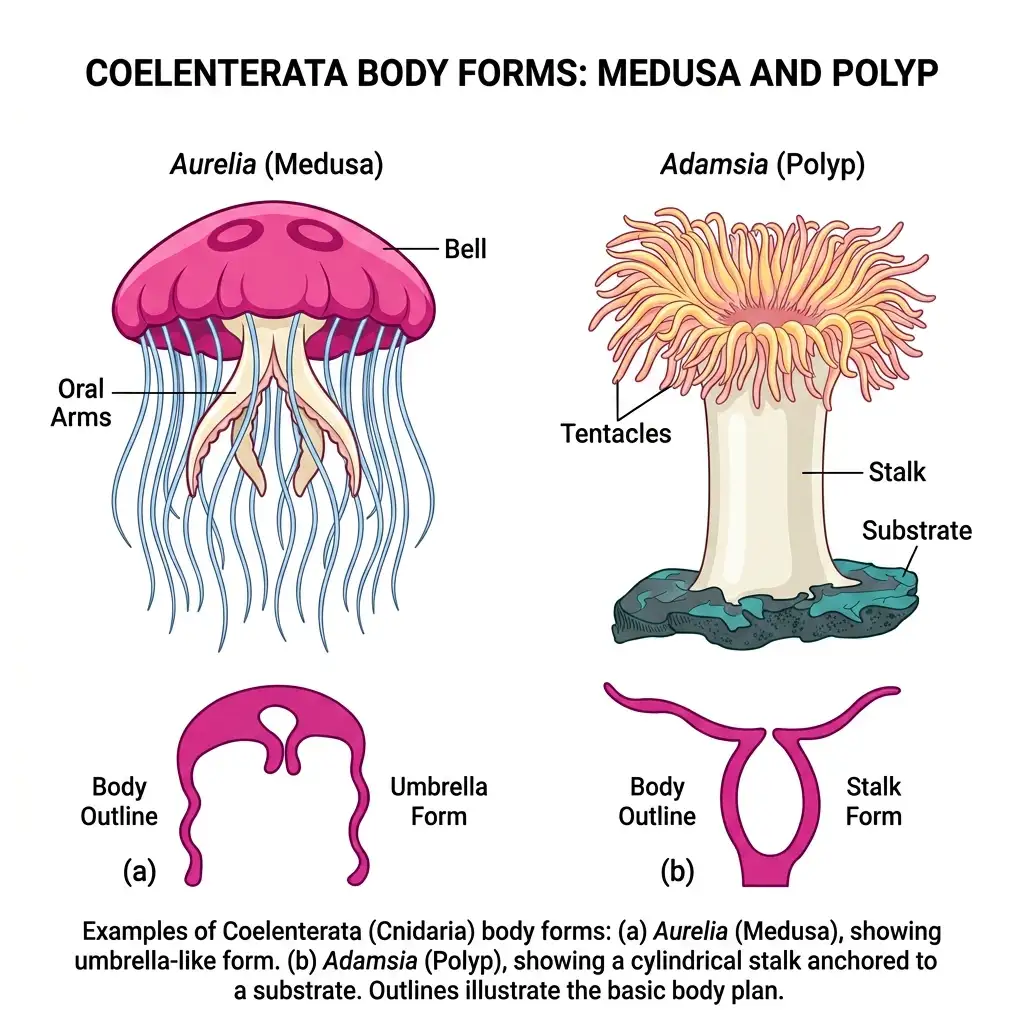
Kingdom Animalia - Coelenterata (Cnidaria) Body Forms: (a) Aurelia (Medusa) with umbrella-like form, and (b) Adamsia (Polyp) with cylindrical stalk and crown of tentacles.
🔬 Detailed Anatomical Description
Coelenterates (Cnidarians) display two basic body plans: Polyp and Medusa. (a) Medusa is an umbrella-shaped, free-swimming form (such as Aurelia/jellyfish) which reproduces sexually. (b) Polyp is a sessile, cylindrical form (such as Adamsia/sea anemone) which reproduces asexually. This is a classic textbook taxonomic example.
Structure of Cnidoblast
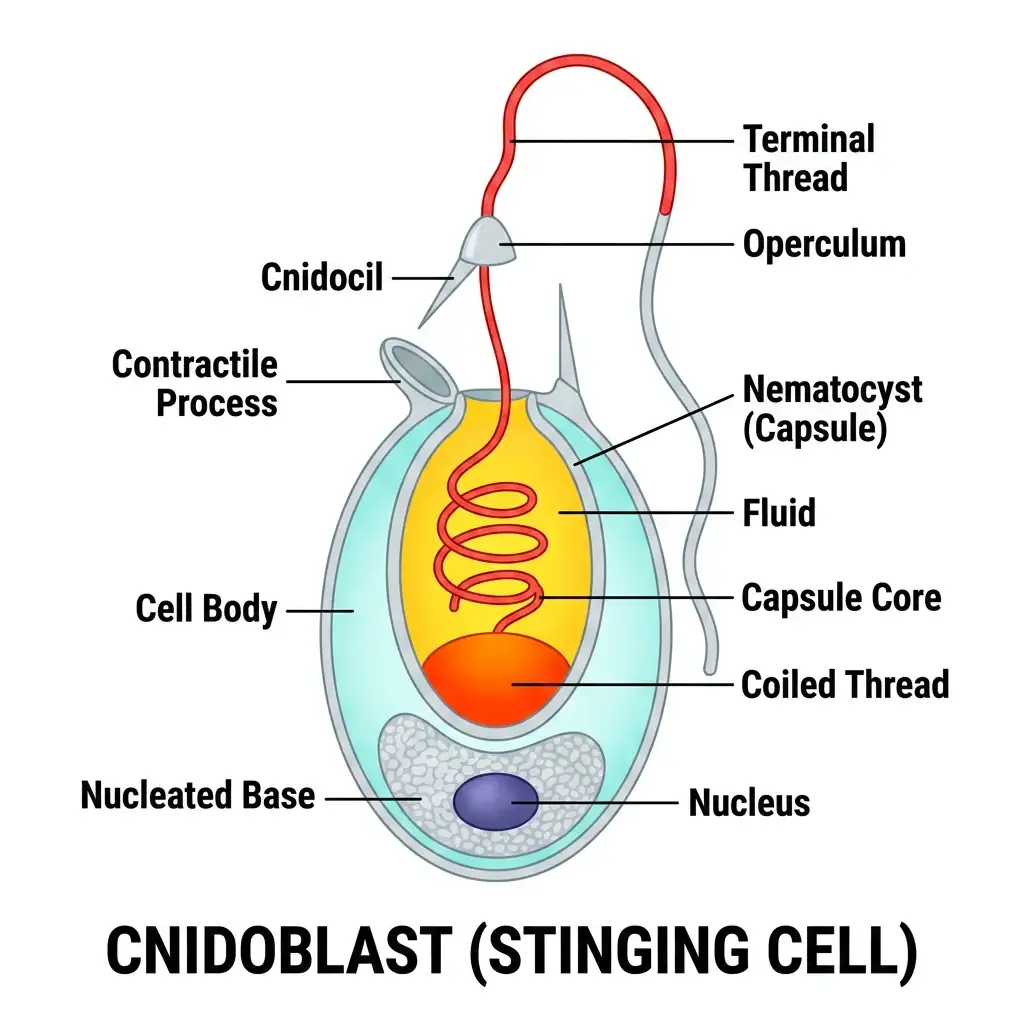
Stinging Cell (Cnidoblast/Cnidocyte) of Cnidarians: Shows cellular body, coiled nematocyst capsule, trigger cnidocil, and thread.
🔬 Detailed Anatomical Description
Cnidoblasts (cnidocytes or stinging cells) are characteristic features of Phylum Cnidaria, situated on tentacles and body walls. They contain a stinging organelle called a nematocyst, comprising a fluid-filled capsule with a coiled, hollow thread. When the trigger (cnidocil) is stimulated, the thread shoots out to inject venom, serving for anchorage, defense, and prey capture.
PHYLUM CTENOPHORA
| FEATURE | DETAIL |
|---|---|
| Common name | Sea walnuts / Comb jellies |
| Habitat | Exclusively marine ⭐ |
| Symmetry / Layers | Radial; Diploblastic; Tissue level |
| Locomotion | Eight rows of ciliated comb plates ⭐ |
| Special property | Bioluminescence ⭐ |
| Reproduction | Only sexual; External fertilisation |
| Examples | Pleurobrachia, Ctenoplana ⭐ |
Structure of Ctenophora
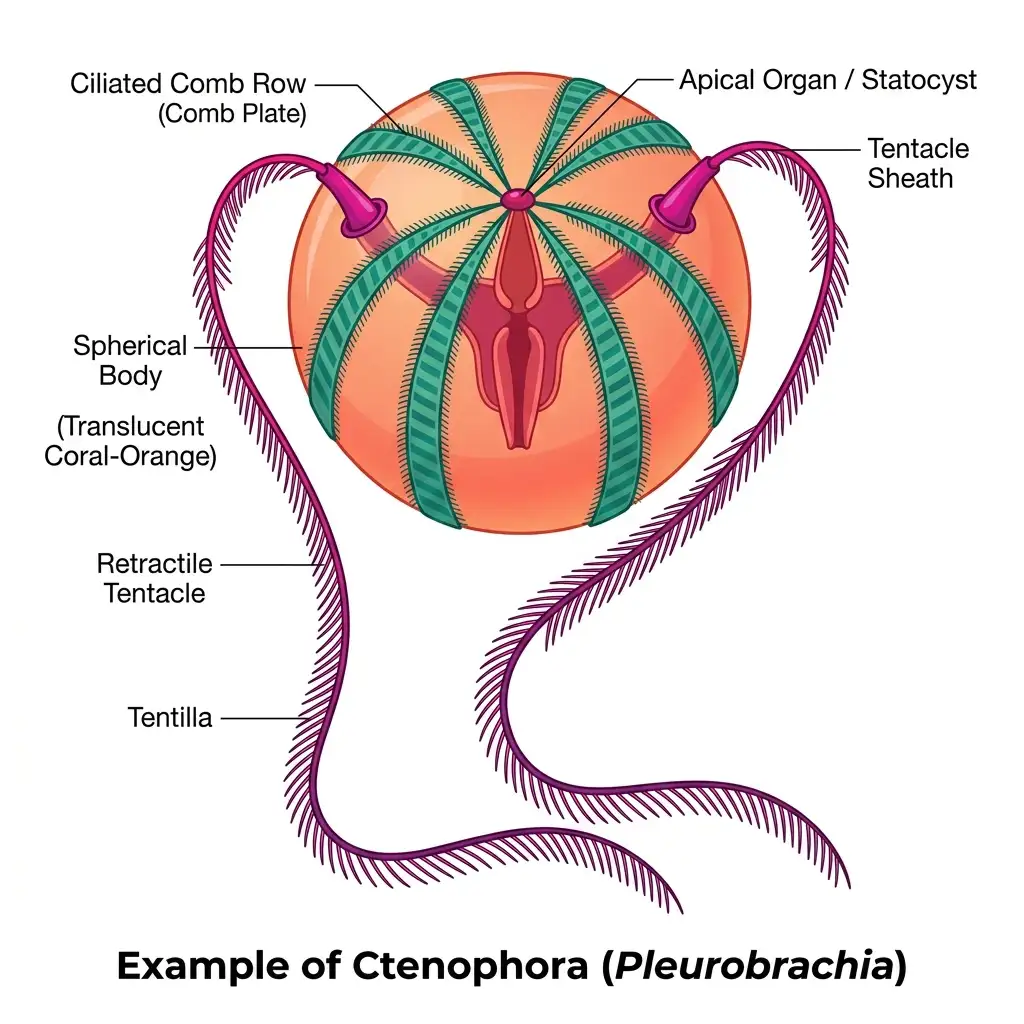
Kingdom Animalia - Ctenophora (Pleurobrachia): Represents a comb jelly with eight ciliated comb plates and tentacles.
🔬 Detailed Anatomical Description
Ctenophores, commonly known as comb jellies or sea walnuts, are exclusively marine, radially symmetrical organisms. Pleurobrachia represents a classic model: characterized by a spherical transparent body bearing eight external rows of ciliated comb plates (comb rows) used for locomotion, and two long retractile tentacles containing colloblast cells for prey capture.
PHYLUM PLATYHELMINTHES (FLATWORMS)
| FEATURE | DETAIL |
|---|---|
| Body shape | Dorso-ventrally flattened ⭐ |
| Habitat | Mostly endoparasites |
| Symmetry | Bilateral; Triploblastic |
| Coelom | ACOELOMATE ⭐⭐ |
| Level | Organ level |
| Excretion | Flame cells ⭐⭐ |
| Digestion | Incomplete (single opening) |
| Regeneration | Planaria — high capacity ⭐ |
| Sexes | Hermaphrodite |
| Examples | Taenia (Tapeworm), Fasciola (Liver fluke), Planaria |
NEET 2026: Platyhelminthes have INCOMPLETE digestive system (single opening = mouth = anus). Acoelomate, triploblastic, bilaterally symmetrical.
Structure of Platyhelminthes
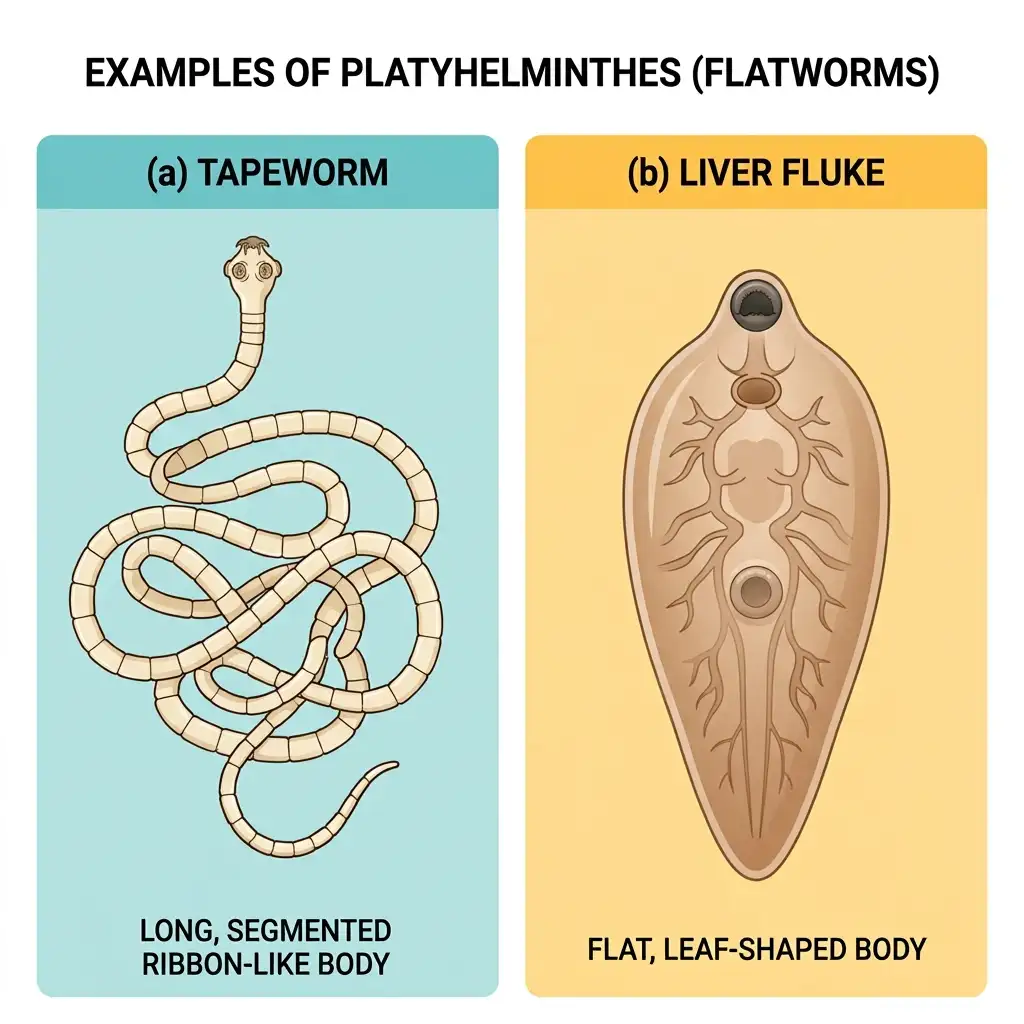
Kingdom Animalia - Platyhelminthes: Labeled flatworms: (a) Segmented tapeworm ribbon structure, and (b) Leaf-shaped liver fluke with suckers.
🔬 Detailed Anatomical Description
Platyhelminthes, commonly known as flatworms, are bilaterally symmetrical, triploblastic, acoelomate dorsoventrally flattened organisms. This diagram compares two parasitic examples: (a) Tapeworm (Taenia solium), displaying an elongated segmented ribbon-like body (proglottids); (b) Liver fluke (Fasciola hepatica), displaying a flat leaf-like body with oral and ventral suckers.
PHYLUM ASCHELMINTHES (ROUNDWORMS)
| FEATURE | DETAIL |
|---|---|
| Body | Circular in cross-section |
| Coelom | PSEUDOCOELOMATE ⭐⭐ |
| Level | Organ-system level |
| Digestion | Complete (two openings) |
| Sexes | Separate (dioecious) ⭐; females longer than males |
| Examples | Ascaris, Wuchereria (Filaria worm), Ancylostoma (Hookworm) ⭐ |
NEET 2026: Aschelminthes possess PSEUDOCOELOM (body cavity not lined by mesoderm on both sides). Complete digestive system; mostly dioecious.
Aschelminthes: Roundworm
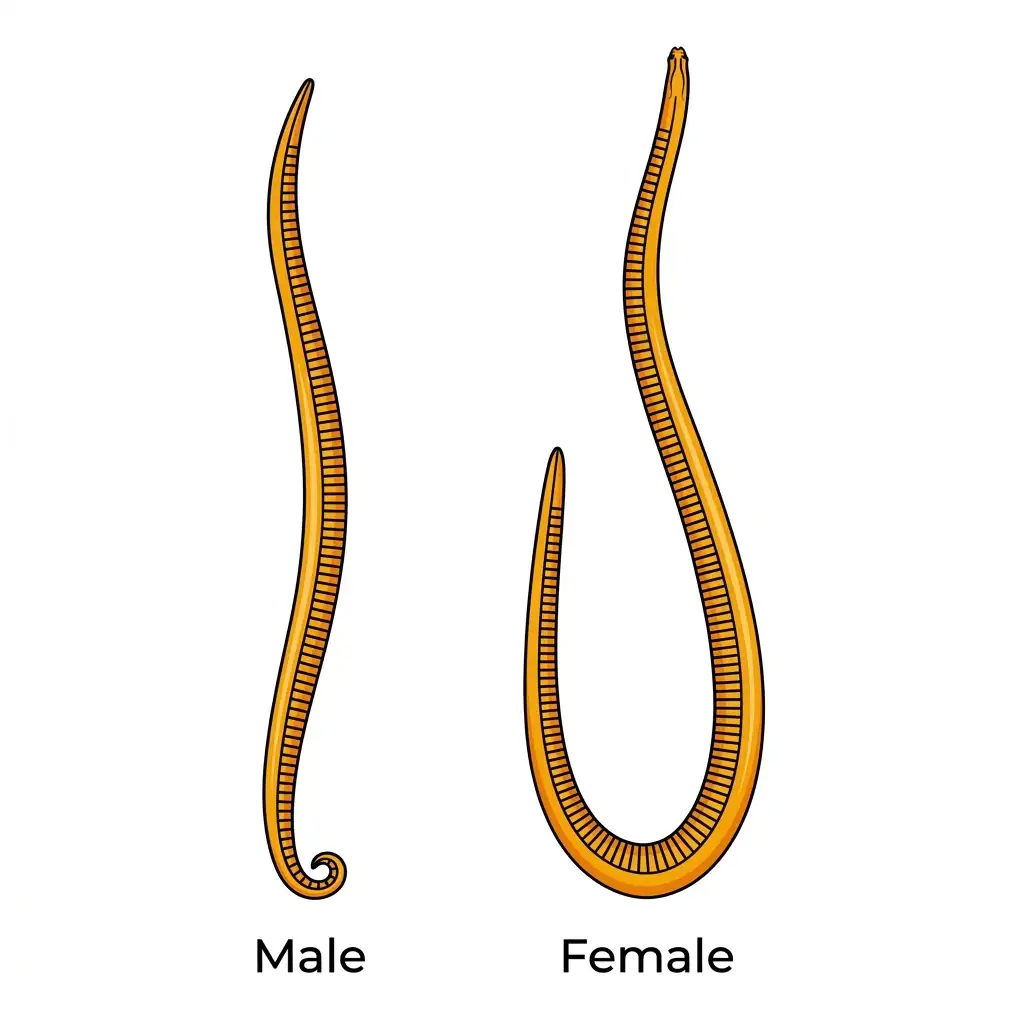
Kingdom Animalia - Aschelminthes (Ascaris): Shows sexual dimorphism in roundworms comparing longer female with shorter curved male.
🔬 Detailed Anatomical Description
Aschelminthes, commonly known as roundworms, are pseudocoelomate, bilaterally symmetrical, triploblastic unsegmented worms. Ascaris lumbricoides shows clear sexual dimorphism: (1) Female: Longer, thicker, with a straight posterior end; (2) Male: Shorter, thinner, with a distinctly curved tail tip containing copulatory spicules.
PHYLUM ANNELIDA
| FEATURE | DETAIL |
|---|---|
| Body | Metamerically segmented ⭐⭐ |
| Coelom | True coelomate |
| Circulatory | CLOSED type ⭐ |
| Excretion | Nephridia ⭐ |
| Appendages | Parapodia in Nereis (swimming) ⭐ |
| Sexes | Nereis = dioecious; Pheretima & Hirudinaria = monoecious |
| Examples | Nereis (parapodia), Pheretima (Earthworm), Hirudinaria (Leech) |
Examples of Annelida
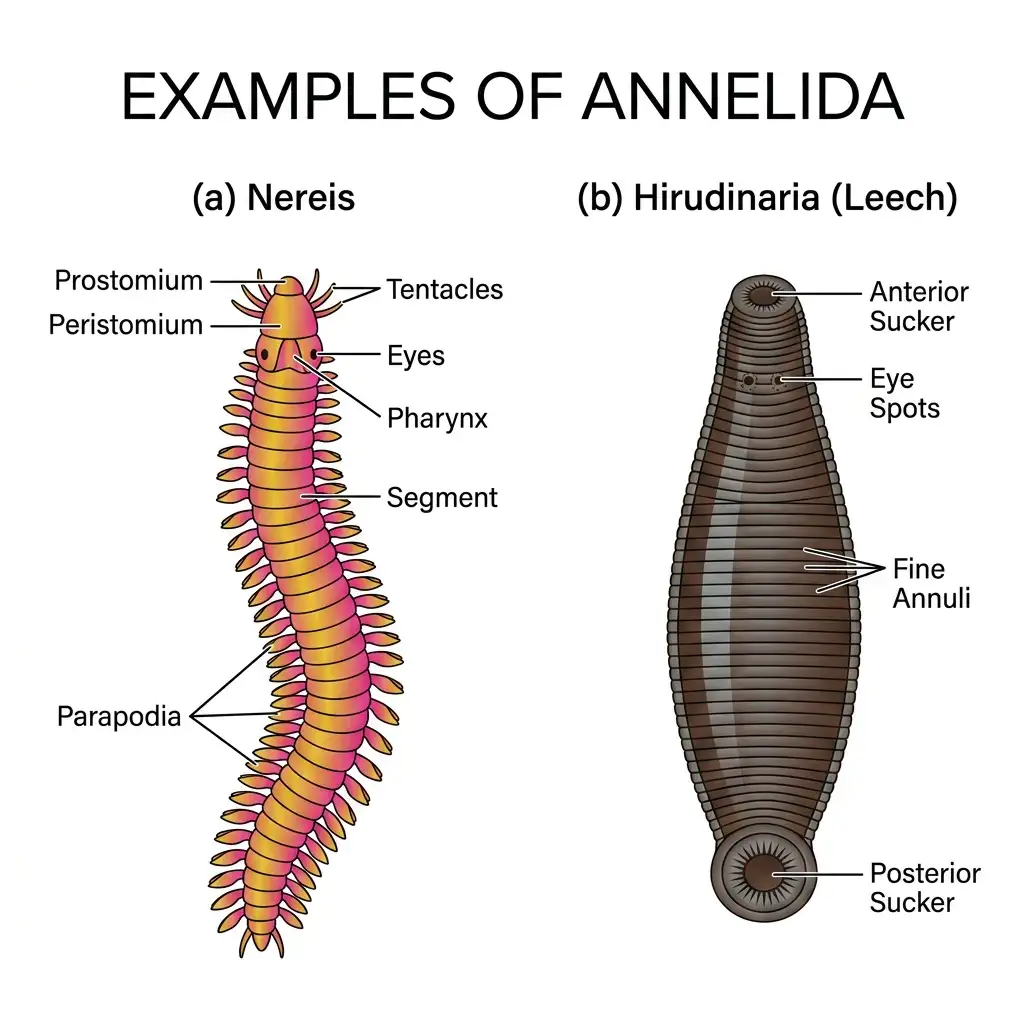
Kingdom Animalia - Annelida: Labeled segmented worms: (a) Nereis with parapodia appendages, and (b) Hirudinaria (leech) with suckers.
🔬 Detailed Anatomical Description
Annelids are coelomate, segmented, bilaterally symmetrical organisms. Segmented rings are called metameres. This diagram compares: (a) Nereis: An aquatic dioecious worm displaying lateral swimming appendages called parapodia; (b) Hirudinaria (cattle leech): A terrestrial monoecious ectoparasite with a flattened muscular body and terminal suckers.
PHYLUM ARTHROPODA (LARGEST PHYLUM)
| FEATURE | DETAIL |
|---|---|
| Size | LARGEST phylum; Insecta = largest class ⭐⭐ |
| Body covering | Chitinous exoskeleton ⭐⭐ |
| Appendages | Jointed (arthros = joint) ⭐ |
| Circulatory | OPEN type |
| Excretion | Malpighian tubules ⭐ |
| Respiration | Gills, Book gills, Book lungs, Tracheal system |
| Examples | Apis (Honeybee), Bombyx (Silkworm), Laccifer (Lac insect), Locusta (Locust), Limulus (King crab — living fossil) ⭐ |
Examples of Arthropoda
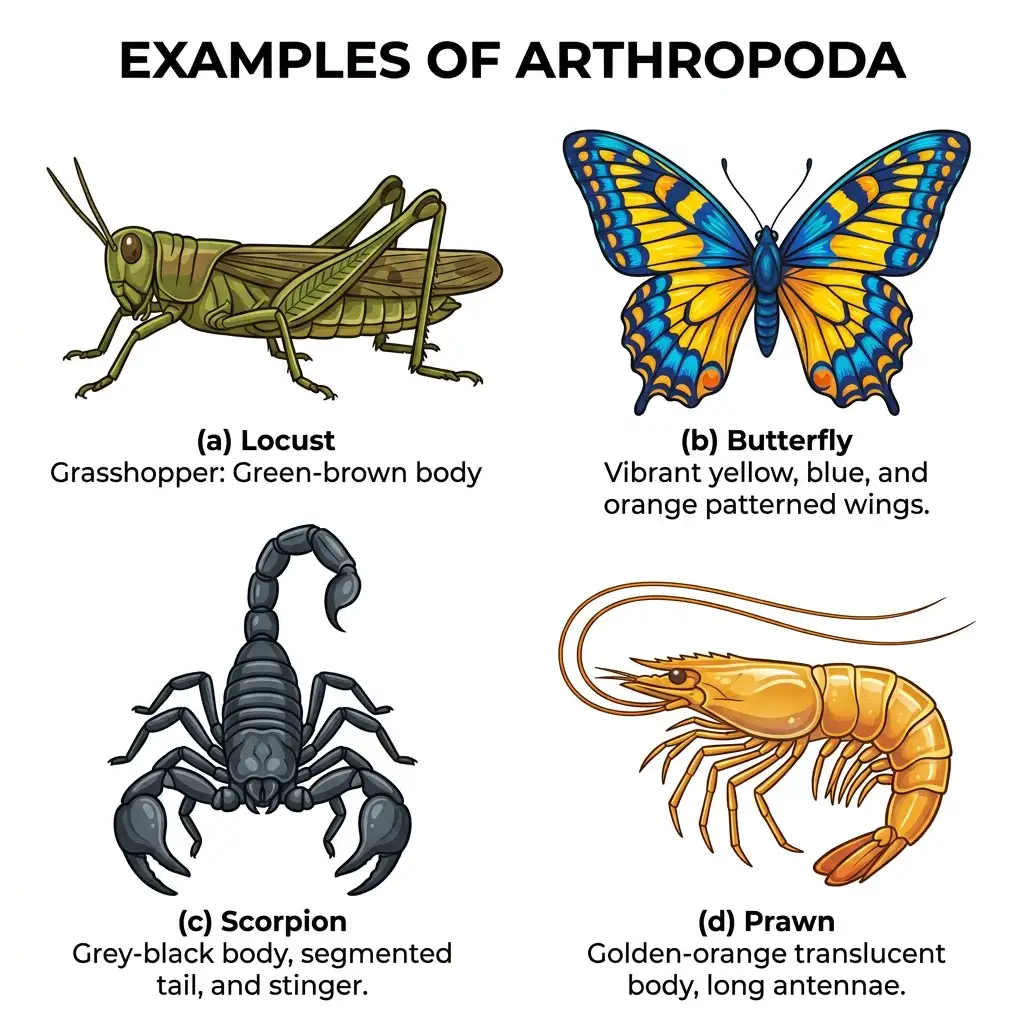
Kingdom Animalia - Arthropoda: Diversity of jointed-legged animals: (a) Locust, (b) Butterfly, (c) Scorpion, and (d) Prawn.
🔬 Detailed Anatomical Description
Arthropoda is the largest phylum of Animalia, characterized by jointed appendages and a chitinous exoskeleton. Illustrated members: (a) Locust: A gregarious pest; (b) Butterfly: An insect with colorful patterned wings; (c) Scorpion: An arachnid with a venomous segmented tail; (d) Prawn: An aquatic crustacean with long antennae and swimming legs.
PHYLUM MOLLUSCA (SECOND LARGEST)
| FEATURE | DETAIL |
|---|---|
| Size | Second largest animal phylum |
| Body | Unsegmented; Head + Muscular foot + Visceral hump; Calcareous shell |
| Mantle | Soft spongy layer; mantle cavity with feather-like gills |
| Feeding organ | RADULA (rasping organ) ⭐⭐ |
| Circulatory | OPEN type |
| Examples | Pila (Apple snail), Pinctada (Pearl oyster) ⭐, Sepia (Cuttlefish), Loligo (Squid), Octopus (Devil fish) |
Examples of Mollusca
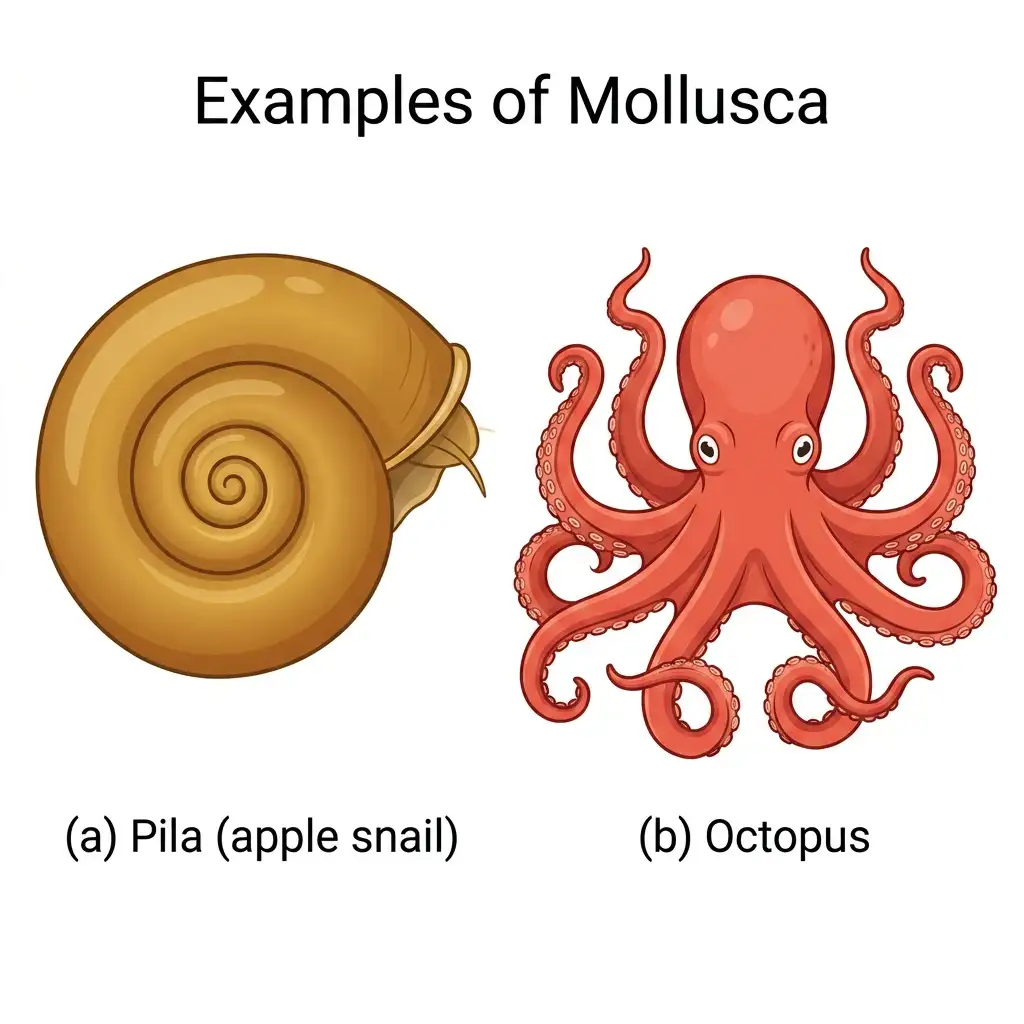
Kingdom Animalia - Mollusca: (a) Pila (apple snail) showing a smooth spiral calcareous shell, and (b) Octopus displaying tentacled arms.
🔬 Detailed Anatomical Description
Mollusca is the second largest phylum, characterized by a soft, unsegmented body covered by a calcareous shell. (a) Pila: An aquatic apple snail with a spiral shell; (b) Octopus (devil fish): A shell-less marine cephalopod with a prominent head, large eyes, and eight sucker-bearing arms.
PHYLUM ECHINODERMATA
| FEATURE | DETAIL |
|---|---|
| Habitat | All marine ⭐ |
| Symmetry | Adults: Radial; Larvae: Bilateral ⭐⭐ |
| Endoskeleton | Calcareous ossicles |
| Most distinctive | WATER VASCULAR SYSTEM ⭐⭐⭐ (locomotion, food capture, respiration) |
| Excretory system | ABSENT ⭐ |
| Circulatory | Open type |
| Examples | Asterias (Starfish), Echinus (Sea urchin), Antedon (Sea lily), Cucumaria (Sea cucumber), Ophiura (Brittle star) |
RE-NEET 2026 + NEET 2026: Adults show RADIAL symmetry; larvae show BILATERAL symmetry. Water vascular system for locomotion, food capture & respiration. Excretory system ABSENT. All marine.
Examples of Echinodermata
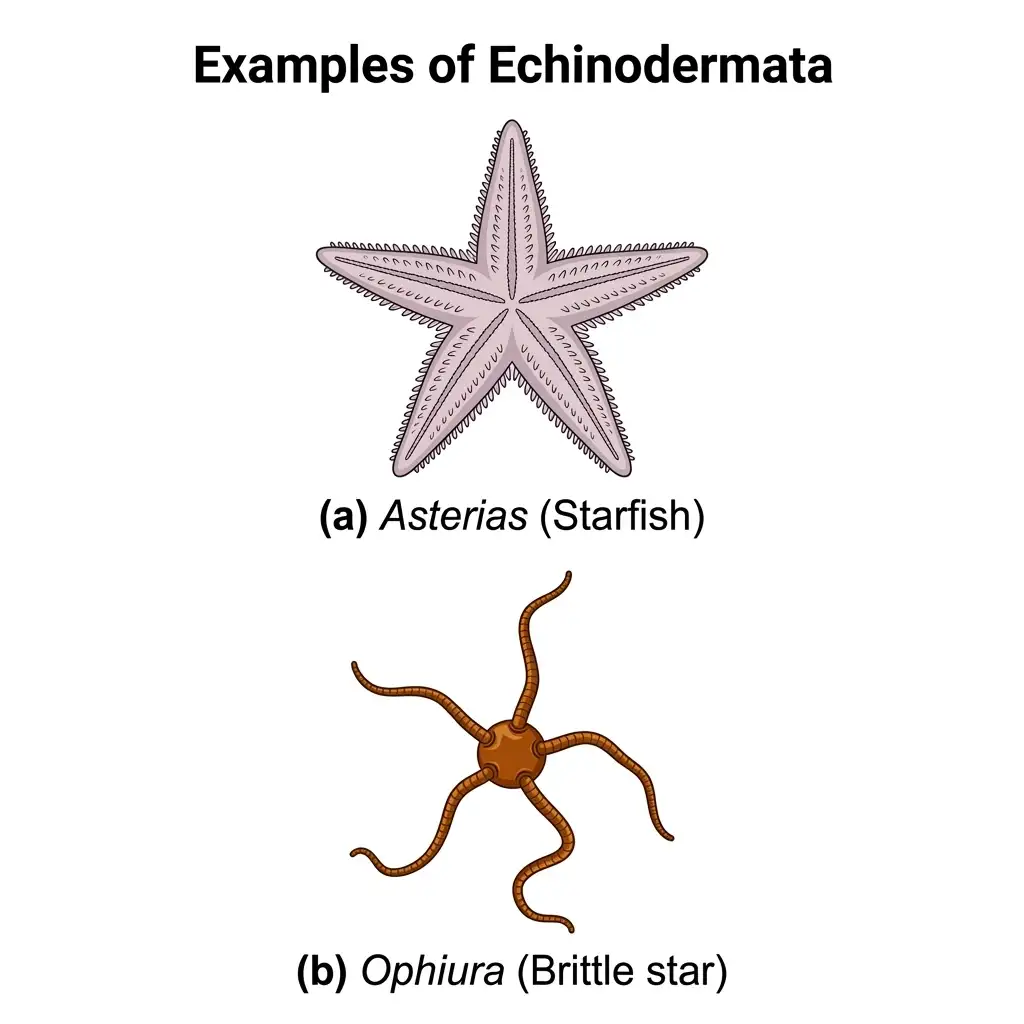
Kingdom Animalia - Echinodermata: Spiny-skinned animals: (a) Asterias (starfish) with broad arms, and (b) Ophiura (brittle star) with long serpent arms.
🔬 Detailed Anatomical Description
Echinoderms are spiny-skinned marine organisms with radial symmetry and a water vascular system. (a) Asterias: A typical starfish displaying five broad, spiny arms lined with tube feet; (b) Ophiura: A brittle star showing a small central circular disc and five long, thin, jointed, fragile arms.
PHYLUM HEMICHORDATA
| FEATURE | DETAIL |
|---|---|
| Classification | Now separate phylum under NON-CHORDATA ⭐ |
| Body | Proboscis + Collar + Trunk ⭐ |
| Key structure | Stomochord (rudimentary, similar to notochord) ⭐⭐ |
| Circulatory | Open type |
| Excretion | Proboscis gland ⭐ |
| Examples | Balanoglossus ⭐, Saccoglossus |
Structure of Balanoglossus
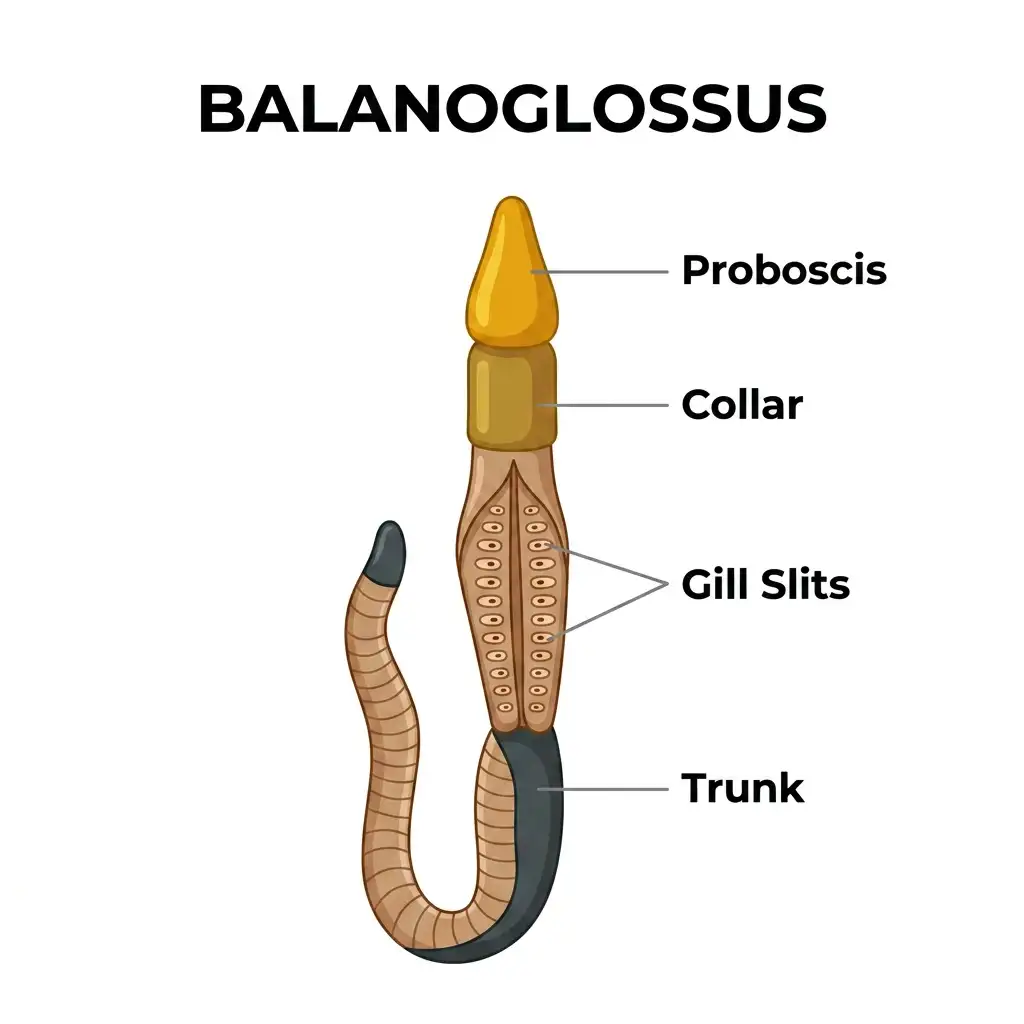
Kingdom Animalia - Hemichordata (Balanoglossus): A worm-like tongue-worm detailing Proboscis, Collar, and Trunk divisions.
🔬 Detailed Anatomical Description
Balanoglossus, commonly known as the tongue worm, represents Phylum Hemichordata. It is a marine, worm-like bilaterally symmetrical organism. The body is divided into three distinct regions: (1) Proboscis: A cone-shaped anterior part used for burrowing; (2) Collar: A cylindrical middle part; (3) Trunk: A long segmented posterior body containing gill slits.
III. PHYLUM CHORDATA
FUNDAMENTAL CHARACTERISTICS
| FEATURE | CHORDATES | NON-CHORDATES |
|---|---|---|
| Notochord | Present ⭐ | Absent |
| CNS | Dorsal, hollow, single ⭐ | Ventral, solid, double |
| Pharyngeal gill slits | Present (paired) | Absent |
| Heart | Ventral | Dorsal (if present) |
| Post-anal tail | Present | Absent |
| Circulatory | Closed ⭐ | Open (usually) |
RE-NEET 2026: All chordates have notochord (at some stage), dorsal hollow CNS, pharyngeal gill slits (at some stage), post-anal tail, ventral heart + closed circulation. "Absence of gills" is NOT a defining feature.
Chordata Characteristics
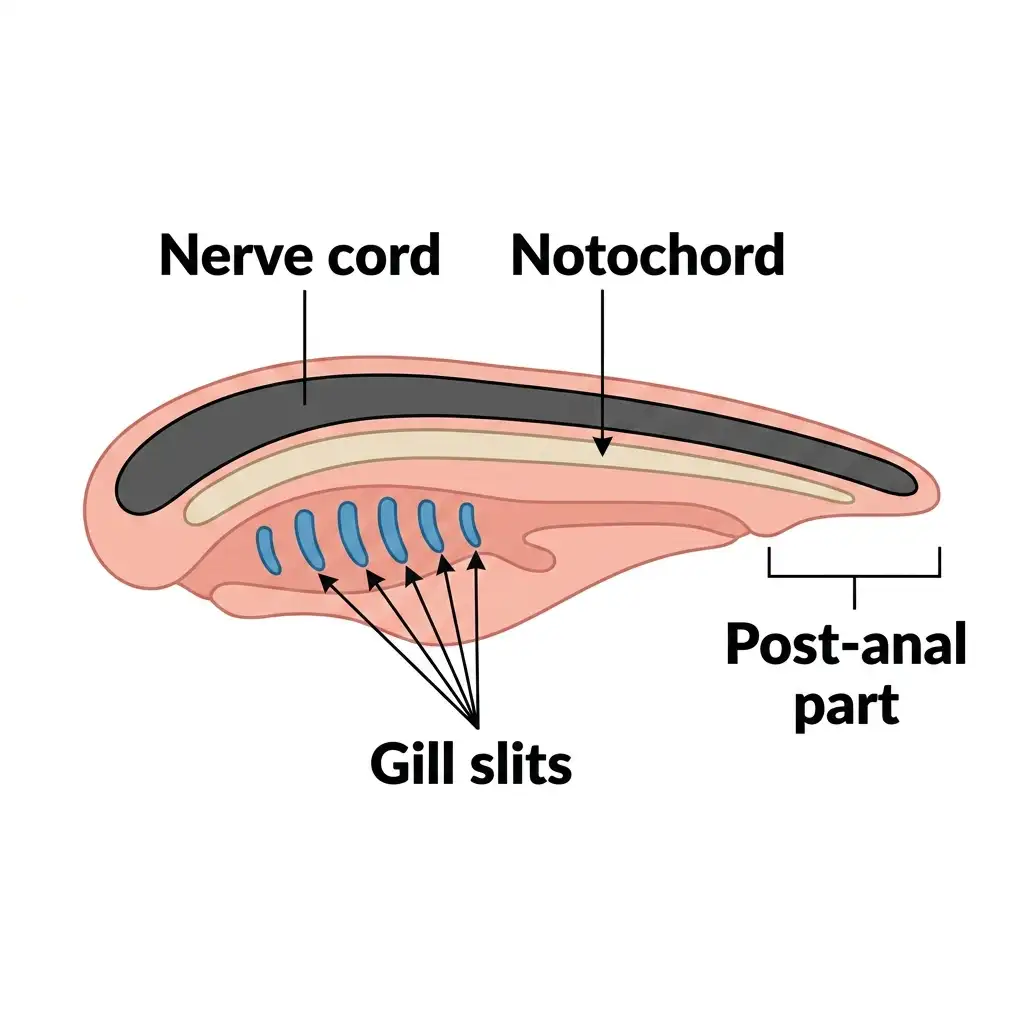
Phylum Chordata Primary Characteristics: Labeled body outline showing dorsal Nerve cord, Notochord, pharyngeal Gill slits, and Post-anal tail.
🔬 Detailed Anatomical Description
Phylum Chordata is characterized by four primary diagnostic features: (1) Notochord: A flexible, solid rod-like structure extending along the dorsal side; (2) Nerve cord: A hollow, tubular dorsal nerve cord situated above the notochord; (3) Gill slits: Pharyngeal gill perforations for respiration; (4) Post-anal tail: An extension of the body past the anus.
THREE SUBPHYLA OF CHORDATA
| SUBPHYLUM | NOTOCHORD | HABITAT | EXAMPLES |
|---|---|---|---|
| Urochordata / Tunicata | Only in larval tail ⭐ | Exclusively marine | Ascidia, Salpa, Doliolum |
| Cephalochordata | Head to tail; persistent ⭐ | Exclusively marine | Branchiostoma (Amphioxus) |
| Vertebrata | Embryonic only; replaced by vertebral column in adult ⭐⭐ | — | All vertebrates |
Structure of Ascidia
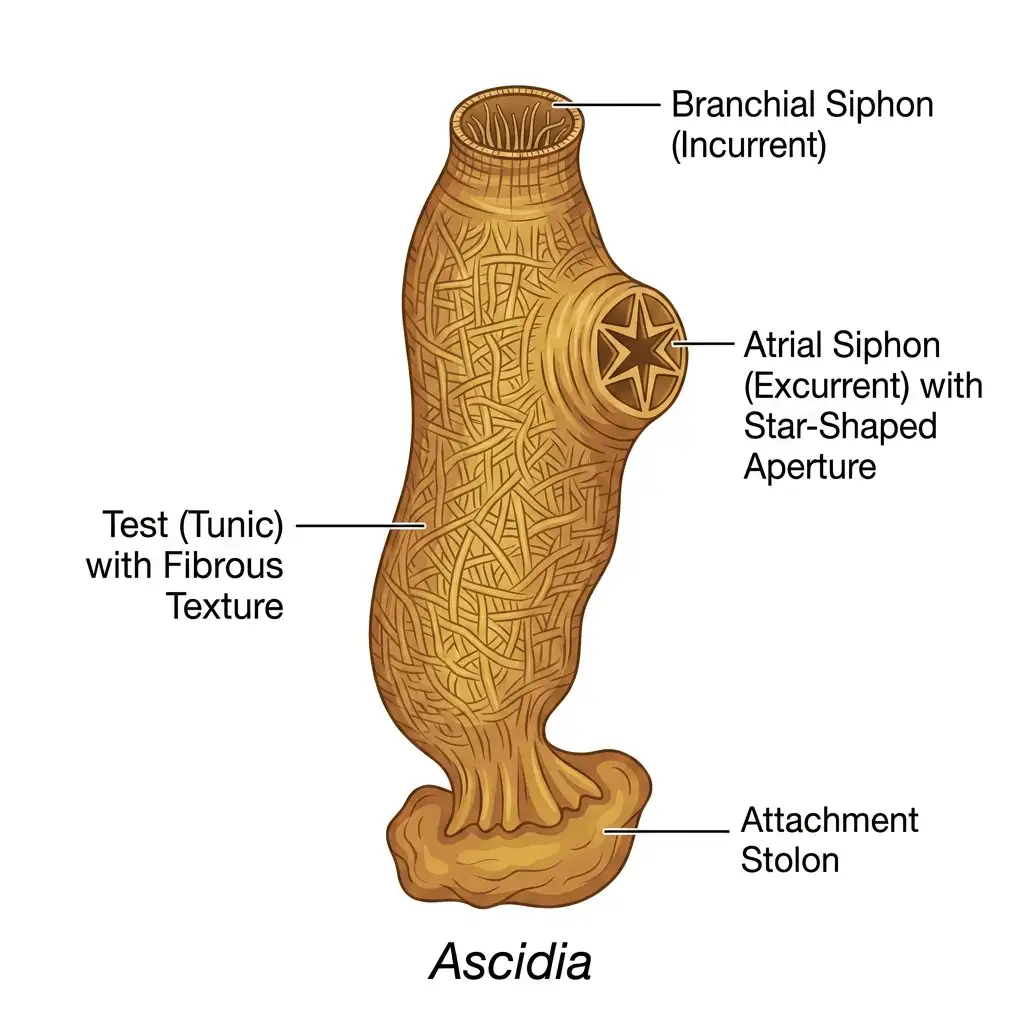
Subphylum Urochordata - Ascidia: Shows the sessile, sac-like body of a tunicate showing branchial and atrial siphons.
🔬 Detailed Anatomical Description
Ascidia represents Subphylum Urochordata (Tunicata). In urochordates, the notochord is present only in the larval tail and disappears in sessile adults. Ascidia has a sac-like body covered by a test/tunic, with a top branchial siphon and a lateral atrial siphon marked by a star-shaped pattern.
CLASS CYCLOSTOMATA (JAWLESS FISHES)
| FEATURE | DETAIL |
|---|---|
| Habitat | Marine; migrate to freshwater for spawning → die after spawning ⭐ |
| Mouth | Sucking & circular; without jaws ⭐ |
| Body | Elongated; 6–15 pairs of gill slits ⭐ |
| Scales / Fins | No scales, no paired fins |
| Skeleton | Cartilaginous |
| Examples | Petromyzon (Lamprey) ⭐, Myxine (Hagfish) |
NEET 2026: Petromyzon (lamprey) fits: cartilaginous endoskeleton, ectoparasitic, circular sucking mouth (jawless), no paired fins/scales, 6–7 pairs of gill slits, marine but migrate to freshwater for spawning.
Structure of Petromyzon
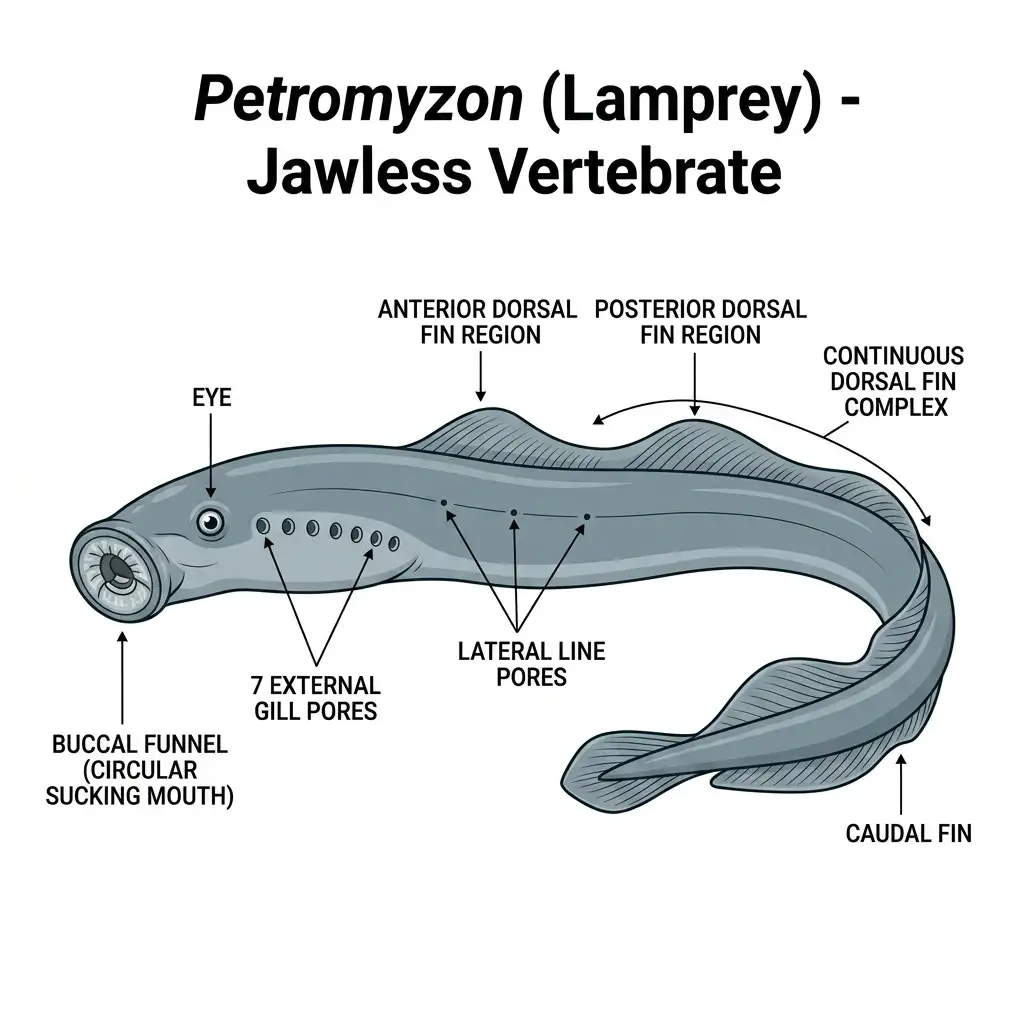
Class Cyclostomata - Petromyzon (Lamprey): A jawless, eel-like parasite displaying circular mouth and circular gill pores.
🔬 Detailed Anatomical Description
Petromyzon (lamprey) represents Class Cyclostomata. Cyclostomes are jawless ectoparasites on fishes. Characterized by an elongated eel-like body, circular sucking jawless mouth, 7 pairs of lateral gill pores, smooth scaleless skin, and absence of paired fins.
CLASS CHONDRICHTHYES (CARTILAGINOUS FISHES)
| FEATURE | DETAIL |
|---|---|
| Endoskeleton | Cartilaginous ⭐ |
| Notochord | Persistent throughout life ⭐ |
| Gill slits | Separate; no operculum ⭐ |
| Skin | Tough; minute placoid scales |
| Air bladder | ABSENT → must swim constantly ⭐⭐ |
| Heart | 2-chambered; Poikilothermous |
| Males | Claspers on pelvic fins ⭐ |
| Caudal fin | Heterocercal ⭐ |
| Fertilisation | Internal; many viviparous |
| Examples | Scoliodon (Dog fish), Pristis (Saw fish), Carcharodon (Great white shark), Trygon (Sting ray — poison sting) ⭐, Torpedo (electric organ) ⭐ |
NEET 2026: Notochord persistent throughout life in Chondrichthyes. Air bladder ABSENT. Examples: Saw fish, Dog fish = Chondrichthyes (NOT Osteichthyes).
Examples of Cartilaginous fishes
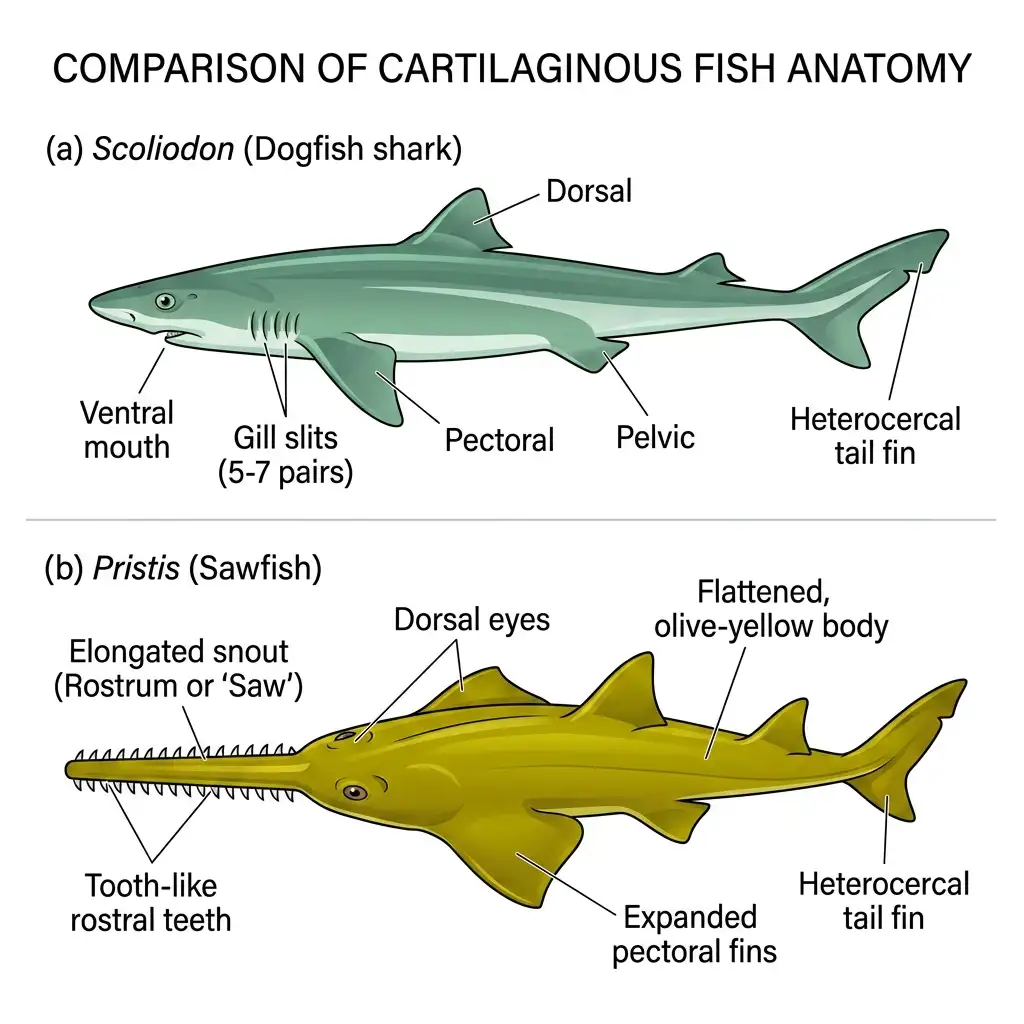
Class Chondrichthyes (Cartilaginous Fishes): Compares (a) Scoliodon (dogfish) with ventral mouth, and (b) Pristis (sawfish) with an elongated toothed rostrum.
🔬 Detailed Anatomical Description
Class Chondrichthyes (cartilaginous fishes) possess a cartilaginous endoskeleton, placoid scales, and ventral mouth. (a) Scoliodon: Spindle-shaped body with a heterocercal caudal fin and distinct gill slits; (b) Pristis: Flat body with a long snout lined with tooth-like spikes forming a saw.
CLASS OSTEICHTHYES (BONY FISHES)
| FEATURE | DETAIL |
|---|---|
| Endoskeleton | Bony ⭐ |
| Gill slits | 4 pairs; covered by operculum ⭐ |
| Skin | Cycloid or ctenoid scales |
| Air bladder | PRESENT → regulates buoyancy ⭐⭐ |
| Heart | 2-chambered; Poikilothermous |
| Fertilisation | Usually external; mostly oviparous |
| Examples | Exocoetus (Flying fish), Hippocampus (Sea horse), Labeo (Rohu), Catla (Katla), Clarias (Magur), Betta (Fighting fish), Pterophyllum (Angel fish) |
NEET 2026: Select the set belonging to Osteichthyes: Flying fish, Angel fish and Fighting fish. (Saw fish, Dog fish, Hagfish, Devil fish, Cuttlefish, Starfish do NOT belong.) Air bladder present in Osteichthyes (for buoyancy). Absent in Chondrichthyes. Air BLADDER (Osteichthyes) vs Air SACS (Aves) — different structures, different functions!
Examples of Bony fishes
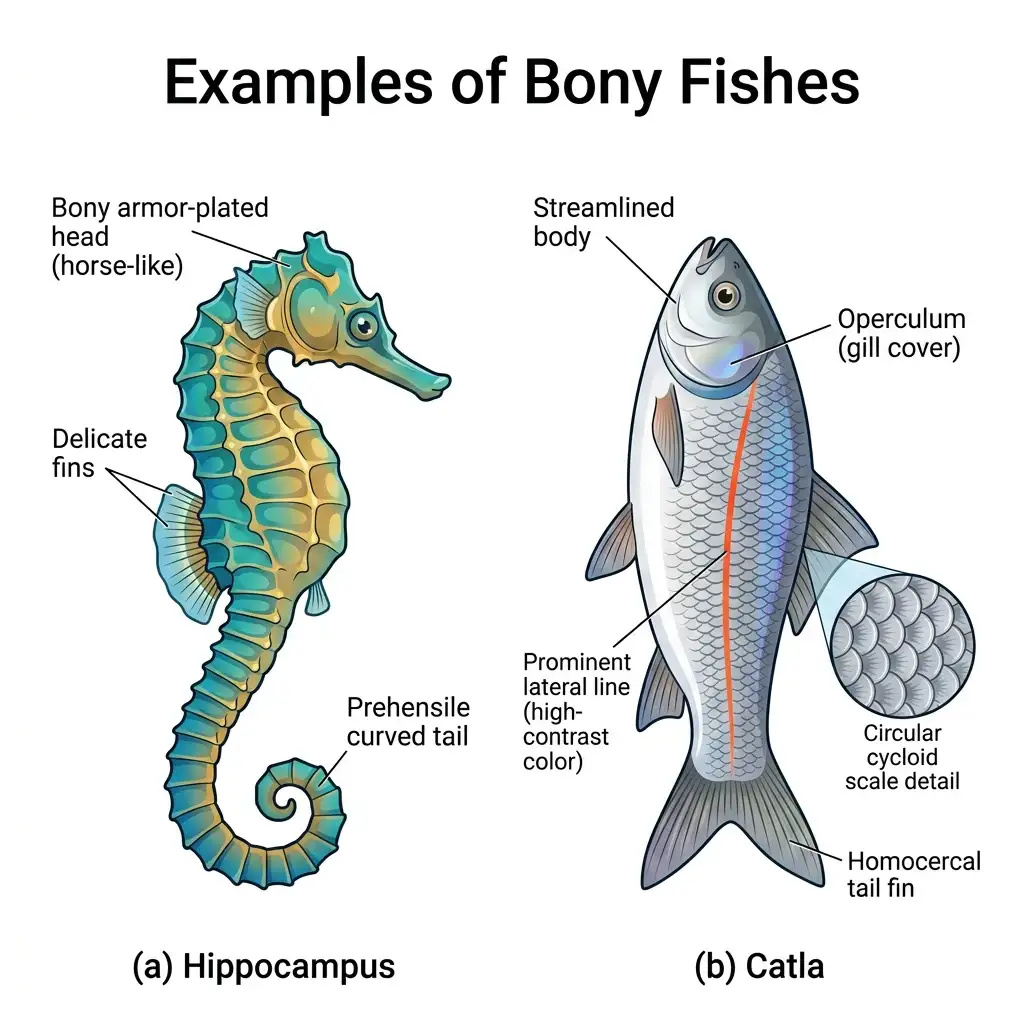
Class Osteichthyes (Bony Fishes): Compares (a) Hippocampus (seahorse) with prehensile tail, and (b) Catla (freshwater fish) with cycloid scales and terminal mouth.
🔬 Detailed Anatomical Description
Class Osteichthyes (bony fishes) possess a bony endoskeleton, terminal mouth, operculum covering gills, and cycloid scales. (a) Hippocampus: Marine seahorse with a prehensile curved tail; (b) Catla: Streamlined freshwater fish with cycloid scales and lateral lines.
CLASS AMPHIBIA
| FEATURE | DETAIL |
|---|---|
| Habitat | Both aquatic & terrestrial |
| Skin | Moist, without scales |
| Ears | Tympanum represents the ear ⭐ |
| Respiration | Gills, lungs AND through skin |
| Heart | 3-chambered (2A + 1V) |
| Fertilisation | External ⭐ |
| Development | Indirect |
| Examples | Bufo (Toad), Rana (Frog), Hyla (Tree frog), Salamandra, Ichthyophis (Limbless) ⭐ |
NEET 2025, 2026: Male frogs can be distinguished by presence of vocal sacs and copulatory pads (on the first digit of the forelimb). Frogs respire in water by skin and buccal cavity; on land by skin, buccal cavity and lungs. RE-NEET 2026 context: In frogs, number of pairs of cranial nerves is 10.
Examples of Amphibia
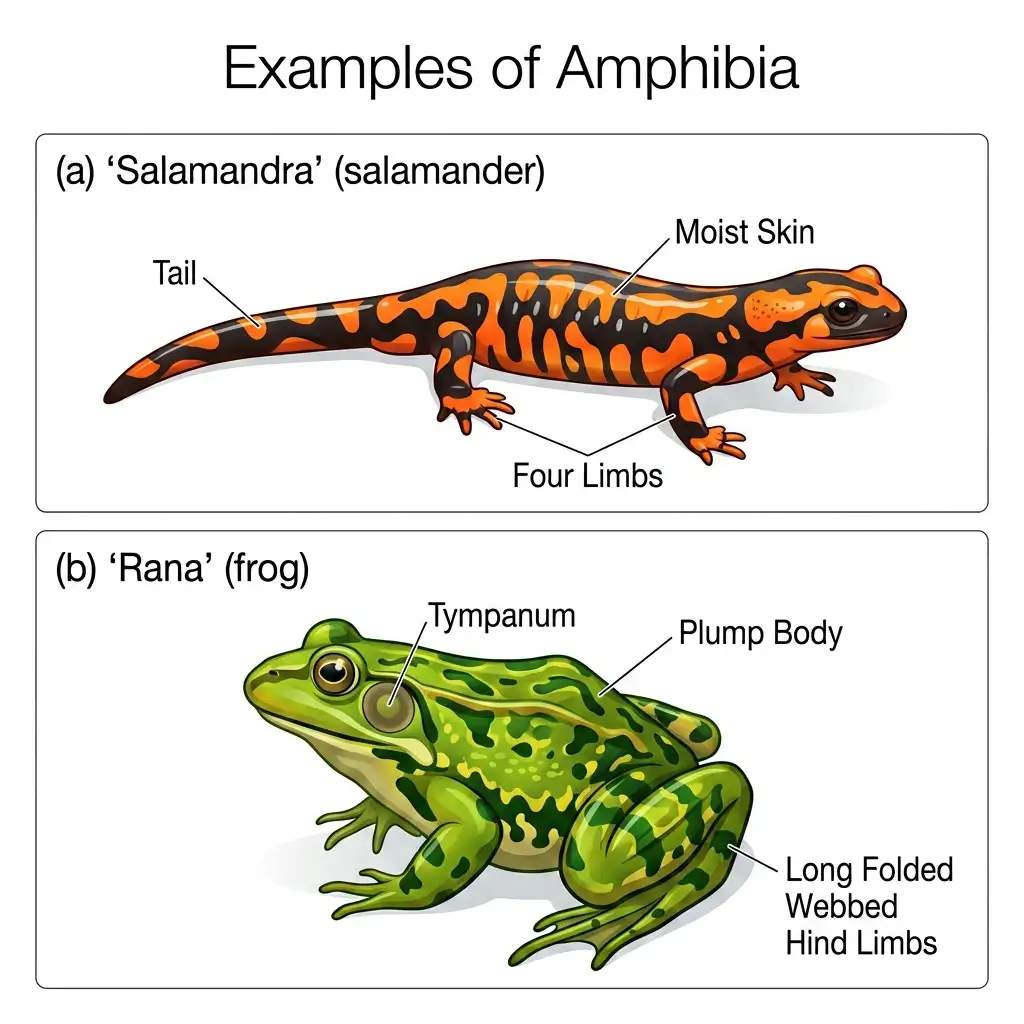
Class Amphibia (Amphibians): Compares (a) Salamandra (salamander) with a distinct tail, and (b) Rana (frog) with folded hind legs and tympanum.
🔬 Detailed Anatomical Description
Class Amphibia contains organisms living in both aquatic and terrestrial habitats, possessing moist skin and tympanum ear drum. (a) Salamandra: Lizard-like body with four limbs and tail; (b) Rana: Plump frog body with webbed hind legs for jumping.
CLASS REPTILIA
| FEATURE | DETAIL |
|---|---|
| Skin | Dry & cornified; epidermal scales ⭐ |
| Heart | Usually 3-chambered; 4-chambered in Crocodiles ⭐⭐ |
| Thermoregulation | Poikilothermous |
| Fertilisation | Internal |
| Examples | Chelone (Turtle), Testudo (Tortoise), Crocodilus (4-chambered heart!), Naja (Cobra), Bangarus (Krait), Vipera (Viper), Hemidactylus (Wall lizard) |
RE-NEET 2026: Reptilia — creeping/crawling locomotion correct. All do NOT have 3-chambered heart (Crocodiles have 4-chambered heart — exception). Poikilothermous.
Examples of Reptilia
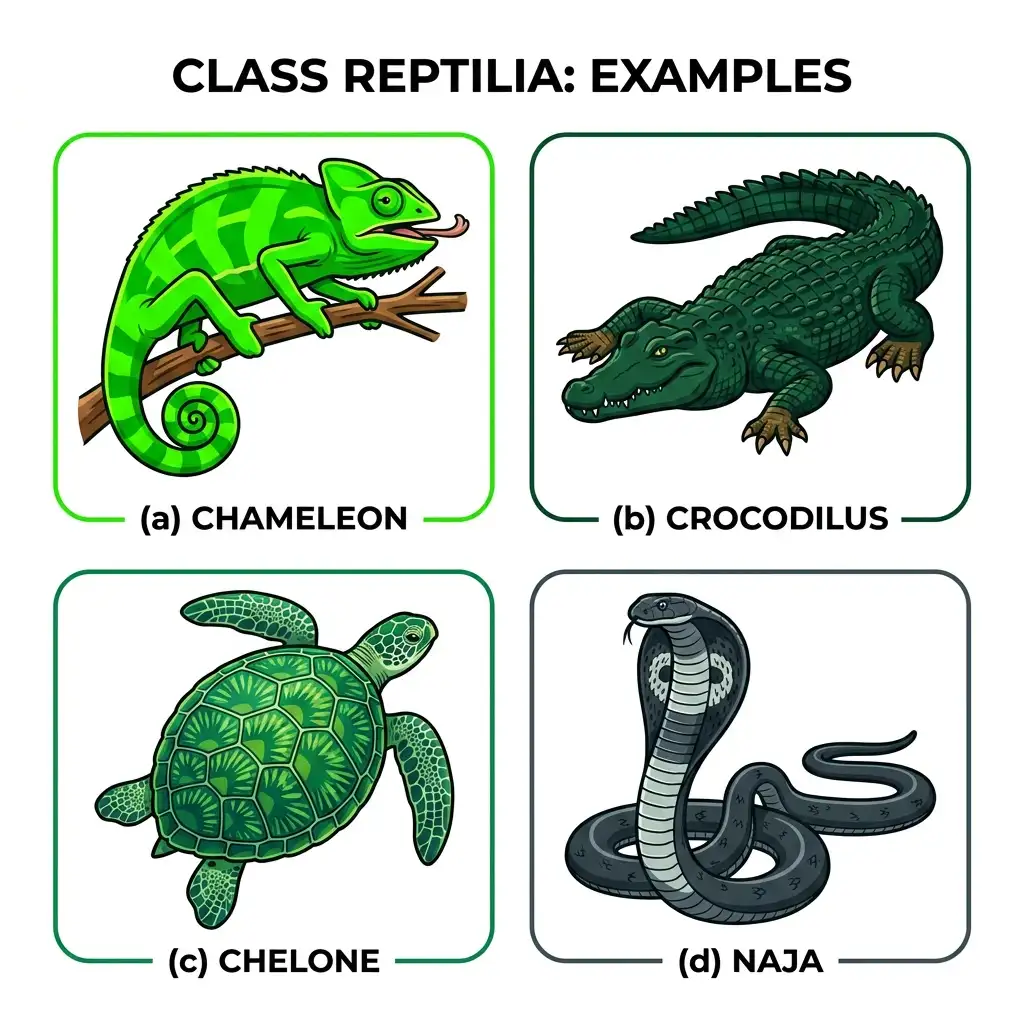
Class Reptilia (Reptiles): Compares (a) Chameleon (tree lizard), (b) Crocodilus (crocodile), (c) Chelone (sea turtle), and (d) Naja (cobra snake).
🔬 Detailed Anatomical Description
Class Reptilia contains creeping and crawling terrestrial animals possessing dry, cornified skin with epidermal scales or scutes. Illustrated members: (a) Chameleon: Tree lizard with a prehensile tail; (b) Crocodilus: Crocodile with thick armored scales; (c) Chelone: Turtle with a hard carapace shell; (d) Naja: Highly venomous cobra snake in striking hood-pose.
CLASS AVES (BIRDS)
| FEATURE | DETAIL |
|---|---|
| Characteristic | Presence of feathers ⭐ |
| Forelimbs | Modified into wings |
| Skin | Dry; only oil gland at base of tail ⭐ |
| Bones | Pneumatic (hollow with air cavities) ⭐⭐ |
| Digestive | Crop & Gizzard ⭐⭐ |
| Heart | Completely 4-chambered |
| Thermoregulation | Homoiothermous (warm-blooded) ⭐ |
| Respiration | Lungs; air sacs supplement ⭐ |
| Reproduction | Oviparous ⭐ |
| Examples | Corvus (Crow), Columba (Pigeon), Psittacula (Parrot), Struthio (Ostrich), Pavo (Peacock), Aptenodytes (Penguin), Neophron (Vulture) ⭐ |
NEET 2026: The flightless bird with forelimbs modified as paddle-like structures for swimming is Aptenodytes (Penguin).
Examples of Aves (Birds)
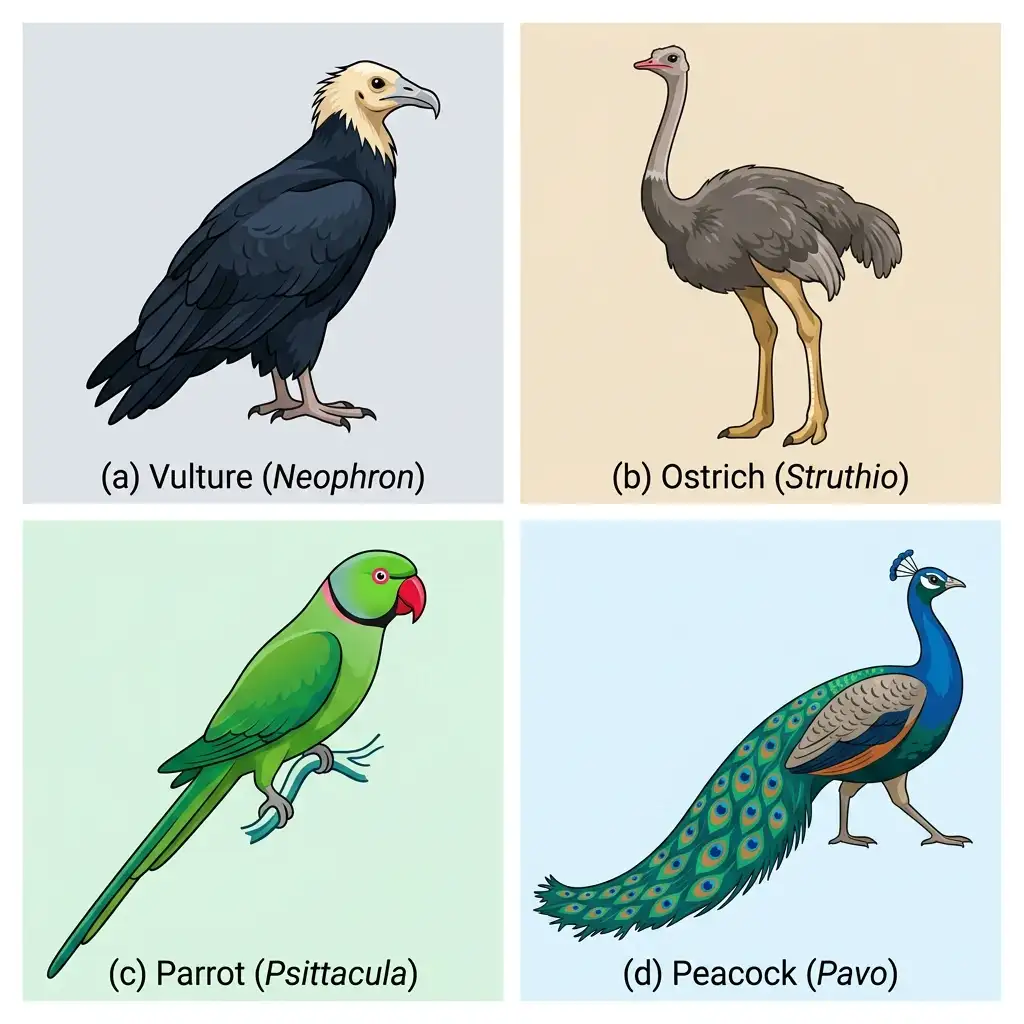
Class Aves (Birds): Compares (a) Neophron (vulture), (b) Struthio (ostrich), (c) Psittacula (parrot), and (d) Pavo (peacock).
🔬 Detailed Anatomical Description
Class Aves (birds) are characterized by the presence of feathers, beak, forelimbs modified into wings, and hollow pneumatic bones. Illustrated: (a) Neophron: Scavenging vulture with curved beak; (b) Struthio: Flightless ostrich with strong running legs; (c) Psittacula: Bright green parakeet; (d) Pavo: Peacock with its brilliant fan-like train of eye-spotted tail feathers.
CLASS MAMMALIA
| FEATURE | DETAIL |
|---|---|
| Most unique | Mammary glands ⭐⭐⭐ |
| Skin | Unique in possessing hair ⭐ |
| External ears | Pinnae present ⭐ |
| Teeth | Heterodont dentition |
| Heart | 4-chambered; Homoiothermous |
| Reproduction | Viviparous (mostly) ⭐ |
| Oviparous exception | Ornithorhynchus (Platypus) ⭐⭐ |
| Marsupial | Macropus (Kangaroo) ⭐ |
| Other examples | Pteropus (Flying fox), Camelus (Camel), Delphinus (Dolphin), Balaenoptera (Blue whale), Panthera tigris (Tiger), Panthera leo (Lion) |
NEET 2015, 2026 context: Ornithorhynchus (Platypus) = OVIPAROUS mammal. Most unique mammalian character = mammary glands.
Examples of Mammalia
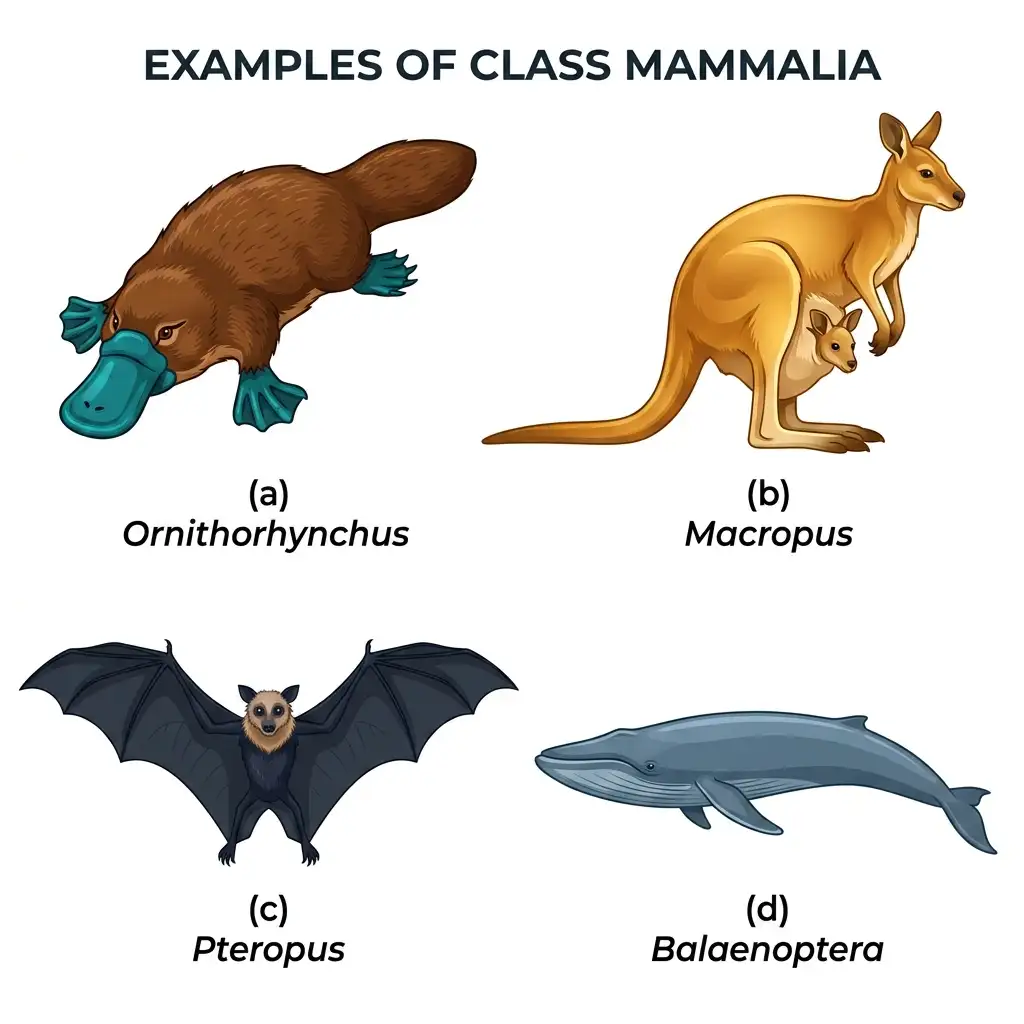
Class Mammalia (Mammals): Compares (a) platypus Ornithorhynchus, (b) kangaroo Macropus, (c) flying fox Pteropus, and (d) blue whale Balaenoptera.
🔬 Detailed Anatomical Description
Class Mammalia are characterized by milk-producing mammary glands, hair on skin, and pinnae ears. Illustrated: (a) Ornithorhynchus: Oviparous platypus with a duck bill; (b) Macropus: Viviparous marsupial kangaroo with a pouch; (c) Pteropus: Flying bat with membranous wings; (d) Balaenoptera: Aquatic blue whale (longest mammal).
IV. RAPID REVISION — MASTER PHYLUM COMPARISON
| PHYLUM | LEVEL | SYMM. | LAYERS | COELOM | SEGM. | DIGEST. | CIRC. | DISTINCTIVE |
|---|---|---|---|---|---|---|---|---|
| Porifera | Cellular | Asym. | — | Absent | No | Absent | Absent | Canal system |
| Cnidaria | Tissue | Radial | Diplo | Absent | No | Incom. | Absent | Cnidoblasts |
| Ctenophora | Tissue | Radial | Diplo | Absent | No | Incom. | Absent | Comb plates |
| Platyhelm. | Organ | Bilat. | Triplo | Acoelo | No | Incom. | Absent | Flame cells |
| Aschelm. | Org-sys | Bilat. | Triplo | Pseudo | No | Compl. | Absent | Roundworm |
| Annelida | Org-sys | Bilat. | Triplo | Coelo | Yes | Compl. | Closed | Segments |
| Arthropoda | Org-sys | Bilat. | Triplo | Coelo | Yes | Compl. | Open | Chitin exo |
| Mollusca | Org-sys | Bilat. | Triplo | Coelo | No | Compl. | Open | Radula |
| Echinod. | Org-sys | Radial (adult) | Triplo | Coelo | No | Compl. | Open | Water vasc. system |
| Hemich. | Org-sys | Bilat. | Triplo | Coelo | No | Compl. | Open | Stomochord |
| Chordata | Org-sys | Bilat. | Triplo | Coelo | Yes | Compl. | Closed | Notochord |
V. HIGH-YIELD MATCH-THE-FOLLOWING TABLE
| FEATURE / STRUCTURE | ANSWER |
|---|---|
| Canal system | Porifera |
| Choanocytes (collar cells) | Porifera |
| Cnidoblasts | Cnidaria |
| Comb plates | Ctenophora |
| Bioluminescence | Ctenoplana (Ctenophora) |
| Flame cells | Platyhelminthes |
| Metamerism | Annelida (first observed) |
| Parapodia | Nereis (Annelida) |
| Nephridia | Annelida |
| Malpighian tubules | Arthropoda |
| Radula | Mollusca |
| Water vascular system | Echinodermata |
| Stomochord | Hemichordata |
| Proboscis gland | Hemichordata |
| Notochord | Chordata |
| Claspers (pelvic fins) | Chondrichthyes (males) |
| Air bladder | Osteichthyes |
| Heterocercal caudal fin | Chondrichthyes |
| Operculum (gill cover) | Osteichthyes |
| Placoid scales | Chondrichthyes |
| Cycloid / Ctenoid scales | Osteichthyes |
| Poison sting | Trygon (Chondrichthyes) |
| Electric organ | Torpedo (Chondrichthyes) |
| Book lungs | Scorpion (Arthropoda) |
| Crop & Gizzard | Aves |
| Pneumatic bones | Aves |
| Air sacs | Aves |
| Oil gland (base of tail) | Aves |
| Mammary glands | Mammalia |
| Pinnae (external ears) | Mammalia |
| Limulus | Living fossil / King crab |
| Pinctada | Pearl oyster |
| Locusta | Gregarious pest |
VI. COMMON EXAM TRAPS — QUICK REFERENCE
| TRAP | CORRECT ANSWER |
|---|---|
| Water canal system vs Water vascular system? | Canal = Porifera; Water vascular = Echinodermata |
| Sponge fertilisation? | Internal (development indirect) |
| Porifera digestion? | Intracellular |
| Cnidaria digestion? | Both extra- AND intracellular |
| Flatworms — triplo or diplo? | Triploblastic |
| Aschelminthes coelom? | Pseudocoelomate |
| First true coelom? | Annelida |
| First circulatory system? | Annelida |
| First respiratory system? | Arthropoda |
| First excretory system? | Platyhelminthes (flame cells) |
| Largest animal phylum? | Arthropoda |
| Second largest? | Mollusca |
| All chordates = vertebrates? | No — protochordates are chordates but NOT vertebrates |
| Echinoderms always radial? | No — adults radial, larvae bilateral |
| Hemichordata — chordate? | Non-chordate (separate phylum) |
| Crocodile heart? | 4-chambered (exception!) |
| Chelone (turtle) — warm? | Cold-blooded (reptile) |
| Platypus — viviparous? | No — OVIPAROUS mammal |
| Air bladder in which fish? | Osteichthyes only (absent in Chondrichthyes) |
| Air sacs in which group? | Aves (not fishes) |
| Chondrichthyes swim always? | No air bladder → would sink |
| Amphibian fertilisation? | External |
| Reptilian fertilisation? | Internal |
| Nereis — monoecious? | No — Dioecious |
| Earthworm — dioecious? | No — Monoecious |
| Annelida circulation? | Closed |
| Arthropoda circulation? | Open |
| Ctenophora habitat? | Exclusively marine |
| Ctenophora reproduction? | Only sexual; external fert. |
| National aquatic animal of India? | River dolphin (Gangetic dolphin) |
- RE-NEET 2026: Radial symmetry definition is CORRECT. In Echinodermata: adults radially symmetrical BUT larvae bilaterally symmetrical.
- RE-NEET 2026 + NEET 2026: "Absence of gills" is NOT a characteristic of chordates (pharyngeal gill slits are present at some stage).
- NEET 2026 context: Platyhelminthes = acoelomate; Aschelminthes = pseudocoelomate; Annelida → Chordata = true coelomates.
- RE-NEET 2026: Crocodiles are reptiles with a 4-chambered heart.
- NEET 2026: Platyhelminthes have incomplete digestive system (mouth = anus); Aschelminthes have complete digestive system.
- RE-NEET 2026 + NEET 2026: Echinodermata = adults radial, larvae bilateral; water vascular system; excretory system ABSENT; all marine.
- NEET 2026: Petromyzon (lamprey) = jawless cyclostome, cartilaginous, circular sucking mouth, 6–7 pairs of gill slits, marine but spawn in freshwater.
- NEET 2026: Chondrichthyes = persistent notochord, no air bladder (e.g., saw fish, dog fish).
- NEET 2026: Osteichthyes set = Flying fish, Angel fish and Fighting fish. Air bladder present.
- NEET 2025, 2026: Male frogs have vocal sacs and copulatory pads on the first digit of the forelimb. Respire by skin/buccal cavity in water; skin/buccal/lungs on land. Cranial nerves = 10 pairs.
- NEET 2026: Flightless swimming bird with paddle wings = Aptenodytes (Penguin).
- NEET 2026: Platypus (Ornithorhynchus) = oviparous mammal.