I. CHEMICAL COMPOSITION OF LIVING ORGANISMS
A ELEMENTAL COMPOSITION
| FEATURE | DETAIL |
|---|---|
| Key difference | Relative abundance of Carbon & Hydrogen is HIGHER in living organisms than in Earth's crust ⭐ |
| Qualitative comparison | All elements in Earth's crust are also present in living tissue ⭐ |
| Absolute terms | No difference — same elements present ⭐ |
| Biomolecules | All carbon compounds present in living tissue ⭐ |
B AVERAGE COMPOSITION OF CELLS
| COMPONENT | % OF TOTAL CELLULAR MASS |
|---|---|
| Water | 70–90% (MOST abundant chemical in living organisms) ⭐⭐ |
| Proteins | 10–15% ⭐ |
| Nucleic acids | 5–7% ⭐ |
| Carbohydrates | 3% ⭐ |
| Lipids | 2% ⭐ |
| Ions | 1% ⭐ |
RE-NEET 2026 (reinforced): Descending % weight of elements in the human body is Oxygen > Carbon > Hydrogen > Nitrogen. Water is the most abundant chemical (70-90%).
C ACID-SOLUBLE vs ACID-INSOLUBLE FRACTIONS
| FEATURE | PROCEDURE & DETAIL |
|---|---|
| Procedure ⭐ | Living tissue ground in Trichloroacetic acid (Cl₃CCOOH) → thick slurry → strained through cheesecloth or filtered ⭐ |
Two Fractions ⭐⭐⭐
| FRACTION | ALSO CALLED | CONTAINS | MOL. WT. |
|---|---|---|---|
| Filtrate | Acid-soluble pool ⭐ | Bio-micromolecules (thousands of organic compounds) | 18–800 Daltons ⭐ |
| Retentate | Acid-insoluble fraction ⭐ | Bio-macromolecules (Proteins, Nucleic acids, Polysaccharides, Lipids) | ≥10,000 Daltons ⭐ |
Key Facts ⭐⭐
| KEY FACT | DETAIL |
|---|---|
| Acid-soluble pool represents | Roughly the cytoplasmic composition ⭐ |
| Acid-insoluble fraction represents | Macromolecules from cytoplasm & organelles ⭐ |
| Together | Represent entire chemical composition of living tissue ⭐ |
D WHY LIPIDS COME IN ACID-INSOLUBLE FRACTION?
| FEATURE | DETAIL |
|---|---|
| Lipid mol. wt. | <800 Da (small molecular weight compound) ⭐ |
| Lipids are | NOT strictly macromolecules ⭐⭐ |
| Why in insoluble fraction? | Lipids are arranged in cell membranes → when tissue is ground, membranes break into vesicles → vesicles are NOT water-soluble → separate with acid-insoluble pool ⭐⭐ |
NEET 2017, 2022, 2024, 2026 (reinforced): Lipids = NOT strictly macromolecules (mol. wt. <800 Da); found in acid-insoluble fraction due to membrane vesicle association.
II. AMINO ACIDS
A BASIC STRUCTURE
| FEATURE | DETAIL |
|---|---|
| Nature | α-amino acids (amino & carboxyl groups on same carbon = α-carbon) ⭐ |
| Also called | Substituted methanes ⭐ |
| Four substituent groups on α-carbon | (1) –H (2) –COOH (carboxyl) (3) –NH₂ (amino) (4) –R group (variable) ⭐ |
| Ionizable groups | –NH₂ and –COOH → structure changes at different pH → Zwitterionic form ⭐⭐ |
NEET 2022, 2026 (reinforced): Amino acids are substituted methanes; they have ionizable –NH₂ and –COOH groups → exist as zwitterions at characteristic pH.
B CLASSIFICATION BASED ON R GROUP
| R GROUP | AMINO ACID |
|---|---|
| –H | Glycine (also optically inactive — simplest amino acid) ⭐⭐ |
| –CH₃ | Alanine ⭐ |
| –CH₂OH | Serine ⭐ |
NEET 2020: R group = –H → Glycine (optically inactive, simplest amino acid).
C TYPES OF AMINO ACIDS
| CLASSIFICATION | EXAMPLES |
|---|---|
| Acidic | Glutamic acid, Aspartic acid ⭐ |
| Basic | Lysine ⭐⭐ |
| Neutral | Valine ⭐ |
| Aromatic | Tyrosine, Tryptophan, Phenylalanine ⭐ |
| Sulphur-containing | Cysteine, Methionine ⭐ |
NEET 2020, 2021, 2026 (reinforced): Lysine is a basic amino acid (not acidic!); Tyrosine is aromatic; Cysteine contains sulphur.
NEET 2026: Valine is a neutral amino acid. Serine is not aromatic!
D ESSENTIAL vs NON-ESSENTIAL
| TYPE | DETAIL |
|---|---|
| Essential | Cannot be synthesised in our body → must be supplied through diet ⭐ |
| Non-essential | Can be synthesised by our body ⭐ |
| Total in proteins | Only 20 types of amino acids occur in proteins ⭐ |
Organic Compounds in Tissues
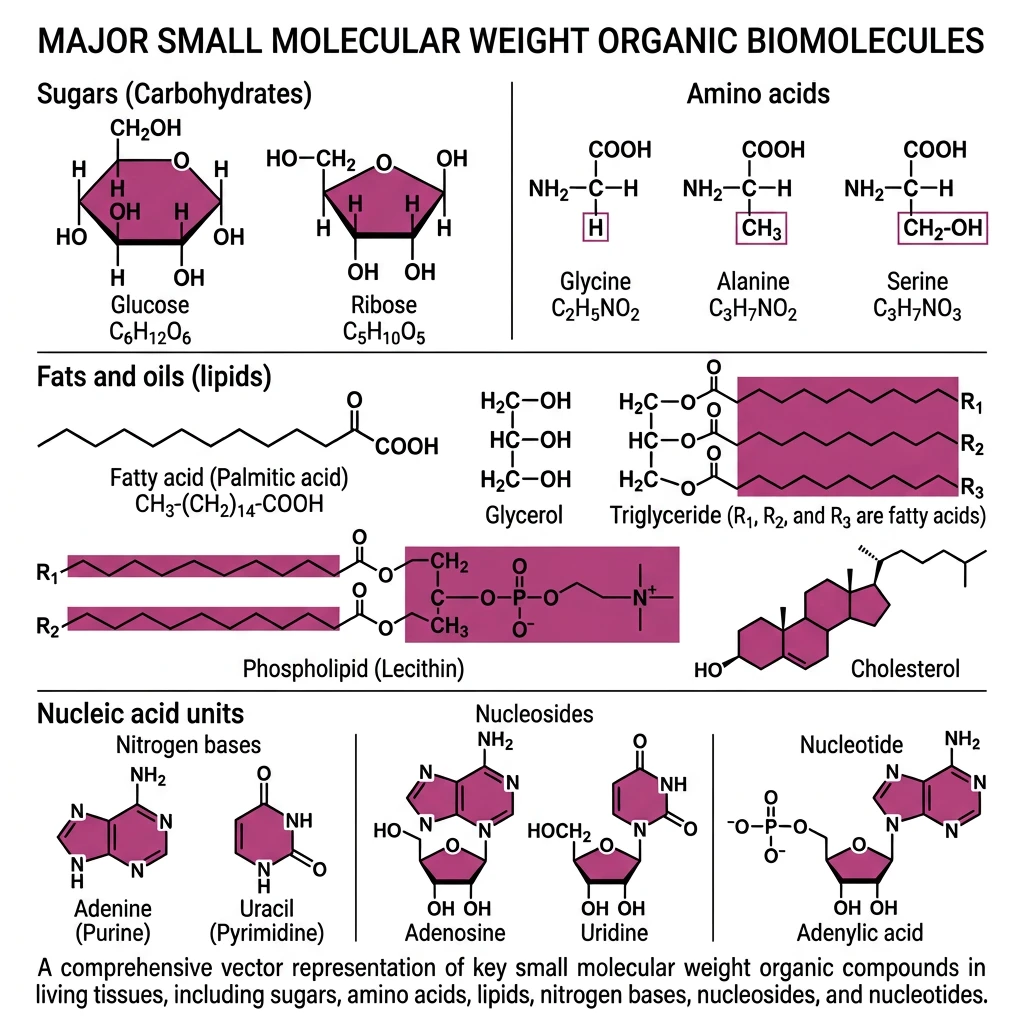
Biomolecular Compounds: Compares key structures of carbohydrates, amino acids, fats, lipids, and nucleic acid bases.
🔬 Detailed Biochemical & Structural Description
Living tissues contain numerous small molecular weight organic compounds (biomolecules). This diagram maps out key structural representatives: (1) Sugars (hexose Glucose and pentose Ribose); (2) Amino acids (Glycine with hydrogen side chain, Alanine with methyl side chain, and Serine with hydroxymethyl side chain); (3) Lipids (Palmitic acid, Glycerol, Triglyceride, Lecithin phospholipid, and Cholesterol); and (4) Nucleic Acid components (purine Adenine, pyrimidine Uracil, nucleosides Adenosine/Uridine, and nucleotide Adenylic acid).
III. LIPIDS
A GENERAL PROPERTIES
| FEATURE | DETAIL |
|---|---|
| Solubility | Generally water-insoluble ⭐⭐ |
| Soluble in | Organic solvents ⭐ |
| Nature | NOT strictly biomacromolecules (mol. wt. <800 Da) ⭐⭐ |
| NOT polymeric | Lipids are not strictly polymeric ⭐ |
| Could be | Simple fatty acids ⭐ |
NEET 2017, 2022, 2024, 2026 (reinforced): Lipids = generally water-insoluble; not strictly macromolecules; not strictly polymeric.
B FATTY ACIDS
| FEATURE | DETAIL |
|---|---|
| Structure ⭐⭐ | Carboxyl group (–COOH) attached to an R group ⭐ |
| R group range | 1 carbon to 19 carbons ⭐ |
Examples ⭐⭐
| FATTY ACID | CARBON ATOMS (INCL. CARBOXYL C) |
|---|---|
| Palmitic acid | 16 Carbons ⭐⭐ |
| Arachidonic acid | 20 Carbons ⭐⭐ |
Types ⭐⭐
| TYPE | DETAIL |
|---|---|
| Saturated | NO double bonds (–C–C–) ⭐ |
| Unsaturated | One or more C=C double bonds ⭐ |
NEET 2021, 2022, 2024: Palmitic acid = 16C; Arachidonic acid = 20C; Saturated = no double bonds; Unsaturated = double bonds.
NEET 2024: Lecithin, Glutamic acid, Aspartic acid are NOT fatty acids!
C GLYCEROL
| FEATURE | DETAIL |
|---|---|
| Definition | Trihydroxy propane (another simple lipid) ⭐ |
NEET 2021: Glycerol = trihydroxy propane.
D FATS AND OILS (GLYCERIDES)
| FEATURE | DETAIL |
|---|---|
| Formation | Fatty acids esterified with glycerol ⭐ |
| Types | Monoglycerides, Diglycerides, Triglycerides ⭐ |
| Triglyceride | 1 Glycerol + 3 Fatty acids (esterified together) ⭐⭐ |
| Bond formed | Ester bond ⭐ |
| Called fats OR oils | Based on their melting point ⭐ |
| Oils | Lower melting point → remain as oil in winter (e.g., Gingelly oil) ⭐ |
NEET 2016, 2022: Triglyceride = glycerol + 3 fatty acids; ester bonds; oils = lower melting point.
E PHOSPHOLIPIDS
| FEATURE | DETAIL |
|---|---|
| Definition | Lipids containing phosphorus and a phosphorylated organic compound ⭐ |
| Found in | Cell membranes ⭐ |
| Example | Lecithin ⭐⭐ |
| Phosphoglyceride | Fatty acid esterified to glycerol + phosphate group attached ⭐ |
NEET 2020, 2021, 2024: Lecithin = phospholipid found in cell membranes; contains phosphorus.
NEET 2022: Lecithin is a PHOSPHOLIPID, NOT a glycolipid (NTA Trap!).
F NEURAL TISSUE LIPIDS
| FEATURE | DETAIL |
|---|---|
| Neural tissues | Have lipids with more complex structures ⭐ |
NEET 2012, 2021: Neural tissue — complex lipid structure.
IV. NUCLEOSIDES & NUCLEOTIDES
A COMPONENTS
| COMPONENT | DETAIL |
|---|---|
| Nitrogenous bases | Heterocyclic compounds (Adenine, Guanine, Cytosine, Uracil, Thymine) ⭐ |
| Purines | Adenine & Guanine (substituted purines) ⭐⭐ |
| Pyrimidines | Cytosine, Uracil, Thymine (substituted pyrimidines) ⭐⭐ |
| Sugar | Ribose (in RNA) or 2'-Deoxyribose (in DNA) — monosaccharide pentose ⭐ |
| Phosphate | Phosphoric acid ⭐ |
NEET 2021, 2022, 2026 (reinforced): Adenine & Guanine = substituted Purines; Cytosine, Uracil, Thymine = substituted Pyrimidines.
B NUCLEOSIDES vs NUCLEOTIDES
| FEATURE | NUCLEOSIDE | NUCLEOTIDE |
|---|---|---|
| Components | Base + Sugar ⭐ | Base + Sugar + Phosphate ⭐ |
| Examples | Adenosine, Guanosine, Thymidine, Uridine, Cytidine ⭐ | Adenylic acid, Guanylic acid, Thymidylic acid, Uridylic acid, Cytidylic acid ⭐ |
NEET 2024, 2025 (reinforced): Adenosine is a nucleoside, Adenylic acid is a nucleotide, Adenine is a nitrogen base, Alanine is an amino acid!
C NUCLEIC ACIDS
| FEATURE | DETAIL |
|---|---|
| Composition | Polynucleotides ⭐ |
| Types | DNA (deoxyribose) and RNA (ribose) ⭐ |
| Function | Genetic material ⭐ |
| Double helix | Given by Watson & Crick ⭐ |
| Forms of DNA | More than a dozen forms named after English alphabets ⭐ |
| Bond in nucleic acids | Phosphodiester bonds ⭐ |
D SUGARS — FUNCTIONAL GROUPS
| FEATURE | DETAIL |
|---|---|
| Two characteristic functional groups of sugars | Carbonyl group (C=O) and Hydroxyl group (–OH) ⭐ |
NEET 2018: Sugars = carbonyl (C=O) + hydroxyl (–OH) functional groups.
E REDUCING vs NON-REDUCING SUGARS
| TYPE | EXAMPLES |
|---|---|
| Reducing | Maltose, Lactose ⭐ |
| Non-reducing | Sucrose ⭐⭐ |
NEET 2014, 2016: Sucrose = non-reducing disaccharide; Maltose & Lactose = reducing.
V. PRIMARY & SECONDARY METABOLITES
A PRIMARY METABOLITES
| FEATURE | DETAIL |
|---|---|
| Present in | Animal tissues (all organisms) ⭐ |
| Function | Have identifiable functions in normal physiological processes ⭐ |
| Examples | Sugars, Amino acids, Fats & Oils, Nitrogenous bases, Nucleotides, Nucleosides, Lecithin, Glucose ⭐ |
NEET 2021, 2023: Primary metabolites — amino acids, glucose, lecithin.
B SECONDARY METABOLITES
| FEATURE | DETAIL |
|---|---|
| Present in | Plants, Fungi, Microbes (NOT typically in animal tissues) ⭐ |
| Function | Role/function NOT known in host organisms ⭐ |
| Significance | Many are useful to human welfare (rubber, drugs, spices, scents, pigments) ⭐ |
| Some have | Ecological importance ⭐ |
Table of Secondary Metabolites ⭐⭐⭐
| CATEGORY | EXAMPLES |
|---|---|
| Pigments | Carotenoids, Anthocyanins ⭐ |
| Alkaloids | Morphine, Codeine ⭐ |
| Terpenoids | Monoterpenes, Diterpenes ⭐ |
| Essential oils | Lemon grass oil ⭐ |
| Toxins | Abrin, Ricin ⭐⭐ |
| Lectins | Concanavalin A ⭐⭐ |
| Drugs | Vinblastin, Curcumin ⭐ |
| Polymeric substances | Rubber, Gums, Cellulose ⭐ |
NEET 2019, 2021, 2022, 2023: Secondary metabolites — know all categories & examples; Concanavalin A = lectin; Abrin, Ricin = toxins.
NEET 2026: Morphine is an alkaloid, Concanavalin A is a lectin!
VI. BIOMICROMOLECULES VS BIOMACROMOLECULES
| FEATURE | BIO-MICROMOLECULES | BIO-MACROMOLECULES |
|---|---|---|
| Molecular weight | 18–800 Daltons ⭐ | ≥10,000 Daltons ⭐ |
| Found in | Acid-soluble pool | Acid-insoluble fraction |
| Examples | Monosaccharides, Nucleotides, Amino acids ⭐ | Proteins, Nucleic acids, Polysaccharides ⭐ |
| Nature | Monomers / small molecules | Polymers ⭐ |
| Exception | — | Lipids (mol. wt. <800 Da but come in macromolecular fraction due to membrane association) ⭐ |
VII. PROTEINS
A DEFINITION & NATURE
| FEATURE | DETAIL |
|---|---|
| Definition | Polypeptides — linear chains of amino acids linked by peptide bonds ⭐⭐ |
| Nature | Heteropolymer of amino acids (20 different types → NOT homopolymer) ⭐⭐ |
| Homopolymer | Has only one type of monomer repeating 'n' times ⭐ |
| Bond | Peptide bond ⭐⭐ |
| Bond formation | By dehydration (elimination of water molecule) ⭐ |
NEET 2020, 2021, 2026 (reinforced): Proteins are polypeptides; heteropolymers of amino acids linked by peptide bonds formed by dehydration.
B MOST ABUNDANT PROTEINS
| PROTEIN | CLAIM TO FAME |
|---|---|
| Collagen | Most abundant protein in Animal world ⭐⭐ |
| RuBisCO | Most abundant protein in the whole Biosphere ⭐⭐ |
NEET 2012, 2020: Collagen = most abundant in animal world; RuBisCO = most abundant in biosphere.
C STRUCTURE OF PROTEINS
Four Levels of Protein Structure ⭐⭐⭐
| LEVEL | DETAIL | STABILISED BY |
|---|---|---|
| Primary structure | Linear chain of polypeptide; positional information (sequence of amino acids) ⭐⭐ | Peptide bonds |
| Secondary structure | α-Helix and β-pleated sheet ⭐⭐ | Hydrogen bonds |
| Tertiary structure | 2° structure folded upon itself like hollow woollen ball; gives 3D view ⭐⭐ | H-bonds, Hydrophobic interactions, Disulphide bonds |
| Quaternary structure | Assembly of more than one polypeptide/ subunit; arrangement like cube or plate ⭐ | Interactions between subunits |
RE-NEET 2024, NEET 2026 (reinforced): Alpha-helix is found in secondary structure! Primary = linear sequence.
NEET 2016: Tertiary structure = 3D folding.
Primary Structure — Terminals ⭐⭐
| END | DETAIL |
|---|---|
| Left end | First amino acid = N-terminal ⭐⭐ |
| Right end | Last amino acid = C-terminal ⭐⭐ |
NEET 2023: Left end = N-terminal (first amino acid); Right end = C-terminal (last amino acid). NTA Trap: PYQ 2023 flipped the terminals!
Quaternary Structure Example ⭐⭐⭐
| FEATURE | DETAIL |
|---|---|
| Adult Human Haemoglobin | 4 subunits — 2 α-type + 2 β-type ⭐⭐⭐ |
NEET 2023, RE-NEET 2024: Haemoglobin = 4 subunits (2α + 2β) = quaternary structure.
Key Facts ⭐⭐
| FEATURE | DETAIL |
|---|---|
| Tertiary structure | Absolutely necessary for many biological activities of proteins ⭐ |
| Helices in proteins | Only right-handed helices are observed ⭐ |
Bonds Stabilising Tertiary Structure ⭐⭐
| BOND TYPE | INVOLVED? |
|---|---|
| Hydrogen bonds | ✅ Yes ⭐ |
| Hydrophobic interactions | ✅ Yes ⭐ |
| Disulphide bonds | ✅ Yes ⭐ |
| Ester bonds | ❌ NO — LEAST likely involved in stabilising protein folding (ester bonds are in lipids!) ⭐⭐ |
NEET 2016, 2024: Ester bonds = NOT involved in protein folding (NTA Trap! — ester bonds are in lipids).
Various Levels of Protein Structure
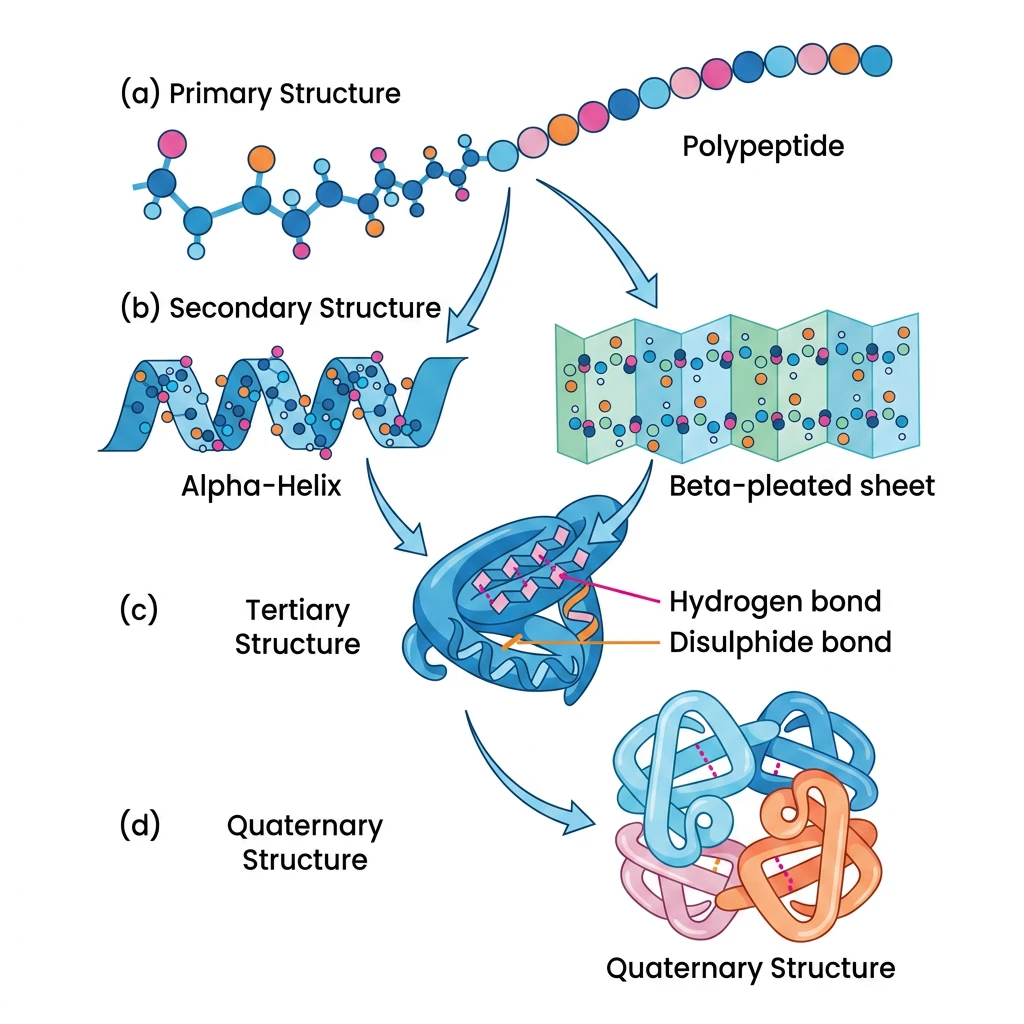
Levels of Protein Folding: Shows structural hierarchy from primary chain, secondary helices/sheets, to tertiary and quaternary complexes.
🔬 Detailed Biochemical & Structural Description
Proteins are heteropolymers of amino acids folded into specific 3D configurations across four structural levels: (1) Primary: Linear sequence of amino acids in a polypeptide chain; (2) Secondary: Local folding into alpha-helices or beta-pleated sheets stabilized by hydrogen bonds; (3) Tertiary: Overall 3D folding of a single polypeptide chain stabilized by disulfide, ionic, and hydrogen bonds; (4) Quaternary: Spatial arrangement of multiple folded polypeptide subunits working as a functional complex.
D PROTEINS & THEIR FUNCTIONS
| PROTEIN | FUNCTION |
|---|---|
| Collagen | Intercellular ground substance ⭐ |
| Trypsin | Enzyme (protease) ⭐ |
| Insulin | Hormone ⭐ |
| Antibody (Globulin) | Fights infectious agents ⭐ |
| Receptor | Sensory reception (smell, taste, hormone, etc.) ⭐ |
| GLUT-4 | Enables glucose transport into cells (insulin-dependent) ⭐⭐ |
NEET 2019, 2020, 2022, 2024, 2026 (reinforced): Protein functions — Trypsin is an enzyme, Collagen is intercellular ground substance, GLUT-4 = glucose transport (insulin-dependent).
VIII. POLYSACCHARIDES
A GENERAL FEATURES
| FEATURE | DETAIL |
|---|---|
| Definition | Long chains of sugars ⭐ |
| Building blocks | Monosaccharides ⭐ |
| Bond | Glycosidic bonds ⭐ |
| Bond formation | By dehydration (elimination of water) ⭐ |
NEET 2026: Polysaccharides are long chains of sugars.
B KEY POLYSACCHARIDES
| POLYSACCHARIDE | MONOMER | TYPE | DETAIL |
|---|---|---|---|
| Cellulose | Glucose | Homopolymer ⭐ | Plant cell walls; cotton fibre; paper ⭐ |
| Starch | Glucose | — | Store house of energy in plant tissues; variant of cellulose polymer ⭐ |
| Glycogen | Glucose | — | Animal variant (storage in animals) ⭐ |
| Inulin | Fructose | — | Polymer of fructose ⭐⭐ |
| Chitin | N-acetyl glucosamine | Homopolymer (complex) ⭐ | Exoskeletons of Arthropods; cell walls of fungi ⭐⭐⭐ |
NEET 2015, 2016, 2020, 2022, 2023: Cellulose = homopolymer of glucose; Inulin = polymer of fructose; Chitin = exoskeleton of arthropods & cell walls of fungi.
C STARCH & IODINE TEST
| FEATURE | DETAIL |
|---|---|
| Starch secondary structure | Helical ⭐ |
| Starch can hold | I₂ (Iodine) molecules in the helical portion ⭐ |
| Starch + I₂ | Blue colour ⭐⭐ |
| Cellulose + I₂ | Does NOT hold I₂ (no complex helical structure) → NO blue colour ⭐⭐ |
Polysaccharide Ends ⭐
| END | DETAIL |
|---|---|
| Right end | Reducing end ⭐ |
| Left end | Non-reducing end ⭐ |
NEET 2023: Starch holds I₂ → blue colour; Cellulose cannot hold I₂ (no complex helices).
IX. BONDS IN BIOMOLECULES — SUMMARY
| BIOMOLECULE | BOND |
|---|---|
| Proteins | Peptide bonds ⭐ |
| Polysaccharides | Glycosidic bonds ⭐ |
| Nucleic acids (DNA/RNA) | Phosphodiester bonds ⭐ |
| Lipids (Fats) | Ester bonds ⭐ |
| All above bonds formed by | Dehydration (elimination of water molecules) ⭐ |
NEET 2020, 2021, 2023, 2024: Know all bond types — Peptide (proteins), Glycosidic (polysaccharides), Phosphodiester (nucleic acids), Ester (lipids). All formed by dehydration.
X. ENZYMES
A NATURE OF ENZYMES
| FEATURE | DETAIL |
|---|---|
| Almost all enzymes | Are proteins ⭐ |
| Exception | Some nucleic acids behave like enzymes = Ribozymes (RNA enzymes; non-proteinaceous) ⭐⭐ |
NEET 2016, 2026 (reinforced): Almost all enzymes are proteins; Ribozymes = non-proteinaceous enzymes (nucleic acid / RNA catalysts).
B ACTIVE SITE
| FEATURE | DETAIL |
|---|---|
| Origin | Tertiary structure folds → chain criss-crosses → many crevices or pockets → one such pocket = Active site ⭐⭐ |
| Function | Substrate fits into active site ⭐ |
| Catalysis | Enzymes catalyse reactions at high rate through active site ⭐ |
NEET 2014: Substrate fits in active site (formed from tertiary structure folding).
C ENZYME vs INORGANIC CATALYSTS
| FEATURE | ENZYMES | INORGANIC CATALYSTS |
|---|---|---|
| Temperature | Get damaged above ~40°C ⭐ | Work efficiently at high temperatures ⭐ |
| Pressure | — | Work at high pressures |
| Exception | Enzymes from thermophilic organisms (hot vents, sulphur springs) → stable at 80–90°C ⭐ | — |
D CHEMICAL REACTIONS & RATE
| FEATURE | DETAIL |
|---|---|
| Rate | Amount of product formed per unit time ⭐ |
| Rate = Velocity | If direction is specified ⭐ |
| Rule of thumb | Rate doubles or decreases by half for every 10°C change in either direction ⭐ |
| Catalysed reactions | Proceed at rates vastly higher than uncatalysed ones ⭐ |
E CARBONIC ANHYDRASE — EXAMPLE
| CONDITION | RATE |
|---|---|
| Without enzyme | 200 molecules/hour of H₂CO₃ ⭐ |
| With Carbonic Anhydrase | 600,000 molecules/second ⭐ |
| Acceleration | ~10 million times faster ⭐ |
F ACTIVATION ENERGY
| FEATURE | DETAIL |
|---|---|
| Definition | Difference in average energy content between Substrate (S) and the Transition state ⭐⭐ |
| Enzymes | Lower the activation energy → making transition of S to P more easy ⭐⭐ |
| Transition state | Higher energy state that substrate must pass through ⭐ |
| If P is at lower level than S | Exothermic reaction (no need to supply energy by heating) ⭐ |
NEET 2010, 2016: Activation energy = energy difference between S and transition state; enzymes LOWER it.
Concept of Activation Energy
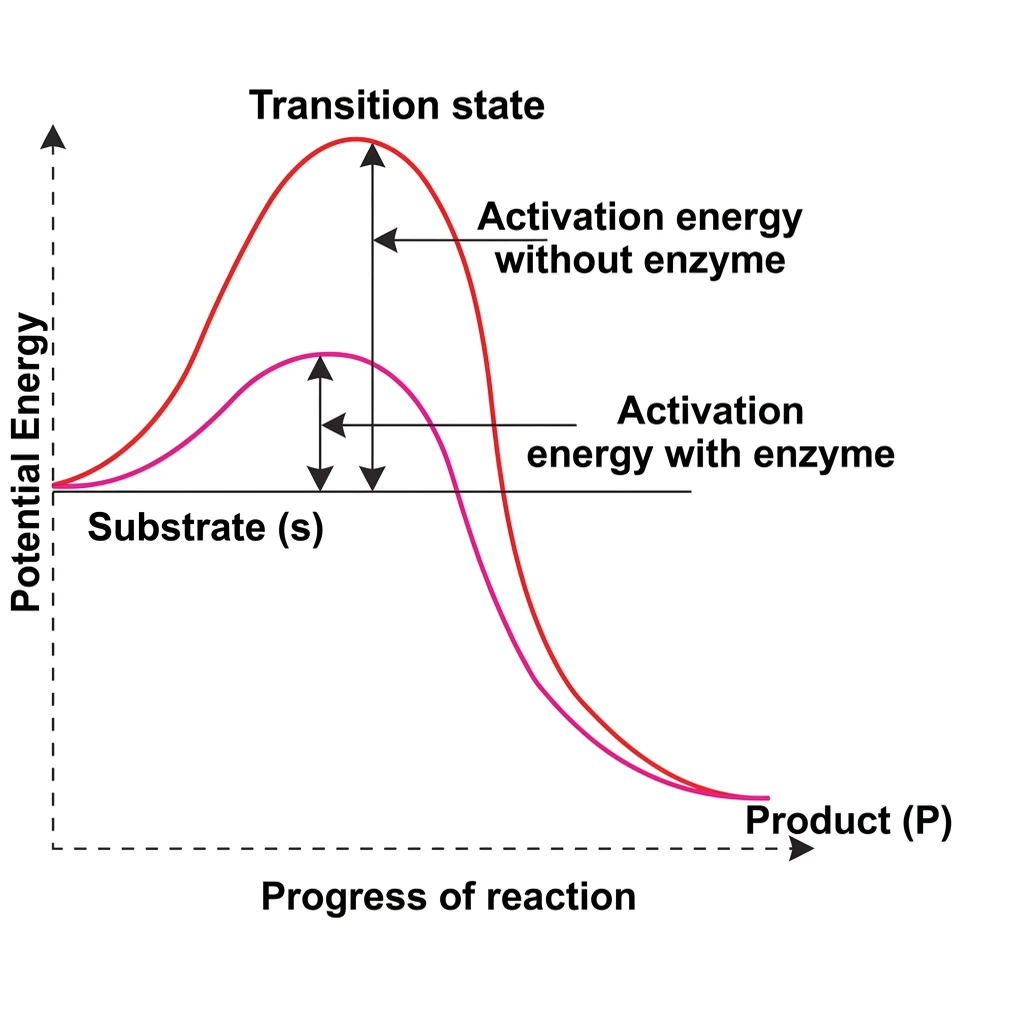
Catalysis Energetics: Compares activation energy levels in enzymatically catalyzed and uncatalyzed reactions.
🔬 Detailed Biochemical & Structural Description
Enzymes increase reaction rates by lowering the activation energy barrier. This potential energy graph illustrates: (1) Substrate (S) starting baseline; (2) Uncatalyzed curve peaking at a high transition state (activation energy without enzyme); (3) Catalyzed curve peaking at a much lower transition state (activation energy with enzyme); (4) Exergonic drop-off to the Product (P) baseline, showing that the overall free energy change of the reaction remains completely unaffected.
G ENZYME-SUBSTRATE COMPLEX (ES COMPLEX)
| FEATURE | DETAIL |
|---|---|
| ES complex nature | Unstable & Transient (short-lived) ⭐ |
| Formation of ES complex | Essential for catalysis ⭐ |
| Catalytic cycle | E + S ⇌ ES → EP → E + P ⭐⭐ |
NEET 2013: ES complex = transient; essential for catalysis.
NEET 2024: Know the complete catalytic cycle: E + S ⇌ ES → EP → E + P.
Steps of Catalytic Cycle ⭐⭐
| STEP | DETAIL |
|---|---|
| 1 | Substrate binds to active site ⭐ |
| 2 | Binding induces enzyme to alter its shape → fits more tightly around substrate ⭐ |
| 3 | Active site breaks chemical bonds of substrate → new EP complex formed ⭐ |
| 4 | Enzyme releases product → free enzyme ready for next cycle ⭐ |
H FACTORS AFFECTING ENZYME ACTIVITY
| FACTOR | DETAIL |
|---|---|
| Temperature | Enzymes function in narrow range ⭐ |
| pH | Enzymes function in narrow range ⭐ |
| Substrate concentration | Affects rate ⭐ |
| Specific chemicals | Inhibitors / Activators ⭐ |
NEET 2013: Enzymes function in narrow range of temperature & pH.
Temperature Effect ⭐⭐⭐
| CONDITION | EFFECT |
|---|---|
| Optimum temperature | Highest activity ⭐ |
| Below optimum | Activity declines ⭐ |
| Low temperature | Enzyme temporarily inactive (preserved) ⭐⭐ |
| High temperature | Denaturation of protein → destroys enzymatic activity ⭐⭐ |
NEET 2023: Low temperature = temporarily inactive (preserved); High temperature = denaturation (destroys activity).
pH Effect ⭐⭐
| FEATURE | DETAIL |
|---|---|
| Each enzyme | Has optimum pH ⭐ |
| Activity | Declines below and above optimum ⭐ |
Substrate Concentration Effect ⭐⭐
| FEATURE | DETAIL |
|---|---|
| With increasing [S] | Velocity rises at first ⭐ |
| V_max | Maximum rate of reaction when enzyme is saturated with substrate ⭐ |
| Above V_max | No further increase even with more substrate ⭐ |
| Reason | Enzyme molecules fewer than substrate → all active sites occupied ⭐ |
RE-NEET 2024: V_max = maximum rate when enzyme saturated with substrate.
Factors Affecting Enzyme Activity
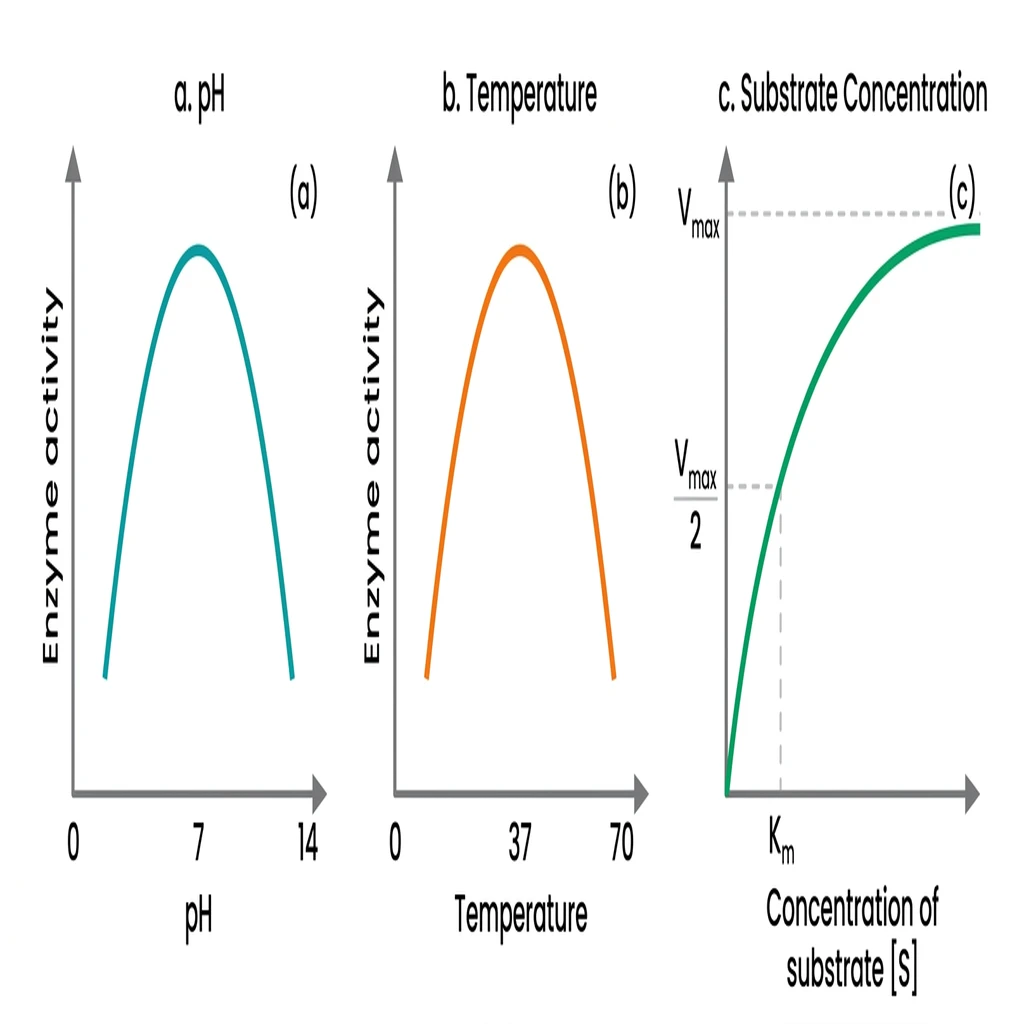
Enzyme Kinetics: Shows bell-shaped pH and temperature curves, and Michaelis-Menten saturation kinetics.
🔬 Detailed Biochemical & Structural Description
Enzyme activity is highly sensitive to physiological variables: (1) pH: Exhibits a bell-shaped curve peaking at an optimal pH; (2) Temperature: Shows a bell-shaped curve peaking at optimal temperature (denaturation occurs at high temps); (3) Substrate Concentration [S]: Shows hyperbolic saturation kinetics (Michaelis-Menten) where reaction velocity rises with [S] until reaching maximum velocity (Vmax). The substrate concentration at half-maximal velocity (Vmax/2) is the Michaelis constant (Km).
I ENZYME INHIBITION
| FEATURE | DETAIL |
|---|---|
| Inhibition | Binding of chemical shuts off enzyme activity ⭐ |
| Inhibitor | The chemical that inhibits ⭐ |
Competitive Inhibition ⭐⭐⭐
| FEATURE | DETAIL |
|---|---|
| Definition | Inhibitor closely resembles substrate in molecular structure ⭐⭐ |
| Mechanism | Competes with substrate for active site (substrate-binding site) ⭐ |
| Result | Substrate cannot bind → enzyme action declines ⭐ |
| Classic example | Inhibition of Succinic dehydrogenase by Malonate (resembles substrate succinate) ⭐⭐⭐ |
| Application | Some competitive inhibitors used to control bacterial pathogens ⭐ |
| Kinetics | K_m increases but V_max remains unchanged ⭐ |
| Reversal | Can be reversed by adding excess substrate (succinate) ⭐ |
NEET 2014, 2020, 2023, 2024: Competitive inhibition — Malonate inhibits Succinic dehydrogenase; resembles substrate; competes for active site; K_m increases, V_max unchanged.
J ENZYME CLASSIFICATION (6 CLASSES)
| CLASS | NAME | CATALYSES |
|---|---|---|
| 1 | Oxidoreductases / Dehydrogenases | Oxidoreduction between two substrates ⭐ |
| 2 | Transferases | Transfer of a group (other than hydrogen) between substrates ⭐⭐ |
| 3 | Hydrolases | Hydrolysis (ester, ether, peptide, glycosidic, C-C, C-halide, P-N bonds) ⭐ |
| 4 | Lyases | Removal of groups leaving double bonds (NOT hydrolysis) ⭐⭐ |
| 5 | Isomerases | Inter-conversion of optical, geometric, or positional isomers ⭐ |
| 6 | Ligases | Linking together of 2 compounds (C-O, C-S, C-N, P-O bonds) ⭐⭐ |
NEET 2024, 2025, 2026 (reinforced): Transferases (group transfer other than H); Ligases link two compounds (C-O, C-S, C-N, P-O — NOT C-C!); Lyases remove groups leaving double bonds without hydrolysis.
Additional Detail ⭐
| ADDITIONAL DETAIL | DETAIL |
|---|---|
| Total classes | 6 ⭐ |
| Subclasses | Each class has 4-13 subclasses ⭐ |
| Named by | Four-digit number ⭐ |
K ENZYME COMPOSITION — SIMPLE vs COMPLEX
| TYPE | COMPOSITION |
|---|---|
| Simple enzyme | Made up of protein only ⭐ |
| Complex enzyme (Holoenzyme) | Made up of Protein part + Non-protein part ⭐⭐ |
| COMPONENT | NAME |
|---|---|
| Protein part | Apoenzyme ⭐⭐ |
| Non-protein part | Cofactor ⭐⭐ |
NEET 2016, 2017, 2025 (reinforced): Holoenzyme = Apoenzyme (protein part) + Cofactor (non-protein part).
L COFACTORS — THREE TYPES
| TYPE | NATURE | ASSOCIATION | EXAMPLE |
|---|---|---|---|
| Prosthetic Groups | Organic compounds | Tightly bound to apoenzyme ⭐ | Haem in Peroxidase & Catalase (breaks H₂O₂ → H₂O + O₂) ⭐⭐ |
| Coenzymes | Organic compounds | Transient association (only during catalysis) ⭐ | NAD, NADP (contain vitamin Niacin) ⭐⭐ |
| Metal ions | Inorganic | Coordination bonds with side chains at active site ⭐ | Zinc (Zn²⁺) = cofactor for Carboxypeptidase (proteolytic enzyme) ⭐⭐ |
Key Facts ⭐
| KEY FACT | DETAIL |
|---|---|
| Many coenzymes are | Vitamins ⭐⭐ |
| When cofactor is removed | Catalytic activity is lost ⭐ |
NEET 2013, 2019, 2022, 2024, 2025 (reinforced): Haem is the prosthetic group of catalase/peroxidase; tightly bound; many coenzymes contain vitamins (Niacin in NAD); Zn²⁺ is metal cofactor for carboxypeptidase.
XI. RAPID REVISION — KEY COMPARISON TABLES
TABLE 1: Acid-Soluble Pool vs Acid-Insoluble Fraction ⭐⭐⭐
| FEATURE | ACID-SOLUBLE POOL | ACID-INSOLUBLE FRACTION |
|---|---|---|
| Also called | Filtrate | Retentate |
| Contains | Bio-micromolecules | Biomacromolecules |
| Molecular weight | 18–800 Da | ≥10,000 Da |
| Examples | Amino acids, Monosaccharides, Nucleotides | Proteins, Nucleic acids, Polysaccharides, Lipids |
| Represents | Cytoplasmic composition | Macromolecules from cytoplasm & organelles |
TABLE 2: Primary vs Secondary Metabolites ⭐⭐⭐
| FEATURE | PRIMARY | SECONDARY |
|---|---|---|
| Found in | Animal tissues (all organisms) | Plants, Fungi, Microbes |
| Function | Known — normal physiological processes | NOT known in host |
| Examples | Sugars, Amino acids, Fats, Nucleotides | Alkaloids, Pigments, Toxins, Drugs, Rubber |
| Useful to humans | Basic nutrition | Drugs, Spices, Scents, Pigments |
TABLE 3: Secondary Metabolites — Quick Reference ⭐⭐⭐
| CATEGORY | EXAMPLES |
|---|---|
| Pigments | Carotenoids, Anthocyanins |
| Alkaloids | Morphine, Codeine |
| Terpenoids | Monoterpenes, Diterpenes |
| Essential oils | Lemon grass oil |
| Toxins | Abrin, Ricin |
| Lectins | Concanavalin A |
| Drugs | Vinblastin, Curcumin |
| Polymeric substances | Rubber, Gums, Cellulose |
TABLE 4: Amino Acid Classification ⭐⭐⭐
| BASIS | TYPE / EXAMPLES | NOTES |
|---|---|---|
| R = –H | Glycine | Optically inactive |
| R = –CH₃ | Alanine | — |
| R = –CH₂OH | Serine | — |
| Acidic | Glutamic acid, Aspartic acid | More –COOH groups |
| Basic | Lysine | More –NH₂ groups |
| Neutral | Valine | — |
| Aromatic | Tyrosine, Tryptophan, Phenylalanine | Aromatic ring |
| Sulphur-containing | Cysteine, Methionine | Contains S |
| Essential | Cannot be synthesised | From diet |
| Non-essential | Can be synthesised | — |
TABLE 5: Fatty Acid Examples ⭐⭐⭐
| FATTY ACID | CARBON ATOMS |
|---|---|
| Palmitic acid | 16C (including carboxyl C) |
| Arachidonic acid | 20C (including carboxyl C) |
TABLE 6: Protein Structure Levels ⭐⭐⭐
| LEVEL | FEATURE | STABILISED BY | EXAMPLE |
|---|---|---|---|
| Primary | Linear sequence | Peptide bonds | — |
| Secondary | α-Helix & β-Pleated sheet | H-bonds | — |
| Tertiary | 3D folding (hollow woollen ball) | H-bonds, Hydrophobic, Disulphide | — |
| Quaternary | Multiple subunits (cube/plate) | Subunit interactions | Haemoglobin (2α + 2β) |
TABLE 7: Protein Functions ⭐⭐⭐
| PROTEIN | FUNCTION |
|---|---|
| Collagen | Intercellular ground substance (most abundant — animal world) |
| RuBisCO | Most abundant — whole biosphere |
| Trypsin | Enzyme (protease) |
| Insulin | Hormone |
| Antibody | Fights infectious agents |
| Receptor | Sensory reception |
| GLUT-4 | Glucose transport into cells |
TABLE 8: Key Polysaccharides ⭐⭐⭐
| POLYSACCHARIDE | MONOMER | TYPE | FOUND IN |
|---|---|---|---|
| Cellulose | Glucose | Homopolymer | Plant cell walls |
| Starch | Glucose | — | Plant tissues (energy storage) |
| Glycogen | Glucose | — | Animal tissues (energy storage) |
| Inulin | Fructose | — | Plants |
| Chitin | N-acetyl glucosamine | Homopolymer | Arthropod exoskeletons; Fungal cell walls |
TABLE 9: Bonds in Biomolecules ⭐⭐⭐
| BIOMOLECULE | BOND TYPE |
|---|---|
| Proteins | Peptide bonds |
| Polysaccharides | Glycosidic bonds |
| Nucleic acids | Phosphodiester bonds |
| Lipids (Fats) | Ester bonds |
| All above | Formed by dehydration |
TABLE 10: Nucleosides vs Nucleotides ⭐⭐⭐
| FEATURE | NUCLEOSIDE | NUCLEOTIDE |
|---|---|---|
| Components | Base + Sugar | Base + Sugar + Phosphate |
| Examples | Adenosine, Guanosine, Uridine, Cytidine, Thymidine | Adenylic acid, Guanylic acid, Uridylic acid, Cytidylic acid, Thymidylic acid |
TABLE 11: Enzyme Classification (6 Classes) ⭐⭐⭐
| CLASS | NAME | ACTION |
|---|---|---|
| 1 | Oxidoreductases / Dehydrogenases | Oxidoreduction |
| 2 | Transferases | Group transfer (not H) |
| 3 | Hydrolases | Hydrolysis |
| 4 | Lyases | Group removal → double bonds |
| 5 | Isomerases | Isomer inter-conversion |
| 6 | Ligases | Linking two compounds |
TABLE 12: Simple vs Complex Enzymes ⭐⭐⭐
| FEATURE | SIMPLE ENZYME | COMPLEX ENZYME (HOLOENZYME) |
|---|---|---|
| Composition | Protein only | Apoenzyme + Cofactor |
| Apoenzyme | = Entire enzyme | = Protein part only |
| Cofactor | Absent | Present (non-protein part) |
TABLE 13: Three Types of Cofactors ⭐⭐⭐
| TYPE | NATURE | BINDING | EXAMPLE |
|---|---|---|---|
| Prosthetic Groups | Organic | Tightly bound | Haem (in Peroxidase, Catalase) |
| Coenzymes | Organic | Transient | NAD, NADP (contain Niacin) |
| Metal ions | Inorganic | Coordination bonds | Zn²⁺ (Carboxypeptidase) |
TABLE 14: Competitive Inhibition ⭐⭐⭐
| FEATURE | DETAIL |
|---|---|
| Inhibitor resembles | Substrate |
| Competes for | Active site |
| Effect on K_m | Increases |
| Effect on V_max | No change |
| Reversible by | Adding excess substrate |
| Classic example | Malonate inhibits Succinic dehydrogenase |
TABLE 15: Temperature Effect on Enzymes ⭐⭐⭐
| TEMPERATURE | EFFECT |
|---|---|
| Below optimum | Activity declines |
| Low temperature | Temporarily inactive (preserved) |
| Optimum | Highest activity |
| Above optimum | Activity declines |
| High temperature | Denaturation (destroys activity) |
| Thermophilic enzymes | Stable at 80–90°C |
TABLE 16: Key Numbers — Quick Reference ⭐⭐⭐
| PARAMETER | VALUE |
|---|---|
| Water in cell | 70–90% |
| Proteins in cell | 10–15% |
| Nucleic acids in cell | 5–7% |
| Carbohydrates in cell | 3% |
| Lipids in cell | 2% |
| Ions in cell | 1% |
| Micromolecule mol. wt. | 18–800 Da |
| Macromolecule mol. wt. | ≥10,000 Da |
| Lipid mol. wt. | <800 Da |
| Amino acid types in proteins | 20 |
| Nitrogenous base types | 5 |
| Palmitic acid carbons | 16C |
| Arachidonic acid carbons | 20C |
| R group range (fatty acids) | 1C to 19C |
| Haemoglobin subunits | 4 (2α + 2β) |
| Enzyme classes | 6 |
| Subclasses per class | 4–13 |
| Enzyme digit designation | 4-digit number |
| Carbonic anhydrase (without) | 200 molecules/hour |
| Carbonic anhydrase (with) | 600,000 molecules/second |
| Acceleration factor | ~10 million times |
| Thermophilic enzyme stability | Up to 80–90°C |
| General enzyme damage | Above ~40°C |
XII. COMMON EXAM TRAPS — QUICK REFERENCE
NEET 2025, 2026 & RE-NEET 2026 REINFORCED TRAPS
CONSOLIDATED PYQ Q&A TABLE
| TRAP / QUESTION | CORRECT ANSWER |
|---|---|
| Relative abundance of C & H higher in? | Living organisms (vs Earth's crust) ⭐ |
| Most abundant chemical in living organisms? | Water (70–90%) ⭐ |
| Biomolecules are? | All carbon compounds in living tissue ⭐ |
| Trichloroacetic acid treatment gives? | Filtrate (acid-soluble) + Retentate (acid-insoluble) ⭐ |
| Acid-soluble pool contains? | Bio-micromolecules (18–800 Da) ⭐ |
| Acid-insoluble fraction contains? | Biomacromolecules (≥10,000 Da) ⭐ |
| Why lipids in acid-insoluble fraction? | Membrane association → vesicles → insoluble ⭐ |
| Are lipids strictly macromolecules? | NO (mol. wt. <800 Da) ⭐⭐ |
| Amino acids are? | α-amino acids = substituted methanes ⭐ |
| Amino acid groups on α-carbon? | –H, –COOH, –NH₂, –R group ⭐ |
| R = –H? | Glycine (optically inactive) ⭐⭐ |
| R = –CH₃? | Alanine ⭐ |
| R = –CH₂OH? | Serine ⭐ |
| Is Glycine a lipid? | NO — it is an amino acid ⭐ |
| Acidic amino acid? | Glutamic acid, Aspartic acid ⭐ |
| Basic amino acid? | Lysine ⭐⭐ |
| Neutral amino acid? | Valine ⭐ |
| Aromatic amino acids? | Tyrosine, Tryptophan, Phenylalanine ⭐ |
| Sulphur-containing amino acids? | Cysteine, Methionine ⭐ |
| Essential amino acids? | Cannot be synthesised in body → from diet ⭐ |
| How many amino acid types in proteins? | 20 ⭐ |
| Zwitterionic form due to? | Ionizable –NH₂ and –COOH groups ⭐ |
| Lipids are soluble in? | Organic solvents (NOT water) ⭐ |
| Fatty acid structure? | –COOH attached to R group ⭐ |
| Palmitic acid carbons? | 16C (including carboxyl C) ⭐⭐ |
| Arachidonic acid carbons? | 20C (including carboxyl C) ⭐⭐ |
| Saturated fatty acid? | No double bonds ⭐ |
| Unsaturated fatty acid? | One or more C=C double bonds ⭐ |
| Glycerol is? | Trihydroxy propane ⭐ |
| Triglyceride = ? | 1 glycerol + 3 fatty acids (ester bonds) ⭐ |
| Bond in fats? | Ester bonds ⭐ |
| Fats vs Oils based on? | Melting point ⭐ |
| Oils have? | Lower melting point (e.g., gingelly oil) ⭐ |
| Lecithin is? | Phospholipid (NOT glycolipid!) ⭐⭐ |
| Lecithin found in? | Cell membranes ⭐ |
| Are Glutamic acid & Aspartic acid fatty acids? | NO — they are amino acids ⭐ |
| Neural tissues have? | Lipids with more complex structures ⭐ |
| Purines? | Adenine & Guanine ⭐ |
| Pyrimidines? | Cytosine, Uracil, Thymine ⭐ |
| Nucleoside = ? | Base + Sugar ⭐ |
| Nucleotide = ? | Base + Sugar + Phosphate ⭐ |
| Adenylic acid is? | Nucleotide ⭐ |
| Uridine is? | Nucleoside ⭐ |
| Double helix given by? | Watson & Crick ⭐ |
| Bond in nucleic acids? | Phosphodiester bonds ⭐ |
| Functional groups in sugars? | Carbonyl (C=O) + Hydroxyl (–OH) ⭐ |
| Sucrose is? | Non-reducing disaccharide ⭐⭐ |
| Maltose and Lactose are? | Reducing sugars ⭐ |
| Primary metabolites found in? | Animal tissues (all organisms) ⭐ |
| Primary metabolites have? | Identifiable functions in physiology ⭐ |
| Secondary metabolites found in? | Plants, Fungi, Microbes ⭐ |
| Secondary metabolites function? | NOT known (but useful to humans) ⭐ |
| Concanavalin A is? | Lectin (secondary metabolite) ⭐ |
| Abrin and Ricin are? | Toxins (secondary metabolites) ⭐ |
| Morphine and Codeine are? | Alkaloids ⭐ |
| Protein is? | Heteropolymer of amino acids ⭐ |
| Bond in proteins? | Peptide bonds ⭐ |
| Homopolymer = ? | One type of monomer repeating 'n' times ⭐ |
| Most abundant protein in animal world? | Collagen ⭐⭐ |
| Most abundant protein in biosphere? | RuBisCO ⭐⭐ |
| Primary structure of protein? | Linear sequence of amino acids ⭐ |
| Left end of protein? | N-terminal (first amino acid) ⭐⭐ |
| Right end of protein? | C-terminal (last amino acid) ⭐⭐ |
| Secondary structure? | α-Helix & β-Pleated sheet ⭐ |
| Tertiary structure? | 3D folding (hollow woollen ball) ⭐ |
| Quaternary structure? | Multiple subunits ⭐ |
| Haemoglobin subunits? | 4 (2α + 2β) ⭐⭐ |
| Tertiary structure needed for? | Many biological activities of proteins ⭐ |
| Ester bonds stabilise protein folding? | NO (least likely — ester bonds are in lipids) ⭐⭐ |
| Right-handed or left-handed helices in proteins? | Right-handed only ⭐ |
| GLUT-4 does what? | Glucose transport into cells ⭐ |
| Is GLUT-4 insulin-dependent? | Yes ⭐ |
| Polysaccharide bond? | Glycosidic bond ⭐ |
| Cellulose monomer? | Glucose (homopolymer) ⭐ |
| Inulin monomer? | Fructose ⭐ |
| Chitin found in? | Exoskeletons of arthropods; cell walls of fungi ⭐ |
| Chitin monomer? | N-acetyl glucosamine ⭐ |
| Is chitin a homopolymer? | Yes (mostly) ⭐ |
| Starch + I₂ = ? | Blue colour ⭐⭐ |
| Cellulose + I₂ = ? | No blue colour (no complex helices) ⭐ |
| Right end of polysaccharide? | Reducing end ⭐ |
| Left end of polysaccharide? | Non-reducing end ⭐ |
| Starch secondary structure? | Helical ⭐ |
| All bonds formed by? | Dehydration (water elimination) ⭐ |
| Almost all enzymes are? | Proteins ⭐ |
| Ribozymes are? | RNA enzymes (non-proteinaceous) ⭐ |
| Active site originates from? | Tertiary structure folding → crevices/pockets ⭐ |
| Inorganic catalysts work at? | High temperature & pressure ⭐ |
| Enzymes damaged above? | ~40°C ⭐ |
| Thermophilic enzymes stable up to? | 80–90°C ⭐ |
| Rate doubles/halves for every? | 10°C change ⭐ |
| Carbonic anhydrase without enzyme? | 200 molecules/hour ⭐ |
| Carbonic anhydrase with enzyme? | 600,000 molecules/second ⭐ |
| Acceleration factor? | ~10 million times ⭐ |
| Activation energy? | Energy difference between S and transition state ⭐ |
| Enzymes do what to activation energy? | Lower it ⭐⭐ |
| ES complex is? | Unstable & transient ⭐ |
| ES complex formation? | Essential for catalysis ⭐ |
| Catalytic cycle? | E + S ⇌ ES → EP → E + P ⭐⭐ |
| Enzymes function in? | Narrow range of temperature & pH ⭐ |
| Optimum temperature / pH? | Highest activity ⭐ |
| Low temperature effect? | Temporarily inactive (preserved) ⭐ |
| High temperature effect? | Denaturation (destroys activity) ⭐ |
| V_max? | Maximum rate when enzyme saturated with substrate ⭐ |
| Competitive inhibitor? | Closely resembles substrate; competes for active site ⭐ |
| Classic competitive inhibition example? | Malonate inhibits Succinic dehydrogenase ⭐⭐ |
| Competitive inhibition — K_m? | Increases ⭐ |
| Competitive inhibition — V_max? | Unchanged ⭐ |
| Reversible by? | Adding excess substrate ⭐ |
| Used to control? | Bacterial pathogens ⭐ |
| How many enzyme classes? | 6 ⭐ |
| Oxidoreductases catalyse? | Oxidoreduction ⭐ |
| Transferases catalyse? | Group transfer (NOT hydrogen) ⭐⭐ |
| Hydrolases catalyse? | Hydrolysis ⭐ |
| Lyases catalyse? | Group removal → double bonds (NOT hydrolysis) ⭐ |
| Isomerases catalyse? | Isomer inter-conversion ⭐ |
| Ligases catalyse? | Linking two compounds (C-O, C-S, C-N, P-O) ⭐ |
| Ligases catalyse C-C bonds? | NO (Trap!) ⭐⭐ |
| Enzyme subclasses? | 4-13 per class ⭐ |
| Named by? | Four-digit number ⭐ |
| Simple enzyme = ? | Protein only ⭐ |
| Holoenzyme = ? | Apoenzyme + Cofactor ⭐⭐ |
| Apoenzyme = ? | Protein part ⭐ |
| Cofactor = ? | Non-protein part ⭐ |
| Three types of cofactors? | Prosthetic groups, Coenzymes, Metal ions ⭐ |
| Prosthetic groups are? | Organic, tightly bound ⭐ |
| Prosthetic group example? | Haem (in Peroxidase & Catalase) ⭐ |
| Coenzymes are? | Organic, transiently associated ⭐ |
| Coenzymes contain? | Often vitamins ⭐ |
| NAD & NADP contain? | Vitamin Niacin ⭐ |
| Metal ion cofactor example? | Zn²⁺ for Carboxypeptidase ⭐ |
| Metal ions form? | Coordination bonds at active site ⭐ |
| Removing cofactor? | Catalytic activity LOST ⭐ |
| Lecithin = phospholipid or glycolipid? | Phospholipid (Trap!) ⭐⭐ |