I. INTRODUCTION & BASICS
| FEATURE | DETAIL |
|---|---|
| Neural coordination | Rapid but short-lived; point-to-point coordination ⭐⭐⭐ |
| Endocrine coordination | Chemical coordination through hormones ⭐⭐⭐ |
| Endocrine glands | Ductless glands ⭐⭐⭐ |
| Their secretions | Hormones ⭐⭐⭐ |
| Hormones | Non-nutrient chemicals, produced in trace amounts, act as intercellular messengers ⭐⭐⭐ |
NEET 2013: Hormones are non-nutrient chemicals acting as intercellular messengers.
Additional Facts ⭐⭐
| FEATURE | DETAIL |
|---|---|
| Invertebrates | Very simple endocrine system with few hormones ⭐ |
| Vertebrates | Well-developed endocrine system with many hormones ⭐⭐ |
II. HUMAN ENDOCRINE SYSTEM — OVERVIEW
Organised endocrine glands / bodies ⭐⭐⭐
- Hypothalamus
- Pituitary
- Pineal
- Thyroid
- Parathyroid
- Thymus
- Adrenal
- Pancreas
- Gonads — Testis in male, Ovary in female
Other hormone-secreting organs / tissues ⭐⭐
- Heart
- Kidney
- Gastrointestinal tract
- Also some growth factor-secreting non-endocrine tissues
Location of Endocrine Glands
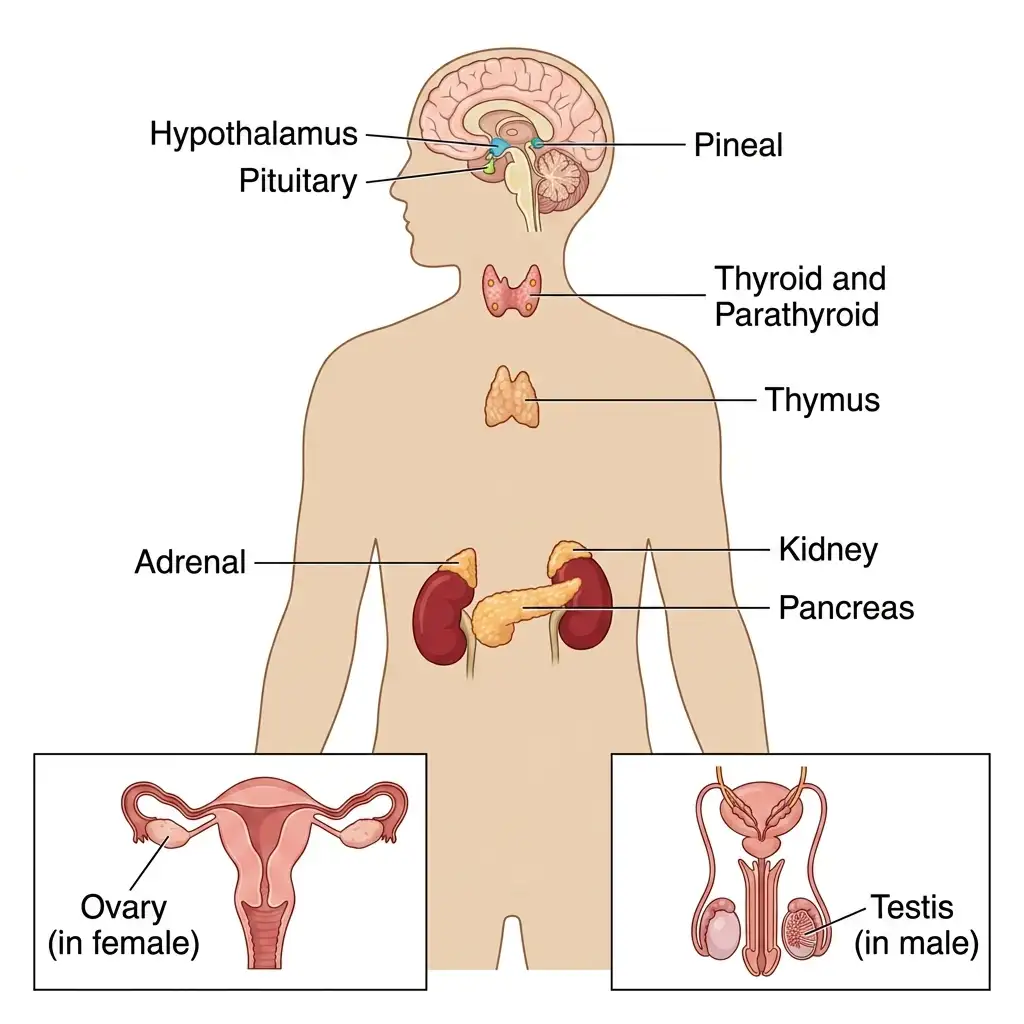
The Human Endocrine System: An overview mapping the major ductless glands secreting hormones directly into blood.
🔬 Detailed Anatomical Description
The endocrine system is a network of ductless glands that release chemical messengers (hormones) directly into the circulatory system. Major glands include: (1) Hypothalamus, pineal, and pituitary in the brain; (2) Thyroid and parathyroid in the neck; (3) Thymus in the upper chest; (4) Pancreas and paired adrenal glands above the kidneys in the abdomen; (5) Gonads (ovaries in females; testes in males) located in the pelvic cavity.
III. HYPOTHALAMUS
| FEATURE | DETAIL |
|---|---|
| Location | Basal part of diencephalon (forebrain) ⭐⭐⭐ |
| Contains | Several groups of neuro-secretory cells called nuclei ⭐⭐⭐ |
| These cells produce | Hypothalamic hormones ⭐⭐⭐ |
Types of Hypothalamic Hormones ⭐⭐⭐
| TYPE | FUNCTION | EXAMPLE |
|---|---|---|
| Releasing hormones | Stimulate synthesis / secretion of pituitary hormones ⭐⭐⭐ | GnRH ⭐⭐⭐ |
| Inhibiting hormones | Inhibit secretion of pituitary hormones ⭐⭐⭐ | Somatostatin ⭐⭐ |
Connections with Pituitary ⭐⭐⭐
| FEATURE | DETAIL |
|---|---|
| Anterior pituitary connection | Through portal circulatory system ⭐⭐⭐ |
| Posterior pituitary connection | Under direct neural regulation of hypothalamus ⭐⭐⭐ |
NEET 2015, 2016: Anterior pituitary connected via portal circulation, posterior pituitary under direct neural control.
GnRH stimulates release of LH and FSH from anterior pituitary.
IV. PITUITARY GLAND
| FEATURE | DETAIL |
|---|---|
| Location | In a bony cavity called sella turcica ⭐⭐⭐ |
| Attachment | Attached to hypothalamus by a stalk ⭐⭐ |
| Main divisions | Adenohypophysis and Neurohypophysis ⭐⭐⭐ |
A DIVISIONS OF PITUITARY
| PART | SUBPARTS |
|---|---|
| Adenohypophysis | Pars distalis + Pars intermedia ⭐⭐⭐ |
| Neurohypophysis | Pars nervosa ⭐⭐⭐ |
Pituitary and Hypothalamus
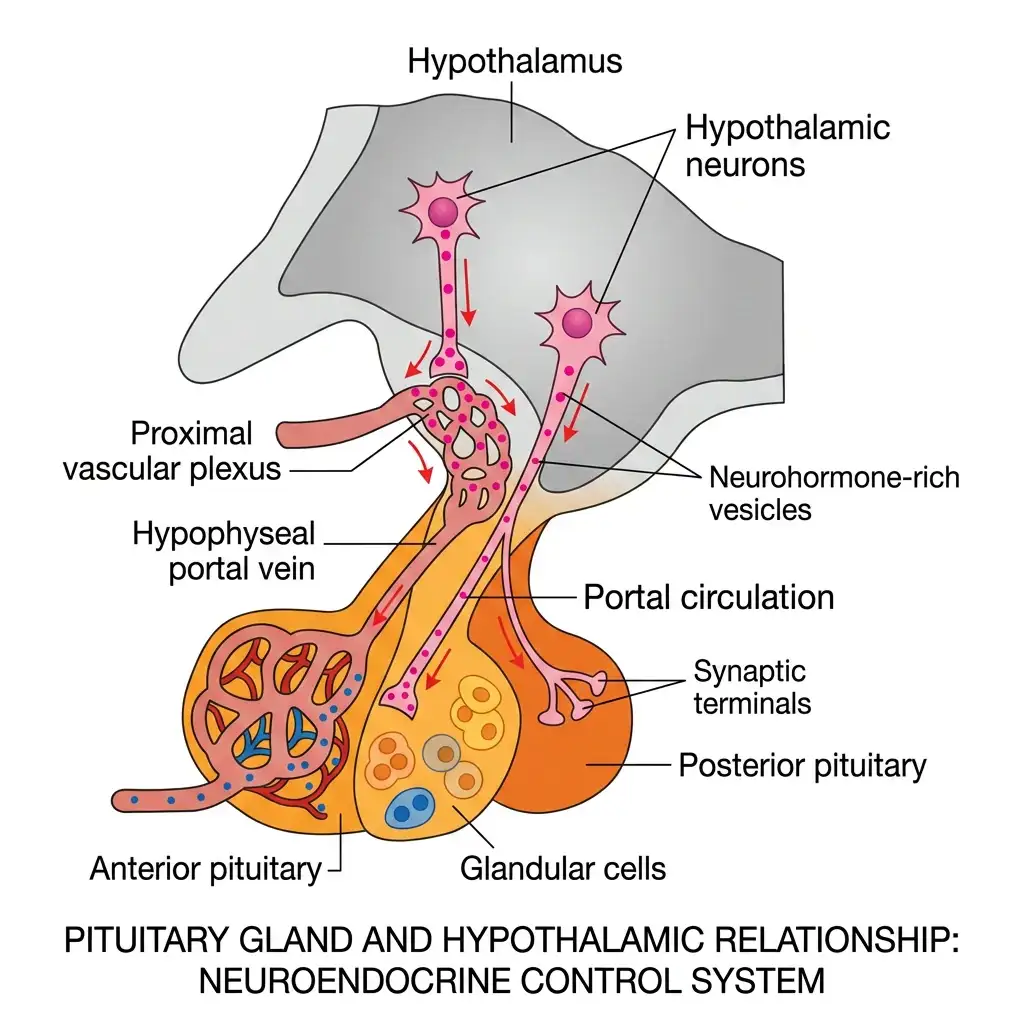
Hypothalamus-Pituitary Axis: Shows neural regulation of posterior pituitary and portal blood vessel regulation of anterior pituitary.
🔬 Detailed Anatomical Description
The pituitary gland (master gland) is anatomically and functionally linked to the hypothalamus. (1) Adenohypophysis (Anterior Pituitary) is regulated by hypothalamic releasing and inhibiting hormones transported through the hypophyseal portal system. (2) Neurohypophysis (Posterior Pituitary) is under direct neural control; hypothalamic neurons send axons directly down the infundibular stalk to store and release oxytocin and ADH.
V. ADENOHYPOPHYSIS (ANTERIOR PITUITARY)
A PARS DISTALIS — 6 HORMONES
| HORMONE | FULL FORM | MAIN FUNCTION |
|---|---|---|
| GH | Growth Hormone | Growth of body tissues ⭐⭐⭐ |
| PRL | Prolactin | Mammary gland growth and milk formation ⭐⭐⭐ |
| TSH | Thyroid Stimulating Hormone | Stimulates thyroid hormone synthesis and secretion ⭐⭐⭐ |
| ACTH | Adreno-corticotrophic Hormone | Stimulates glucocorticoid secretion from adrenal cortex ⭐⭐⭐ |
| LH | Luteinising Hormone | Gonadal function ⭐⭐⭐ |
| FSH | Follicle Stimulating Hormone | Gonadal function ⭐⭐⭐ |
NEET 2017: LH + FSH = gonadotrophins.
B PARS INTERMEDIA
| HORMONE | FUNCTION |
|---|---|
| MSH (Melanocyte Stimulating Hormone) | Acts on melanocytes and regulates skin pigmentation ⭐⭐⭐ |
VI. NEUROHYPOPHYSIS (POSTERIOR PITUITARY)
| FEATURE | DETAIL |
|---|---|
| Main role | Stores and releases hormones ⭐⭐⭐ |
| Important point | It does NOT synthesise its own hormones ⭐⭐⭐ |
| Therefore | Posterior pituitary is not a true endocrine gland ⭐⭐⭐ |
Hormones stored and released ⭐⭐⭐
| HORMONE | ACTUAL SITE OF SYNTHESIS | MAIN FUNCTION |
|---|---|---|
| Oxytocin | Hypothalamus ⭐⭐⭐ | Uterine contraction, milk ejection ⭐⭐⭐ |
| Vasopressin / ADH | Hypothalamus ⭐⭐⭐ | Water reabsorption, anti-diuresis ⭐⭐⭐ |
NEET 2014, 2015, 2016, 2020: Posterior pituitary stores/releases oxytocin and vasopressin, both synthesised in hypothalamus.
VII. FUNCTIONS OF PITUITARY HORMONES
A GROWTH HORMONE (GH)
| CONDITION | EFFECT |
|---|---|
| Hypersecretion in child | Gigantism ⭐⭐⭐ |
| Hypersecretion in adult | Acromegaly ⭐⭐⭐ |
| Hyposecretion in child | Pituitary dwarfism ⭐⭐⭐ |
IMPORTANT GH FACT
| CONDITION | DETAIL |
|---|---|
| In adults, GH excess does not increase height | Because epiphyseal plates close after adolescence ⭐⭐ |
NEET 2013, 2017: GH excess in child = gigantism. NEET 2019, 2024: Adult GH excess = acromegaly.
B PROLACTIN (PRL)
| FEATURE | DETAIL |
|---|---|
| Function | Regulates growth of mammary glands and formation of milk ⭐⭐⭐ |
C TSH
| FEATURE | DETAIL |
|---|---|
| Function | Stimulates synthesis and secretion of thyroid hormones ⭐⭐⭐ |
D ACTH
| FEATURE | DETAIL |
|---|---|
| Function | Stimulates synthesis and secretion of glucocorticoids from adrenal cortex ⭐⭐⭐ |
E LH
| IN MALES | IN FEMALES |
|---|---|
| Stimulates synthesis and secretion of androgens from testis ⭐⭐⭐ | Induces ovulation of fully mature Graafian follicles and maintains corpus luteum ⭐⭐⭐ |
NEET 2024: LH in females induces ovulation and maintains corpus luteum.
F FSH
| IN MALES | IN FEMALES |
|---|---|
| Along with androgens, regulates spermatogenesis ⭐⭐⭐ | Stimulates growth and development of ovarian follicles ⭐⭐⭐ |
NEET 2024: FSH in males with androgens regulates spermatogenesis.
G MSH
| FEATURE | DETAIL |
|---|---|
| Function | Acts on melanocytes and regulates pigmentation of skin ⭐⭐⭐ |
H OXYTOCIN
| FEATURE | DETAIL |
|---|---|
| Acts on | Smooth muscles ⭐⭐⭐ |
| In females | Stimulates uterine contraction during childbirth ⭐⭐⭐ |
| Also causes | Milk ejection from mammary glands ⭐⭐⭐ |
I VASOPRESSIN / ADH
| FEATURE | DETAIL |
|---|---|
| Full form | Antidiuretic Hormone ⭐⭐⭐ |
| Main site of action | Kidney ⭐⭐⭐ |
| Action | Stimulates reabsorption of water and electrolytes by distal tubules ⭐⭐⭐ |
| Effect | Reduces water loss through urine (reduces diuresis) ⭐⭐⭐ |
Disorder due to ADH deficiency ⭐⭐⭐
| DISORDER | CAUSE |
|---|---|
| Diabetes insipidus | Impaired synthesis / release of ADH → inability to conserve water ⭐⭐⭐ |
NEET 2020: ADH reduces water loss by stimulating reabsorption in kidney.
VIII. PINEAL GLAND
| FEATURE | DETAIL |
|---|---|
| Location | On the dorsal side of forebrain ⭐⭐⭐ |
| Secretes | Melatonin ⭐⭐⭐ |
Functions of Melatonin ⭐⭐⭐
| FUNCTION | DETAIL |
|---|---|
| Regulates | 24-hour (diurnal) rhythm of body ⭐⭐⭐ |
| Maintains | Sleep-wake cycle ⭐⭐⭐ |
| Helps regulate | Body temperature ⭐⭐⭐ |
| Also influences | Metabolism, pigmentation, menstrual cycle, defence capability ⭐⭐⭐ |
Additional Fact ⭐⭐
| FEATURE | DETAIL |
|---|---|
| Melatonin is derived from | Amino acid tryptophan ⭐⭐ |
NEET 2014, 2016, 2022, 2023: Pineal gland secretes melatonin; regulates sleep-wake / diurnal rhythm. TRAP: Sleep-wake cycle is regulated by melatonin, not thyroid hormones.
IX. THYROID GLAND
| FEATURE | DETAIL |
|---|---|
| Structure | Composed of two lobes ⭐⭐⭐ |
| Position | Located on either side of trachea ⭐⭐⭐ |
| Connecting structure | Thin flap of connective tissue called isthmus ⭐⭐⭐ |
| Tissue composition | Follicles and stromal tissue ⭐⭐ |
| Thyroid follicle | Made of follicular cells enclosing a cavity ⭐⭐⭐ |
Hormones of Thyroid Follicular Cells ⭐⭐⭐
| HORMONE | FULL FORM |
|---|---|
| T₄ | Thyroxine / Tetraiodothyronine ⭐⭐⭐ |
| T₃ | Triiodothyronine ⭐⭐⭐ |
NEET 2013: T₄ = thyroxine / tetraiodothyronine.
Important Requirement ⭐⭐⭐
| FEATURE | DETAIL |
|---|---|
| Iodine is essential for | Normal synthesis of thyroid hormones ⭐⭐⭐ |
Thyroid and Parathyroid Glands
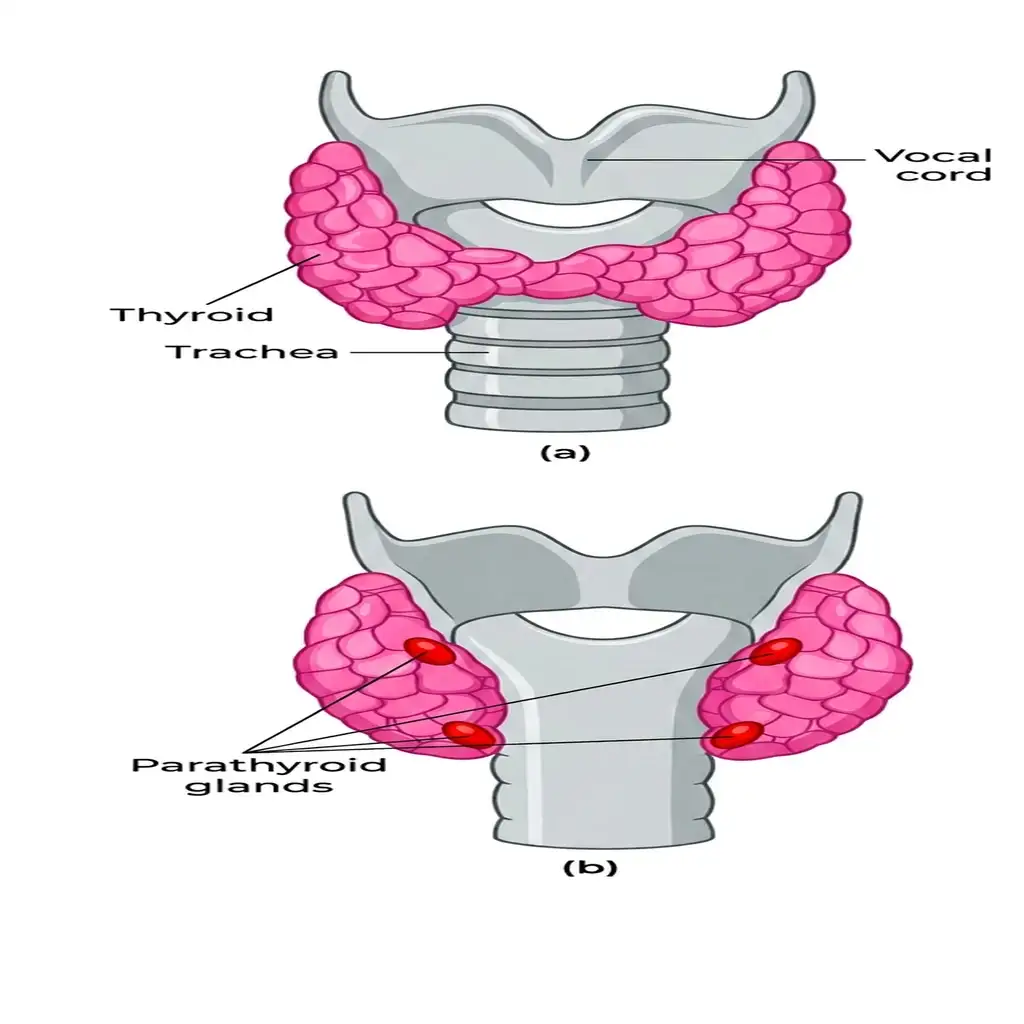
Thyroid & Parathyroid Glands: Situates the thyroid lobes on the trachea (ventral) and parathyroid glands on the back (dorsal).
🔬 Detailed Anatomical Description
The thyroid and parathyroid glands are closely associated in the neck. (1) Thyroid: A bilobed butterfly-shaped gland situating on the ventral side of the trachea, below the larynx. It is composed of follicles that secrete thyroid hormones (T3 & T4) and calcitonin. (2) Parathyroid: Four small pea-sized glands embedded on the dorsal surface of the thyroid gland, secreting parathyroid hormone (PTH) to regulate blood calcium levels.
X. DISORDERS OF THYROID GLAND
A HYPOTHYROIDISM
| CONDITION | EFFECT |
|---|---|
| Iodine deficiency | Hypothyroidism ⭐⭐⭐ |
| Common enlargement of thyroid | Goitre ⭐⭐⭐ |
| Adult hypothyroidism | Myxoedema ⭐⭐⭐ |
B HYPOTHYROIDISM DURING PREGNANCY / CHILD
| FEATURE | DETAIL |
|---|---|
| Effect on baby | Defective development and maturation ⭐⭐⭐ |
| Results in | Cretinism ⭐⭐⭐ |
| Features | Stunted growth, mental retardation, low IQ, abnormal skin, deaf-mutism ⭐⭐⭐ |
NEET 2013, 2024: Cretinism due to hypothyroidism during pregnancy / childhood. NEET 2013: Goitre due to iodine deficiency / hypothyroidism.
C HYPERTHYROIDISM
| DISORDER | FEATURES |
|---|---|
| Exophthalmic goitre / Graves’ disease | Enlargement of thyroid, protrusion of eyeballs, increased BMR, weight loss ⭐⭐⭐ |
NEET 2016, 2017, 2020, 2024: Graves’ disease = hyperthyroidism with exophthalmic goitre.
XI. FUNCTIONS OF THYROID HORMONES
| FUNCTION | DETAIL |
|---|---|
| Regulate | Basal Metabolic Rate (BMR) ⭐⭐⭐ |
| Support | RBC production / erythropoiesis ⭐⭐⭐ |
| Control metabolism of | Carbohydrates, proteins, fats ⭐⭐⭐ |
| Maintain | Water and electrolyte balance ⭐⭐⭐ |
| Also important for | Development and maturation of CNS ⭐⭐ |
| In adult women | Influence menstrual cycle ⭐⭐ |
NEET 2023: Thyroid hormones support RBC production and maintain water-electrolyte balance. TRAP: Thyroid hormones do not regulate sleep-wake cycle (melatonin does).
XII. THYROCALCITONIN / CALCITONIN (TCT)
| FEATURE | DETAIL |
|---|---|
| Secreted by | Thyroid gland ⭐⭐⭐ |
| Nature | Protein hormone ⭐⭐ |
| Function | Regulates blood calcium level ⭐⭐⭐ |
| Effect on Ca²⁺ | Decreases blood calcium → Hypocalcemic hormone ⭐⭐⭐ |
NEET 2023: Calcitonin decreases blood Ca²⁺.
XIII. PARATHYROID GLANDS
| FEATURE | DETAIL |
|---|---|
| Number | 4 glands ⭐⭐⭐ |
| Position | On the back side of thyroid gland ⭐⭐⭐ |
| Secrete | Parathyroid hormone (PTH) ⭐⭐⭐ |
| Nature of PTH | Peptide hormone ⭐⭐⭐ |
Regulation of PTH ⭐⭐⭐
| FEATURE | DETAIL |
|---|---|
| PTH secretion regulated by | Circulating level of Ca²⁺ ions ⭐⭐⭐ |
Functions of PTH ⭐⭐⭐
| FUNCTION | DETAIL |
|---|---|
| Increases blood Ca²⁺ level | Hypercalcemic hormone ⭐⭐⭐ |
| Acts on bone | Stimulates bone resorption / demineralisation ⭐⭐⭐ |
| Acts on kidney | Increases reabsorption of Ca²⁺ from renal tubules ⭐⭐⭐ |
| Acts on intestine (indirectly) | Increases absorption of Ca²⁺ from digested food ⭐⭐⭐ |
Relationship with Calcitonin ⭐⭐⭐
| PAIR | RELATION |
|---|---|
| PTH and TCT | Antagonistic hormones ⭐⭐⭐ |
NEET 2022, 2023: PTH increases blood calcium and stimulates bone resorption. NEET 2016: PTH and calcitonin act antagonistically.
XIV. THYMUS GLAND
| FEATURE | DETAIL |
|---|---|
| Structure | Lobular ⭐⭐ |
| Location | Between lungs, behind sternum, on ventral side of aorta ⭐⭐⭐ |
| Main role | Development of immune system ⭐⭐⭐ |
| Secretes | Thymosins ⭐⭐⭐ |
Functions of Thymosins ⭐⭐⭐
| FUNCTION | DETAIL |
|---|---|
| Differentiation of | T-lymphocytes ⭐⭐⭐ |
| Provides | Cell-mediated immunity (CMI) ⭐⭐⭐ |
| Also promotes | Production of antibodies → Humoral immunity ⭐⭐⭐ |
Age-related change ⭐⭐⭐
| FEATURE | DETAIL |
|---|---|
| In old age | Thymus degenerates ⭐⭐⭐ |
| Result | Thymosin production decreases → immune response weakens ⭐⭐⭐ |
XV. ADRENAL GLANDS
| FEATURE | DETAIL |
|---|---|
| Number | One pair ⭐⭐⭐ |
| Position | One at / above the anterior-upper part of each kidney ⭐⭐⭐ |
| Divisions | Adrenal cortex (outer) and Adrenal medulla (inner) ⭐⭐⭐ |
NEET 2013: Adrenal gland has outer cortex and inner medulla. NEET 2026 context / reinforced: Adrenal medulla secretes adrenaline (epinephrine) and noradrenaline (norepinephrine) — emergency / fight-or-flight hormones.
Structure of Adrenal Gland
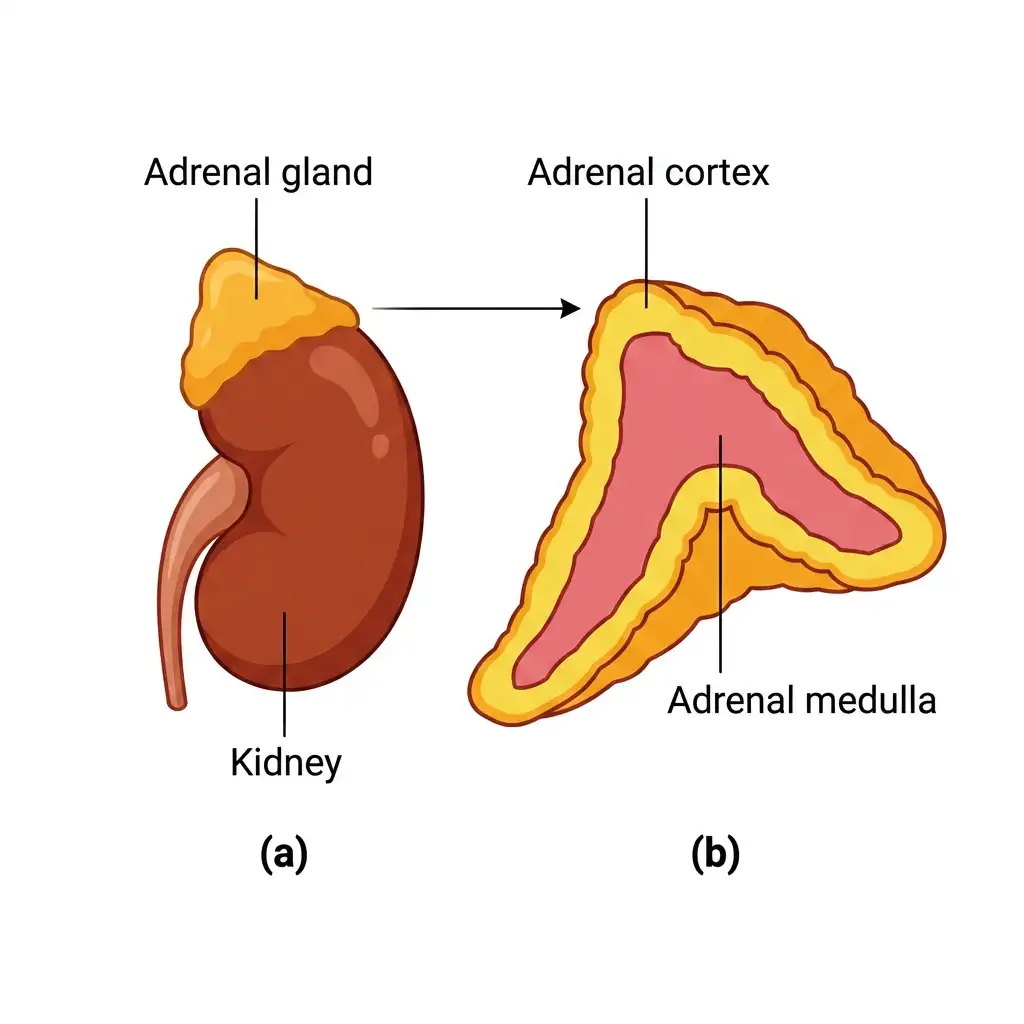
Anatomy of the Adrenal Gland: Depicts the yellow steroid-secreting cortex and pink catecholamine-secreting medulla.
🔬 Detailed Anatomical Description
Our body has a pair of adrenal (suprarenal) glands located at the anterior part of each kidney. Each gland consists of two structurally and functionally distinct tissues: (1) Adrenal cortex: The outer steroidogenic zone divided into three zones, secreting glucocorticoids, mineralocorticoids, and androgens; (2) Adrenal medulla: The inner core secreting catecholamines (adrenaline and noradrenaline) in response to stress (fight-or-flight response).
XVI. ADRENAL MEDULLA
| FEATURE | DETAIL |
|---|---|
| Hormones secreted | Adrenaline (Epinephrine) and Noradrenaline (Norepinephrine) ⭐⭐⭐ |
| Common name | Catecholamines ⭐⭐⭐ |
| Secreted rapidly during | Stress and emergency ⭐⭐⭐ |
| Therefore called | Emergency hormones / Fight-or-Flight hormones ⭐⭐⭐ |
Functions of Catecholamines ⭐⭐⭐
| EFFECT | DETAIL |
|---|---|
| Increase | Alertness ⭐⭐⭐ |
| Cause | Pupillary dilation ⭐⭐⭐ |
| Cause | Piloerection ⭐⭐ |
| Cause | Sweating ⭐⭐ |
| Increase | Heart rate ⭐⭐⭐ |
| Increase | Strength of heart contraction ⭐⭐⭐ |
| Increase | Rate of respiration ⭐⭐⭐ |
| Stimulate | Glycogenolysis → raises blood glucose ⭐⭐⭐ |
| Also stimulate | Breakdown of lipids and proteins ⭐⭐ |
Additional High-Yield Fact ⭐⭐
| FEATURE | DETAIL |
|---|---|
| Epinephrine | Acts as both hormone and neurotransmitter ⭐⭐ |
| Chemical nature | Amino acid derivative / biogenic amine ⭐⭐ |
NEET 2014, 2024: Adrenaline and noradrenaline are fight-or-flight hormones. NEET 2020: Catecholamines stimulate glycogen breakdown. NEET 2026 context / reinforced: Adrenal medulla secretes adrenaline (epinephrine) and noradrenaline (norepinephrine) — emergency / fight-or-flight hormones. Effects include: increased alertness, pupillary dilation, piloerection, sweating, increased heart rate and strength of contraction, increased respiration rate, glycogenolysis (raises blood glucose).
XVII. ADRENAL CORTEX
Layers of Adrenal Cortex ⭐⭐⭐
| LAYER | POSITION | MAJOR SECRETION |
|---|---|---|
| Zona glomerulosa | Outer | Mineralocorticoids ⭐⭐⭐ |
| Zona fasciculata | Middle | Glucocorticoids ⭐⭐⭐ |
| Zona reticularis | Inner | Sex corticoids / androgenic steroids ⭐⭐⭐ |
TRAP: Aldosterone is from zona glomerulosa, not zona reticularis.
XVIII. GLUCOCORTICOIDS
| FEATURE | DETAIL |
|---|---|
| Main glucocorticoid | Cortisol ⭐⭐⭐ |
Functions of Cortisol / Glucocorticoids ⭐⭐⭐
| FUNCTION | DETAIL |
|---|---|
| Stimulates | Gluconeogenesis ⭐⭐⭐ |
| Stimulates | Lipolysis ⭐⭐⭐ |
| Stimulates | Proteolysis ⭐⭐⭐ |
| Inhibits | Cellular uptake and utilisation of amino acids ⭐⭐ |
| Helps maintain | Cardiovascular system ⭐⭐⭐ |
| Helps maintain | Kidney functions ⭐⭐ |
| Produces | Anti-inflammatory effect ⭐⭐⭐ |
| Suppresses | Immune response ⭐⭐⭐ |
| Stimulates | RBC production ⭐⭐⭐ |
NEET 2019, 2020, NEET 2026 context: Cortisol (main glucocorticoid) stimulates gluconeogenesis, lipolysis and proteolysis; produces anti-inflammatory effect and suppresses immune response.
XIX. MINERALOCORTICOIDS
| FEATURE | DETAIL |
|---|---|
| Main mineralocorticoid | Aldosterone ⭐⭐⭐ |
Functions of Aldosterone ⭐⭐⭐
| FUNCTION | DETAIL |
|---|---|
| Acts mainly on | Renal tubules ⭐⭐⭐ |
| Increases reabsorption of | Na⁺ and water ⭐⭐⭐ |
| Increases excretion of | K⁺ and phosphate ⭐⭐⭐ |
| Maintains | Electrolyte balance ⭐⭐⭐ |
| Maintains | Body fluid volume ⭐⭐⭐ |
| Maintains | Osmotic balance / osmotic pressure ⭐⭐⭐ |
| Helps maintain | Blood pressure ⭐⭐⭐ |
NEET 2019, NEET 2026 context: Aldosterone (main mineralocorticoid) increases reabsorption of Na⁺ and water in renal tubules; helps maintain electrolyte balance, body fluid volume and blood pressure.
XX. SEX CORTICOIDS OF ADRENAL CORTEX
| FEATURE | DETAIL |
|---|---|
| Secreted in small amounts | Androgenic steroids ⭐⭐ |
| Role | Growth of axillary hair, pubic hair, and facial hair during puberty ⭐⭐ |
XXI. DISORDERS OF ADRENAL CORTEX
| DISORDER | CAUSE / FEATURE |
|---|---|
| Addison’s disease | Hyposecretion of adrenal cortex hormones; causes weakness and fatigue ⭐⭐⭐ |
| Cushing’s syndrome | Hypersecretion of cortisol; moon face, hyperglycemia etc. ⭐⭐ |
NEET 2019, 2020: Addison’s disease due to adrenal cortex hyposecretion. NEET 2024: Cushing’s syndrome due to cortisol excess.
XXII. PANCREAS
| FEATURE | DETAIL |
|---|---|
| Nature | Composite gland — both exocrine and endocrine ⭐⭐⭐ |
| Endocrine part | Islets of Langerhans ⭐⭐⭐ |
| Number of islets | About 1–2 million ⭐⭐⭐ |
| % of pancreatic tissue | Only 1–2% ⭐⭐⭐ |
Main Cells of Islets ⭐⭐⭐
| CELL TYPE | HORMONE SECRETED |
|---|---|
| α-cells | Glucagon ⭐⭐⭐ |
| β-cells | Insulin ⭐⭐⭐ |
XXIII. GLUCAGON
| FEATURE | DETAIL |
|---|---|
| Secreted by | α-cells ⭐⭐⭐ |
| Nature | Peptide hormone ⭐⭐⭐ |
| Main target | Hepatocytes ⭐⭐⭐ |
| Stimulates | Glycogenolysis ⭐⭐⭐ |
| Stimulates | Gluconeogenesis ⭐⭐⭐ |
| Reduces | Cellular glucose uptake and utilisation ⭐⭐ |
| Final effect | Raises blood glucose (Hyperglycemia) ⭐⭐⭐ |
| Therefore called | Hyperglycemic hormone ⭐⭐⭐ |
NEET 2020: Glucagon = hyperglycemic hormone.
XXIV. INSULIN
| FEATURE | DETAIL |
|---|---|
| Secreted by | β-cells ⭐⭐⭐ |
| Nature | Peptide hormone ⭐⭐⭐ |
| Main targets | Hepatocytes and adipocytes ⭐⭐⭐ |
| Enhances | Cellular glucose uptake and utilisation ⭐⭐⭐ |
| Stimulates | Glycogenesis ⭐⭐⭐ |
| Final effect | Lowers blood glucose (Hypoglycemia) ⭐⭐⭐ |
| Therefore called | Hypoglycemic hormone ⭐⭐⭐ |
NEET 2016, 2020: Insulin acts mainly on hepatocytes and adipocytes; hypoglycemic effect. NEET 2019, 2013: Insulin stimulates glycogenesis.
XXV. GLUCOSE HOMEOSTASIS & DIABETES MELLITUS
| FEATURE | DETAIL |
|---|---|
| Blood glucose homeostasis maintained by | Insulin + Glucagon together ⭐⭐⭐ |
| Prolonged hyperglycemia leads to | Diabetes mellitus ⭐⭐⭐ |
| Diabetes mellitus associated with | Glycosuria and ketone bodies / ketonuria ⭐⭐⭐ |
| Treatment | Insulin therapy ⭐⭐⭐ |
NEET 2020: Diabetes mellitus associated with glycosuria and ketone bodies.
XXVI. TESTIS
| FEATURE | DETAIL |
|---|---|
| Number | One pair ⭐⭐ |
| Location | In scrotal sac outside abdomen ⭐⭐⭐ |
| Function | Primary sex organ + endocrine gland ⭐⭐⭐ |
| Hormone-producing cells | Leydig cells / interstitial cells ⭐⭐⭐ |
| Hormones secreted | Androgens, mainly testosterone ⭐⭐⭐ |
Functions of Androgens ⭐⭐⭐
| FUNCTION | DETAIL |
|---|---|
| Stimulate | Spermatogenesis ⭐⭐⭐ |
| Development / maturation / function of | Male accessory sex organs ⭐⭐⭐ |
| Cause | Muscular growth ⭐⭐ |
| Cause | Growth of facial and axillary hair ⭐⭐⭐ |
| Cause | Aggressiveness, low pitch of voice ⭐⭐⭐ |
| Influence | Male sexual behaviour / libido ⭐⭐⭐ |
| Metabolic effect | Anabolic effect on protein and carbohydrate metabolism ⭐⭐ |
NEET 2013, 2024: Leydig cells secrete androgens / testosterone.
XXVII. OVARY
| FEATURE | DETAIL |
|---|---|
| Number | One pair ⭐⭐ |
| Location | In abdomen ⭐⭐ |
| Produces | One ovum during each menstrual cycle ⭐⭐ |
| Main hormones | Estrogen and Progesterone ⭐⭐⭐ |
Sources in Ovary ⭐⭐⭐
| STRUCTURE | HORMONE |
|---|---|
| Growing ovarian follicles | Estrogens ⭐⭐⭐ |
| Corpus luteum | Mainly Progesterone ⭐⭐⭐ |
NEET 2014, 2020: Corpus luteum mainly secretes progesterone.
Functions of Estrogens ⭐⭐⭐
| FUNCTION | DETAIL |
|---|---|
| Stimulate growth and activity of | Female accessory sex organs ⭐⭐⭐ |
| Help in | Development of growing ovarian follicles ⭐⭐ |
| Cause | Female secondary sex characters (e.g. high pitch voice) ⭐⭐⭐ |
| Promote | Mammary gland development ⭐⭐⭐ |
| Influence | Female sexual behaviour ⭐⭐ |
Functions of Progesterone ⭐⭐⭐
| FUNCTION | DETAIL |
|---|---|
| Supports | Pregnancy ⭐⭐⭐ |
| Acts on mammary glands | Stimulates formation of alveoli ⭐⭐⭐ |
| Also supports | Milk secretion ⭐⭐ |
XXVIII. ADDITIONAL REPRODUCTIVE HORMONE FACTS
| STRUCTURE | HORMONES SECRETED |
|---|---|
| Placenta | hCG, hPL, Estrogen, Progesterone ⭐⭐ |
XXIX. HORMONES OF HEART, KIDNEY & GIT
A HEART
| FEATURE | DETAIL |
|---|---|
| Hormone | Atrial Natriuretic Factor (ANF) ⭐⭐⭐ |
| Secreted by | Atrial wall ⭐⭐⭐ |
| Effect | Decreases blood pressure ⭐⭐⭐ |
| Mechanism | Causes vasodilation ⭐⭐⭐ |
NEET 2014, 2016, 2024, NEET 2026 context: ANF lowers BP (causes vasodilation). ANF functionally opposes RAAS / aldosterone effects.
B KIDNEY
| HORMONE | FUNCTION |
|---|---|
| Erythropoietin | Stimulates erythropoiesis / RBC formation ⭐⭐⭐ |
| Renin | Initiates RAAS, helps increase Na⁺ / water retention and BP ⭐⭐ |
NEET 2021, 2024, NEET 2026 context: Kidney secretes erythropoietin which stimulates RBC formation (erythropoiesis).
C GASTROINTESTINAL TRACT
| HORMONE | ACTION |
|---|---|
| Gastrin | Stimulates secretion of HCl and pepsinogen ⭐⭐⭐ |
| Secretin | Stimulates secretion of water and bicarbonates from exocrine pancreas ⭐⭐⭐ |
| Cholecysto-kinin (CCK) | Stimulates secretion of pancreatic enzymes and bile juice ⭐⭐⭐ |
| Gastric inhibitory peptide (GIP) | Inhibits gastric secretion and motility ⭐⭐⭐ |
NEET 2016, 2024, NEET 2026 context: Gastrin stimulates HCl/pepsinogen; Secretin stimulates water/bicarbonate from exocrine pancreas; CCK stimulates pancreatic enzymes & bile juice. TRAP: Gastrin acts on gastric glands / stomach, not intestine.
XXX. MECHANISM OF HORMONE ACTION
| FEATURE | DETAIL |
|---|---|
| Hormones act by binding to | Specific hormone receptors in target tissues ⭐⭐⭐ |
| Receptors are | Specific for each hormone ⭐⭐⭐ |
| Hormone + receptor | Forms hormone-receptor complex ⭐⭐⭐ |
| This complex leads to | Biochemical changes in target tissue ⭐⭐⭐ |
XXXI. MEMBRANE-BOUND RECEPTOR HORMONES
| FEATURE | DETAIL |
|---|---|
| Receptor location | On cell membrane ⭐⭐⭐ |
| Hormone enters target cell? | No ⭐⭐⭐ |
| Action mediated through | Second messengers ⭐⭐⭐ |
| Second messengers | cAMP, IP₃, Ca²⁺ etc. ⭐⭐⭐ |
Examples ⭐⭐⭐
- Insulin
- Glucagon
- Pituitary hormones
- Hypothalamic hormones
- Epinephrine
NEET 2019, 2022, NEET 2026 context: Protein / peptide hormones act through membrane-bound receptors and second messengers (do not enter target cell).
Mechanism of Protein Hormone
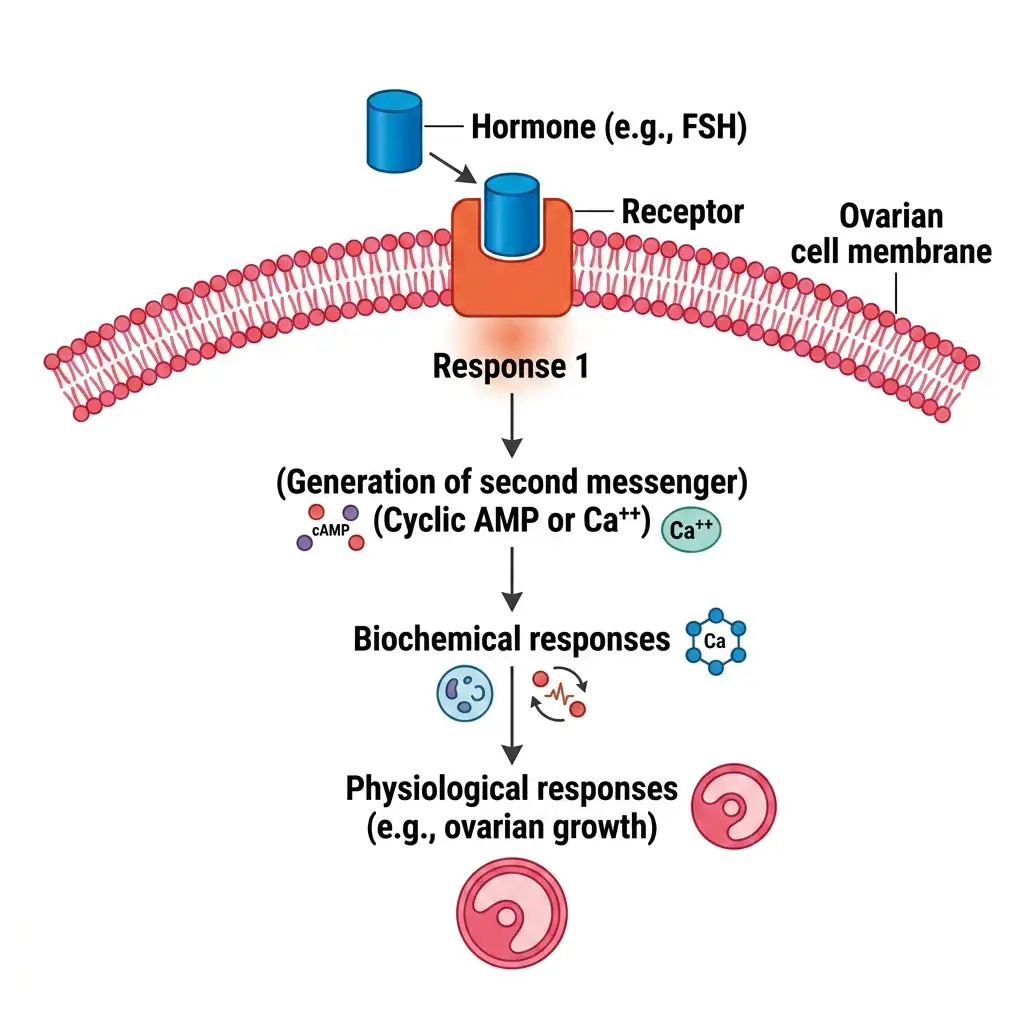
Protein Hormone Action: Non-steroid hormones bind to membrane-bound receptors, generating second messengers to alter cell biochemistry.
🔬 Detailed Anatomical Description
Water-soluble hormones (like FSH, insulin, and glucagon) cannot cross the hydrophobic lipid bilayer of cell membranes. They bind to specific membrane-bound receptors on the target cell surface, forming a hormone-receptor complex. This activates membrane proteins to generate intracellular second messengers (such as cyclic AMP, IP3, or Ca++), which initiate a cascade of biochemical changes that lead to the physiological response.
XXXII. INTRACELLULAR RECEPTOR HORMONES
| FEATURE | DETAIL |
|---|---|
| Receptor location | Inside target cell, mostly nuclear receptors ⭐⭐⭐ |
| Hormones are generally | Lipid soluble ⭐⭐ |
| Main effect | Regulate gene expression / chromosome function ⭐⭐⭐ |
Examples ⭐⭐⭐
- Cortisol
- Testosterone
- Estradiol
- Progesterone
- Thyroid hormones (iodothyronines)
NEET 2012, 2024, NEET 2026 context: Steroid hormones and thyroid hormones act through intracellular (mainly nuclear) receptors and regulate gene expression. TRAP: Though thyroid hormones are not steroids, they act like steroid hormones via intracellular receptors.
Mechanism of Steroid Hormone
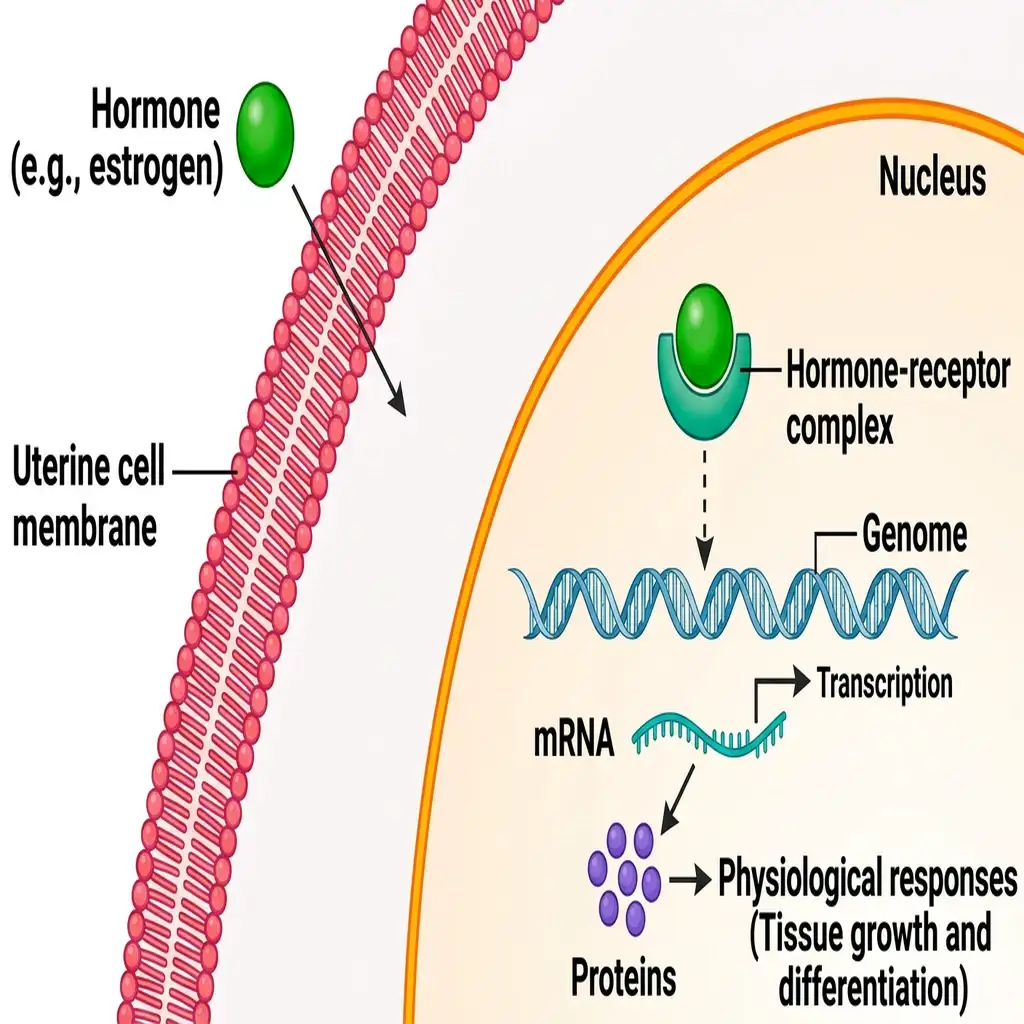
Steroid Hormone Action: Lipid-soluble hormones cross cell membranes directly to form nuclear complexes and regulate gene transcription.
🔬 Detailed Anatomical Description
Lipid-soluble hormones (such as estrogen, progesterone, testosterone, and cortisol) diffuse easily through target cell membranes. They enter the cytoplasm and cross into the nucleus to bind with specific intracellular receptors, forming a hormone-receptor complex. This complex interacts directly with the genome DNA to stimulate or repress gene transcription, producing mRNA and specific proteins that alter cell structure and function.
XXXIII. CHEMICAL CLASSES OF HORMONES
| CLASS | EXAMPLES |
|---|---|
| Peptide / polypeptide / protein hormones | Insulin, Glucagon, Pituitary hormones, Hypothalamic hormones ⭐⭐⭐ |
| Steroid hormones | Cortisol, Testosterone, Estradiol, Progesterone ⭐⭐⭐ |
| Iodothyronines | Thyroid hormones (T₃, T₄) ⭐⭐⭐ |
| Amino acid derivatives | Epinephrine, Norepinephrine, Melatonin ⭐⭐ |
NEET 2020, 2024, NEET 2026 context: Pituitary hormones = peptide/protein; Cortisol = steroid; Epinephrine = amino acid derivative. Glucagon is not a steroid; it is a peptide hormone.
XXXIV. RAPID REVISION — KEY COMPARISON TABLES
TABLE 1: Major Endocrine Glands and Hormones ⭐⭐⭐
| GLAND | HORMONE(S) |
|---|---|
| Hypothalamus | Releasing and inhibiting hormones |
| Pituitary | GH, PRL, TSH, ACTH, LH, FSH, MSH; stores oxytocin & ADH |
| Pineal | Melatonin |
| Thyroid | T₃, T₄, TCT |
| Parathyroid | PTH |
| Thymus | Thymosins |
| Adrenal medulla | Epinephrine, Norepinephrine |
| Adrenal cortex | Cortisol, Aldosterone, Sex corticoids |
| Pancreas | Insulin, Glucagon |
| Testis | Testosterone / Androgens |
| Ovary | Estrogen, Progesterone |
TABLE 2: Pituitary Hormones ⭐⭐⭐
| PART | HORMONES |
|---|---|
| Pars distalis | GH, PRL, TSH, ACTH, LH, FSH |
| Pars intermedia | MSH |
| Pars nervosa | Stores / releases Oxytocin, Vasopressin |
TABLE 3: GH Disorders ⭐⭐⭐
| GH STATUS | CONDITION |
|---|---|
| Excess in child | Gigantism |
| Excess in adult | Acromegaly |
| Deficiency in child | Pituitary dwarfism |
TABLE 4: Thyroid vs Parathyroid ⭐⭐⭐
| FEATURE | THYROID | PARATHYROID |
|---|---|---|
| Main hormones | T₃, T₄, TCT | PTH |
| Main role | BMR, metabolism, RBC support | Calcium balance |
| Blood Ca²⁺ effect | TCT decreases | PTH increases |
TABLE 5: Hyper- vs Hypocalcemic Hormones ⭐⭐⭐
| HORMONE | EFFECT ON BLOOD CA²⁺ |
|---|---|
| Calcitonin / TCT | Decreases (Hypocalcemic) |
| PTH | Increases (Hypercalcemic) |
TABLE 6: Adrenal Cortex vs Medulla ⭐⭐⭐
| FEATURE | CORTEX | MEDULLA |
|---|---|---|
| Position | Outer | Inner |
| Hormones | Corticoids | Catecholamines |
| Main hormones | Cortisol, Aldosterone | Adrenaline, Noradrenaline |
| Main function | Metabolism, electrolytes | Fight-or-flight |
TABLE 7: Pancreatic Hormones ⭐⭐⭐
| FEATURE | GLUCAGON | INSULIN |
|---|---|---|
| Secreted by | α-cells | β-cells |
| Nature | Peptide | Peptide |
| Main target | Hepatocytes | Hepatocytes + adipocytes |
| Blood glucose effect | Increases | Decreases |
| Type | Hyperglycemic | Hypoglycemic |
TABLE 8: Male vs Female Gonadal Hormones ⭐⭐⭐
| FEATURE | TESTIS | OVARY |
|---|---|---|
| Main hormone(s) | Androgens (testosterone) | Estrogen, Progesterone |
| Source cells | Leydig cells | Follicles / corpus luteum |
| Main effects | Spermatogenesis, male secondary sex characters | Female secondary sex characters, pregnancy support |
TABLE 9: Hormones of Other Organs ⭐⭐⭐
| ORGAN | HORMONE | FUNCTION |
|---|---|---|
| Heart | ANF | Lowers blood pressure |
| Kidney | Erythropoietin | RBC formation |
| GIT | Gastrin | HCl + pepsinogen |
| GIT | Secretin | Water + bicarbonate |
| GIT | CCK | Pancreatic enzymes + bile |
| GIT | GIP | Inhibits gastric secretion |
TABLE 10: Mechanism of Hormone Action ⭐⭐⭐
| FEATURE | MEMBRANE-BOUND RECEPTOR HORMONES | INTRACELLULAR RECEPTOR HORMONES |
|---|---|---|
| Receptor location | Cell membrane | Cytoplasm / nucleus |
| Hormone enters cell? | No | Yes |
| Mediator | Second messengers | Gene expression |
| Examples | Insulin, glucagon, pituitary hormones | Cortisol, testosterone, thyroid hormones |
XXXV. KEY NUMBERS / FACTS — QUICK REFERENCE
| PARAMETER / FACT | VALUE / DETAIL |
|---|---|
| Pituitary location | Sella turcica |
| Pars distalis hormones | 6 |
| Pars intermedia hormone | 1 (MSH) |
| Posterior pituitary hormones stored / released | 2 |
| Parathyroid glands | 4 |
| Islets of Langerhans | 1–2 million |
| Endocrine pancreas tissue | 1–2% |
| Thyroid lobes | 2 |
| Major brain-endocrine link | Hypothalamus |
| Main glucocorticoid | Cortisol |
| Main mineralocorticoid | Aldosterone |
XXXVI. COMMON EXAM TRAPS — QUICK REFERENCE
| TRAP / QUESTION | CORRECT ANSWER |
|---|---|
| Endocrine glands have ducts? | No, ductless glands |
| Hormones are nutrients? | No, non-nutrient chemicals |
| Posterior pituitary synthesises oxytocin and ADH? | No, stores / releases them; hypothalamus synthesises |
| Anterior pituitary under direct neural regulation? | No, via portal circulation |
| GnRH inhibits gonadotrophins? | No, stimulates LH and FSH |
| GH excess in adult causes gigantism? | No, acromegaly |
| GH increases height in adults? | No, epiphyseal plates are closed |
| Sleep-wake cycle regulated by thyroid hormone? | No, by melatonin |
| Thyroid hormones regulate immunity directly? | No, thymus / thymosins are key for immunity |
| Goitre = hyperthyroidism only? | No, commonly seen in iodine deficiency / hypothyroidism too |
| Graves’ disease is hypothyroidism? | No, hyperthyroidism |
| Calcitonin increases blood calcium? | No, decreases it |
| PTH decreases blood calcium? | No, increases it |
| PTH and TCT are synergistic? | No, antagonistic |
| Thymus active and large in old age? | No, degenerates with age |
| Adrenal medulla secretes cortisol? | No, cortex secretes cortisol |
| Adrenaline / noradrenaline are cortical hormones? | No, medullary catecholamines |
| Aldosterone is glucocorticoid? | No, mineralocorticoid |
| Zona reticularis secretes aldosterone? | No, zona glomerulosa does |
| Insulin is steroid? | No, peptide hormone |
| Glucagon lowers blood glucose? | No, raises it |
| Insulin raises blood glucose? | No, lowers it |
| Diabetes mellitus associated with glycosuria and ketonuria? | Yes |
| Leydig cells secrete estrogen? | No, androgens / testosterone |
| Corpus luteum mainly secretes estrogen? | No, mainly progesterone |
| ANF increases blood pressure? | No, decreases it |
| Gastrin stimulates bicarbonate secretion? | No, secretin does |
| CCK acts only on gall bladder? | No, acts on pancreas and gall bladder |
| Peptide hormones enter target cell directly? | No |
| Steroid hormones act via second messengers mainly? | No, mainly intracellular receptors |
| Thyroid hormones act via membrane receptors? | No, mainly intracellular receptors |
| Epinephrine is steroid hormone? | No, amino acid derivative |
- NEET 2026 context / reinforced: Adrenal medulla secretes adrenaline (epinephrine) and noradrenaline (norepinephrine) — emergency / fight-or-flight hormones.
- NEET 2026 context: Cortisol = gluconeogenesis, lipolysis, proteolysis, anti-inflammatory, immunosuppressive. Aldosterone = Na⁺/water reabsorption, BP/electrolyte balance.
- NEET 2026 context: ANF lowers BP (vasodilation); Erythropoietin from kidney stimulates RBCs; Gastrin = HCl/pepsinogen; Secretin = water/bicarbonate; CCK = pancreatic enzymes/bile.
- NEET 2026 context: Peptide hormones use membrane receptors & second messengers; Steroid & thyroid hormones use intracellular/nuclear receptors.
- RE-NEET 2026 / NEET 2026: Adrenal medulla = catecholamines; cortex = glucocorticoids + mineralocorticoids.