I. THE ROOT
A ROOT TYPES & ORIGIN
| TYPE | ORIGIN | STRUCTURE | EXAMPLE |
|---|---|---|---|
| Tap root system | Direct elongation of radicle → primary root → lateral roots (secondary, tertiary) | Primary root + its branches | Mustard |
| Fibrous root system | Primary root short-lived; replaced by numerous roots from base of stem | Many roots of similar size from stem base | Wheat |
| Adventitious roots | Arise from parts of plant other than the radicle | Roots from stems, leaves, nodes etc. | Grass, Monstera, Banyan tree |
NEET 2020: Fibrous roots originate from the base of stem. NEET 2018, RE-NEET 2026 context / reinforced: Sweet potato = modified adventitious root for food storage (NOT a stem/tuber).
MAIN FUNCTIONS OF ROOT SYSTEM
- Absorption of water & minerals from soil
- Anchorage to the plant
- Storage of reserve food material
- Synthesis of plant growth regulators
Different Types of Roots
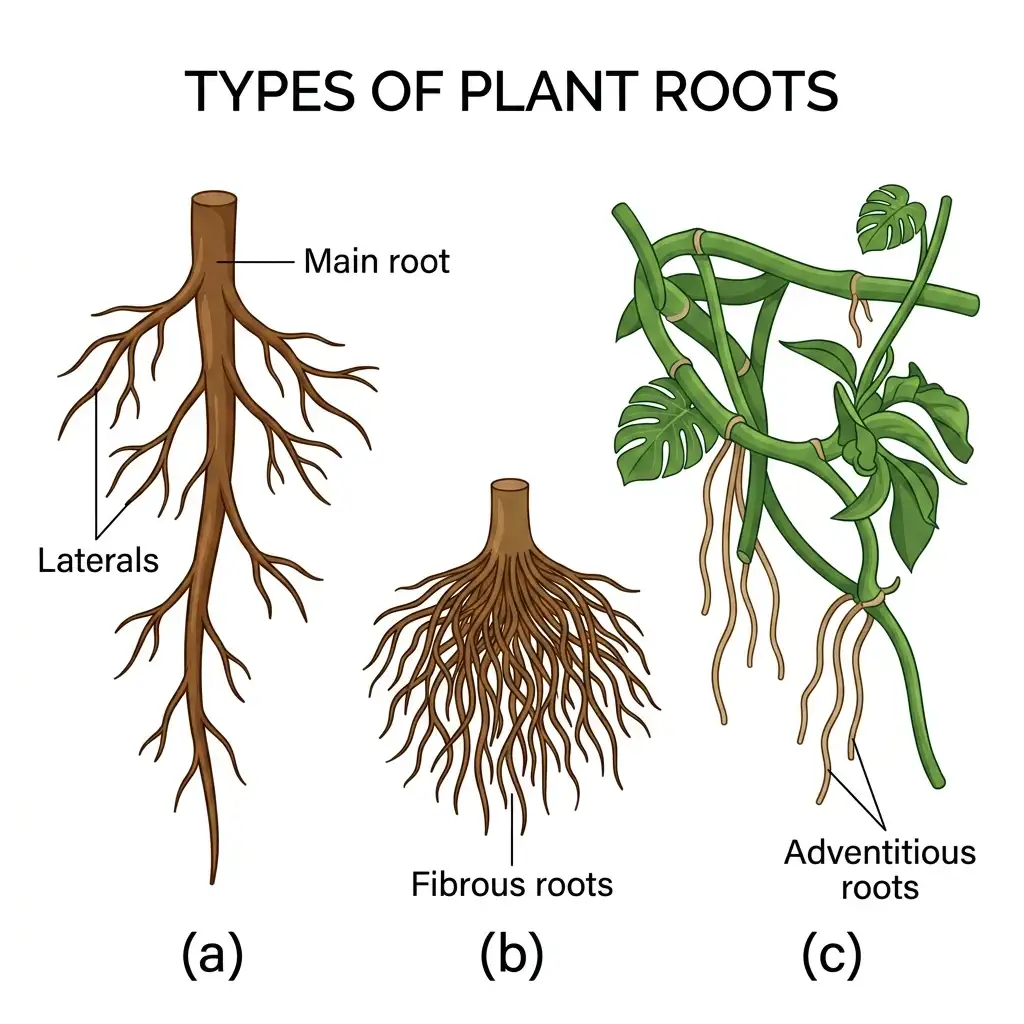
Types of Roots: (a) Tap root with main and lateral roots (e.g., Mustard), (b) Fibrous roots forming a dense tuft (e.g., Wheat), and (c) Adventitious roots growing from stems (e.g., Banyan).
🔬 Detailed Anatomical Description
Plants present three main root system configurations based on origin and structure: Tap root systems develop from the radicle (primary root) and branches; Fibrous root systems arise from the base of the stem when the primary root is short-lived; Adventitious roots develop from any plant part other than the radicle.
B REGIONS OF THE ROOT (TIP UPWARD)
| REGION | FEATURES | FUNCTION |
|---|---|---|
| Root cap | Thimble-like structure at apex | Protects tender root apex as it pushes through soil |
| Region of meristematic activity | Cells very small, thin-walled, dense protoplasm; divide repeatedly | Cell division / growth |
| Region of elongation | Cells undergo rapid elongation & enlargement | Responsible for growth in length |
| Region of maturation | Cells gradually differentiate & mature; ROOT HAIRS present here | Absorption of water & minerals ⭐⭐ |
ROOT HAIRS
- Very fine, delicate, thread-like structures
- Formed from epidermal cells of the region of maturation
- Unicellular outgrowths
- Function: Absorb water & minerals from soil
NEET 2017: Absorption of water & minerals mostly occurs in the REGION OF MATURATION (not elongation, not meristematic). NEET 2015: In Pistia (free-floating aquatic), roots play an insignificant role in absorption of water.
Regions of the Root-Tip
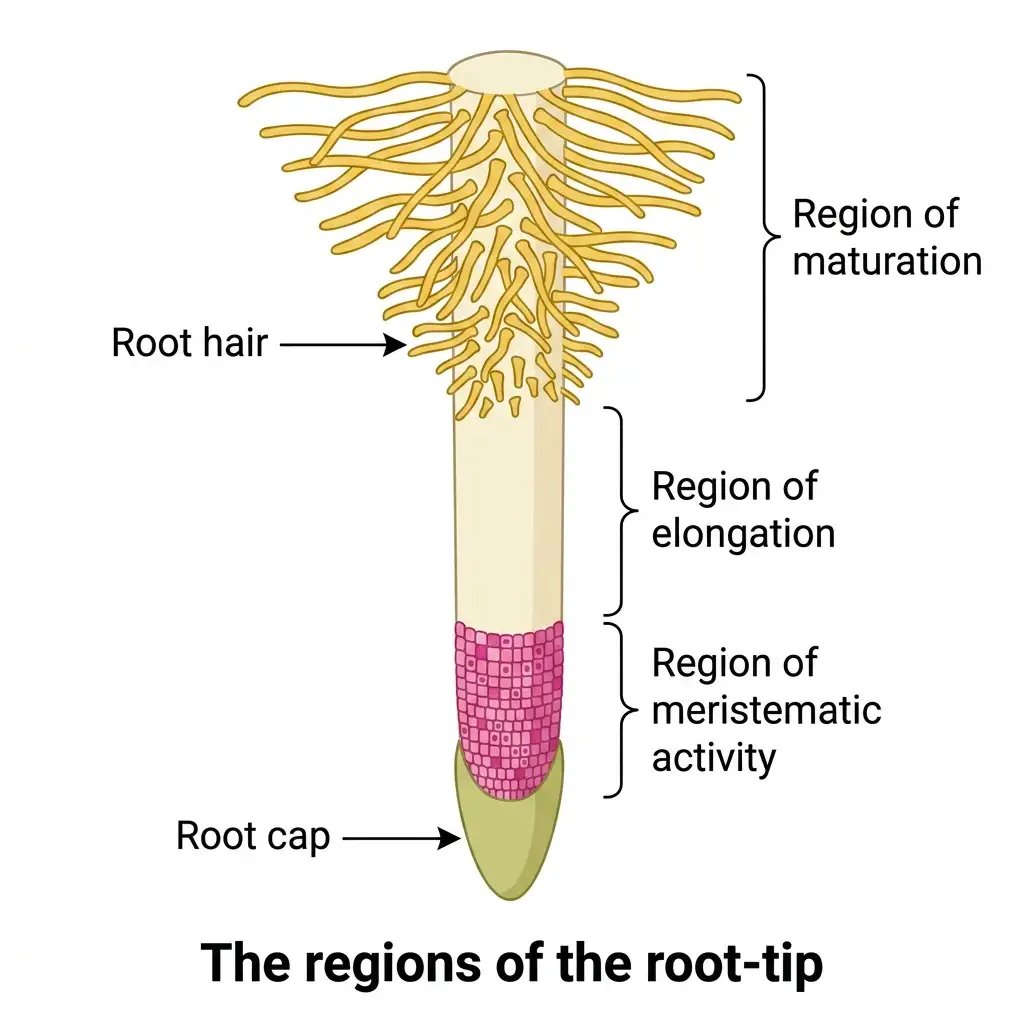
Anatomy of Root-Tip: Features the protective Root Cap, Region of Meristematic Activity, Region of Elongation, and Region of Maturation with dense root hairs.
🔬 Detailed Anatomical Description
The root-tip is structured into distinct functional zones. The root cap protects the tender apex. The meristematic region contains small, thin-walled cells undergoing active division. The elongation region is responsible for root growth in length. The maturation region features differentiated cells and epidermal root hairs for water absorption.
C MODIFICATION OF ROOTS
| PURPOSE | TYPE | EXAMPLES | KEY DETAIL |
|---|---|---|---|
| Food storage | Modified tap root | Carrot, Turnip | Swollen tap root stores food |
| Food storage | Modified adventitious root | Sweet potato ⭐ | NOT a stem modification |
| Support | Prop roots | Banyan tree | Hang down from branches, enter soil |
| Support | Stilt roots | Maize, Sugarcane | Arise from lower nodes of stem |
| Respiration | Pneumatophores | Rhizophora ⭐ | Grow vertically upward to get O₂; found in swampy areas |
NEET 2018, 2022, RE-NEET 2026 context: Pneumatophores occur in halophytes (salt-tolerant plants in marshy/swampy areas); e.g., Rhizophora; they grow vertically upward to get O₂. CLASSIC TRAP: Potato = STEM modification (tuber); Sweet potato = ROOT modification!
II. THE STEM
A BASIC FEATURES
| FEATURE | DETAIL |
|---|---|
| Origin | Develops from plumule of the embryo of a germinating seed |
| Structure | Bears nodes (where leaves arise) & internodes (portions between two nodes) |
| Buds | Terminal or axillary buds |
| Colour | Green when young; often woody & dark brown later |
| Growth | Ascending part of the axis |
MAIN FUNCTIONS
- Spreading branches bearing leaves, flowers & fruits
- Conducting water, minerals & photosynthates
- Some stems: storage, support, protection, vegetative propagation
B MODIFICATION OF STEM
1. UNDERGROUND STEMS (FOOD STORAGE)
| MODIFICATION | EXAMPLE | KEY FEATURE |
|---|---|---|
| Tuber | Potato ⭐ | Has 'eyes' (nodes with axillary buds) |
| Rhizome | Ginger, Turmeric ⭐ | Thick, prostrate, branched; distinct nodes & internodes |
| Corm | Zaminkand (Colocasia) | Underground, vertical, fleshy |
NEET 2014, 2022, NEET 2026 context / reinforced: Potato, Ginger, Turmeric, Zaminkand, Colocasia = underground STEM modifications. Rhizome = thick, prostrate, branched underground stem with distinct nodes & internodes. Potato = underground stem modification (tuber with 'eyes'). Sweet potato = modified adventitious root (classic distinction).
2. STEM TENDRILS
- Function: Help plants to climb
- Origin: Modified axillary buds; slender, spirally coiled
- Examples: Gourds (Cucumber, Pumpkin, Watermelon) & Grapevines
- Note: Stem tendrils and leaf tendrils are ANALOGOUS (similar function, different origin)
3. THORNS
- Function: Protect plant from browsing animals
- Origin: Modification of axillary buds of stem
- Nature: Woody, straight, pointed structures
- ⭐ Examples: Citrus, Bougainvillea
NEET 2017, 2016, 2022: Thorns in Citrus & Bougainvillea = modified AXILLARY BUDS of stem.
4. PHYLLOCLADES
- Function: Perform photosynthesis (stems become green & flat/cylindrical)
- Examples: Opuntia (flat), Euphorbia (cylindrical)
NEET 2016, 2022: Phylloclades = stems modified for photosynthesis. Phyllode = modification of PETIOLE (not stem) — e.g., Australian Acacia. Do NOT confuse with phylloclade!
5. OTHER STEM MODIFICATIONS
| TYPE | FEATURE | EXAMPLE |
|---|---|---|
| Offset | Short, thick horizontal branch | Pistia, Eichhornia (Water hyacinth) |
| Sucker | Underground lateral branch that grows upward | Banana, Pineapple, Chrysanthemum |
| Runner | Creeps on surface; subaerial stem | Grass, Strawberry |
III. THE LEAF
A BASIC FEATURES
- Position: Lateral, generally flattened structure borne on stem
- Origin: Originates from shoot apical meristem
- Development: Develops at the node; bears a bud in its axil (axillary bud → branch)
- Arrangement: Acropetal order (younger leaves near apex)
- Function: Most important vegetative organ for photosynthesis
B PARTS OF A TYPICAL LEAF
| PART | DETAIL |
|---|---|
| Leaf base | Attaches leaf to stem; may bear stipules (two lateral small leaf-like structures) |
| Petiole | Holds the blade to light; long, thin, flexible |
| Lamina (Leaf blade) | Green expanded part with veins & veinlets; has a midrib (middle prominent vein) |
SPECIAL LEAF BASE MODIFICATIONS
| FEATURE | FOUND IN | DETAIL |
|---|---|---|
| Sheathing leaf base | Monocotyledons | Leaf base expands into a sheath covering stem |
| Pulvinus | Some leguminous plants | Leaf base becomes swollen |
C VENATION
| TYPE | PATTERN | TYPICALLY FOUND IN | EXAMPLE |
|---|---|---|---|
| Reticulate | Veinlets form a network | Dicotyledons | Most dicots |
| Parallel | Veins run parallel to each other | Monocotyledons | Most monocots |
Structure and Venation of a Leaf
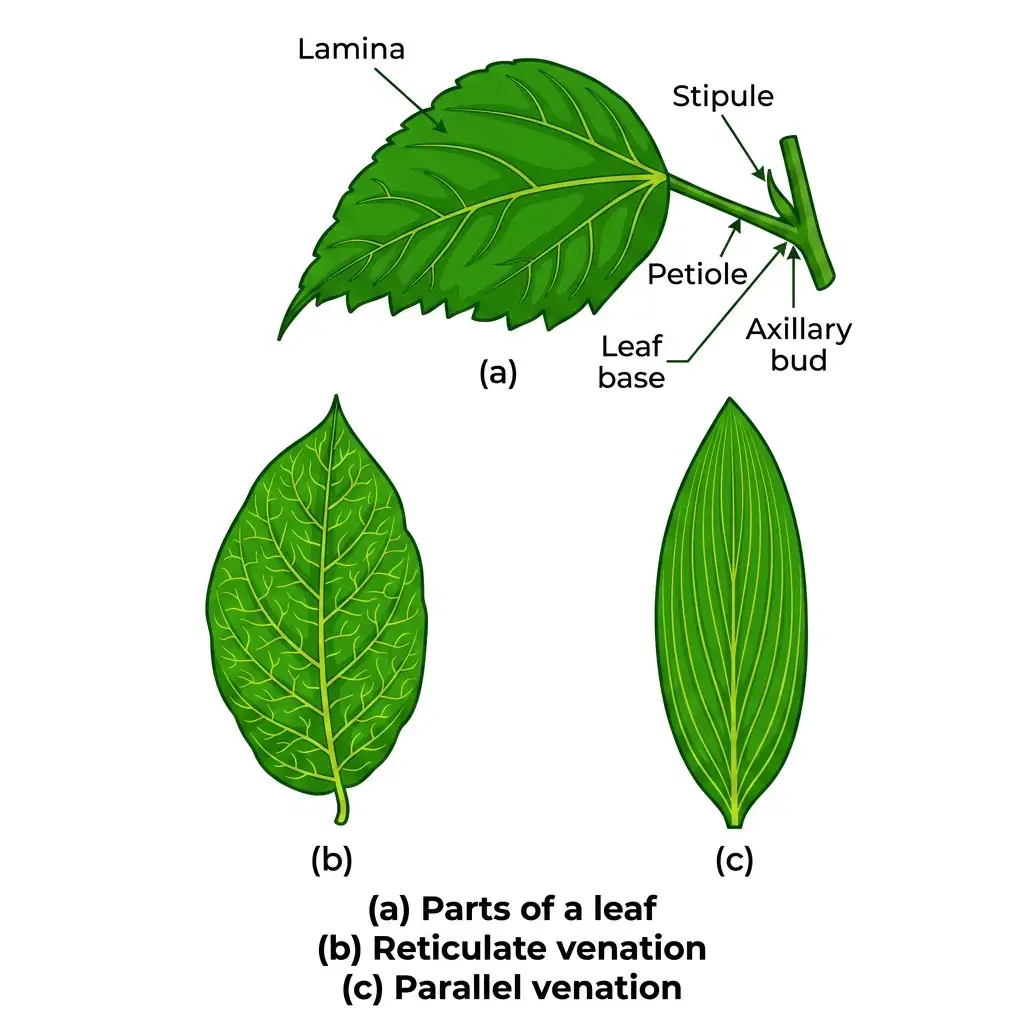
Anatomy and Venation of a Leaf: Shows primary parts (Lamina, Petiole, Stipule, Leaf base) and compares Reticulate vs. Parallel venation.
🔬 Detailed Anatomical Description
A typical leaf is composed of a leaf base (sometimes with stipules), a petiole stalk, and a broad green lamina (leaf blade). The arrangement of veins in the lamina is called venation. Dicotyledonous leaves feature net-like reticulate venation, while monocotyledonous leaves display parallel venation.
D TYPES OF LEAVES
| TYPE | DEFINITION | KEY FEATURE |
|---|---|---|
| Simple leaf | Lamina is entire OR incisions do not touch the midrib | Single undivided blade |
| Compound leaf | Incisions of lamina reach up to the midrib → broken into leaflets | Multiple leaflets |
TWO TYPES OF COMPOUND LEAVES
| TYPE | ARRANGEMENT | LEAFLET POSITION | EXAMPLE |
|---|---|---|---|
| Pinnately compound | Leaflets on a common axis called rachis (represents midrib) | Along the rachis | Neem |
| Palmately compound | Leaflets attached at a common point (tip of petiole) | All from one point | Silk cotton |
Pinnately and Palmately Compound Leaves
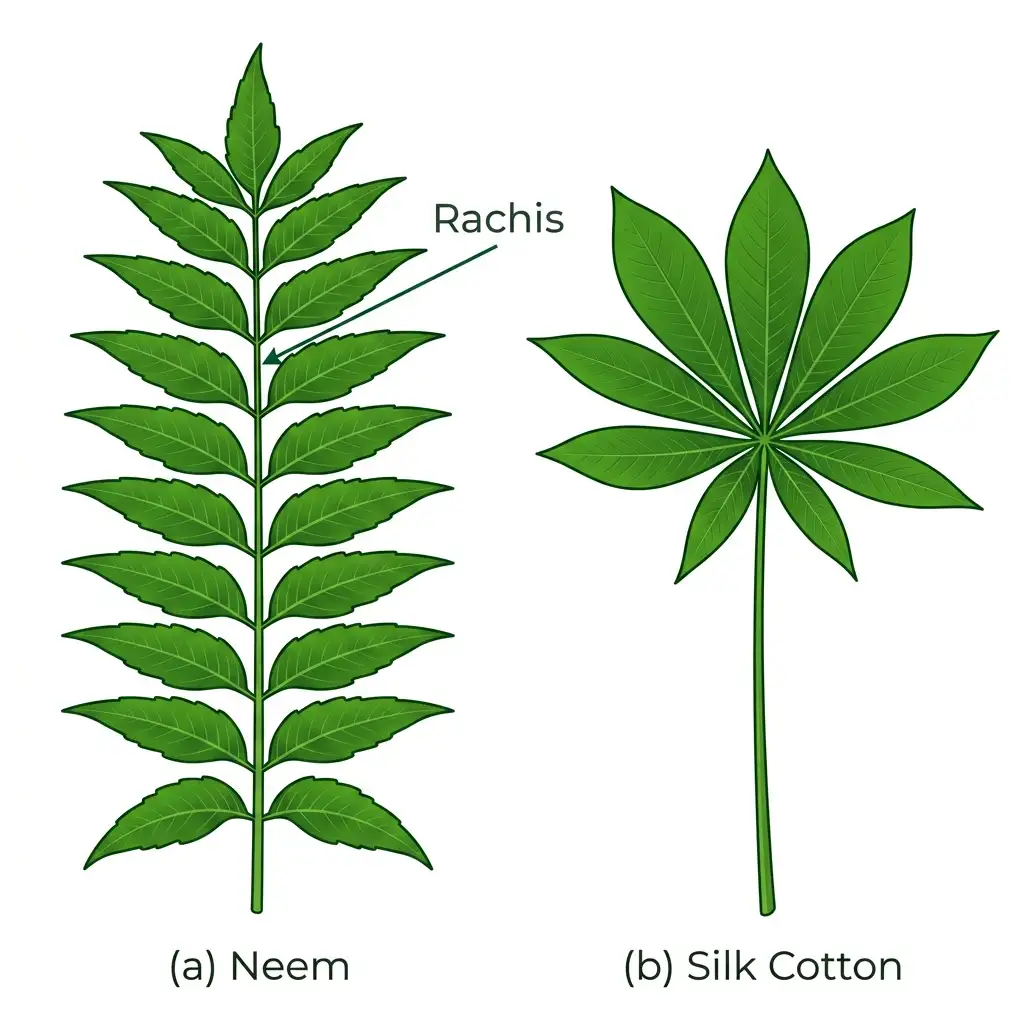
Types of Compound Leaves: (a) Pinnately compound leaf where leaflets are arranged along a central rachis (e.g., Neem), and (b) Palmately compound leaf radiating from a petiole tip (e.g., Silk Cotton).
🔬 Detailed Anatomical Description
In a compound leaf, the lamina is incised down to the midrib, forming distinct leaflets. In pinnately compound leaves, leaflets are attached to a common axis called the rachis (representing the midrib, as in Neem). In palmately compound leaves, leaflets are attached to a single common point at the tip of the petiole (as in Silk Cotton).
E PHYLLOTAXY (ARRANGEMENT OF LEAVES ON STEM/BRANCH)
| TYPE | PATTERN | EXAMPLES |
|---|---|---|
| Alternate | Single leaf at each node, in alternate manner | China rose, Mustard, Sunflower |
| Opposite | Pair of leaves at each node, lying opposite to each other | Calotropis, Guava |
| Whorled | More than two leaves at a node, forming a whorl | Alstonia |
RE-NEET 2026: Phyllotaxy is the pattern of arrangement of leaves on the stem or branch.
Different Types of Phyllotaxy
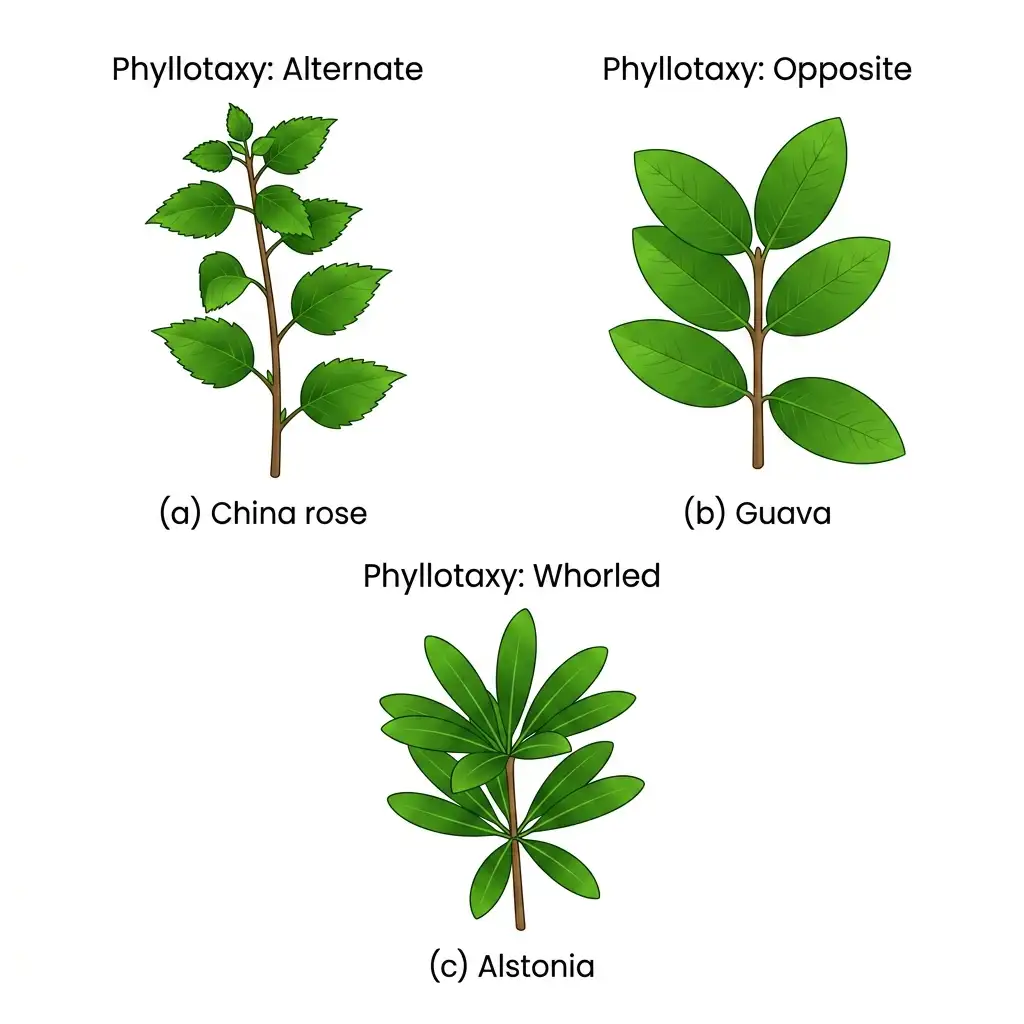
Types of Phyllotaxy: Arrangement of leaves on a stem: (a) Alternate (single leaf per node), (b) Opposite (pair of leaves per node), and (c) Whorled (more than two leaves per node).
🔬 Detailed Anatomical Description
Phyllotaxy refers to the mathematical pattern of leaf arrangement on stem nodes to maximize sunlight interception. It includes: (a) Alternate: Single leaf at each node in a spiral (e.g., China rose, Mustard); (b) Opposite: A pair of leaves at each node facing each other (e.g., Guava, Calotropis); (c) Whorled: Multiple leaves forming a circle at each node (e.g., Alstonia).
F MODIFICATION OF LEAVES
| PURPOSE | MODIFICATION | EXAMPLES |
|---|---|---|
| Climbing | Tendrils | Pea (leaf tendrils) |
| Defence | Spines | Cacti, Opuntia ⭐ |
| Food storage | Fleshy leaves | Onion, Garlic |
| Photosynthesis (petiole modified) | Phyllode | Australian Acacia |
| Trapping insects | Pitcher / Trap | Pitcher plant (Nepenthes), Venus flytrap |
NEET 2017, 2015: Spines of Opuntia = modified LEAVES. The flat green part of Opuntia = modified STEM (phylloclade). NEET 2016: Pitcher of Nepenthes = modified LEAF. NEET 2012: Phyllode = modified PETIOLE (Australian Acacia).
IV. THE INFLORESCENCE
Definition: Arrangement of flowers on the floral axis
- A flower is a modified shoot — shoot apical meristem changes to floral meristem; internodes do not elongate; axis gets condensed.
TWO MAJOR TYPES
| TYPE | MAIN AXIS | FLOWER ORDER | DETAIL |
|---|---|---|---|
| Racemose | Continues to grow (unlimited growth) | Acropetal (younger near apex, older at base) | Flowers borne laterally |
| Cymose | Terminates in a flower (limited growth) | Basipetal (younger at base, older at apex) ⭐ | Main axis has limited growth |
NEET 2017: Inflorescence with younger flowers at base and older ones at apex = CYMOSE (basipetal order). NEET 2012: Cymose inflorescence is present in Solanum. Racemose = acropetal = older at BASE, younger at TOP. Cymose = basipetal = older at TOP, younger at BASE.
Racemose Inflorescence
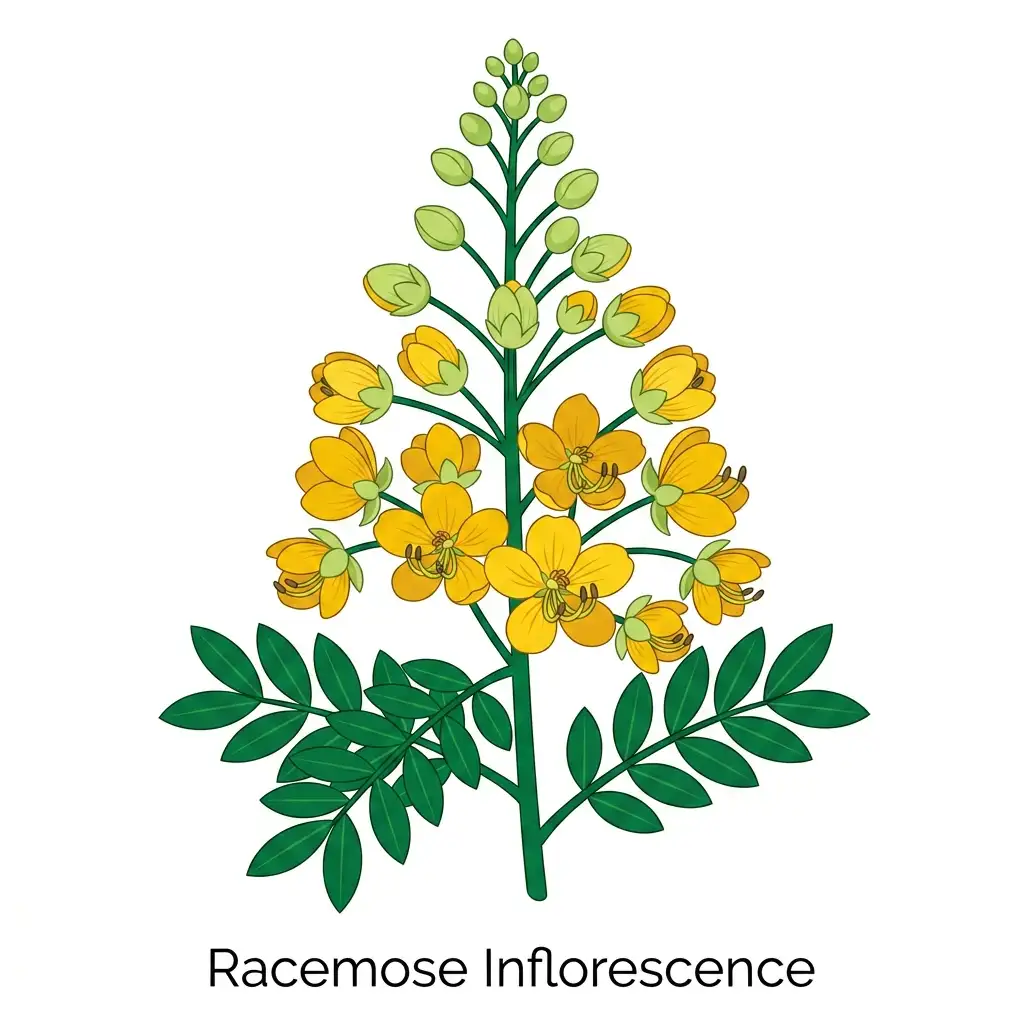
Racemose Inflorescence: The main floral axis (peduncle) continues to grow indefinitely, and flowers are borne laterally in an acropetal succession.
🔬 Detailed Anatomical Description
In a racemose inflorescence, the terminal vegetative bud of the peduncle remains active and continues growing. Flowers are produced laterally. The arrangement is acropetal (younger flowers and buds at the top apex, older open flowers at the base), which is typical of families like Brassicaceae and Fabaceae.
Cymose Inflorescence
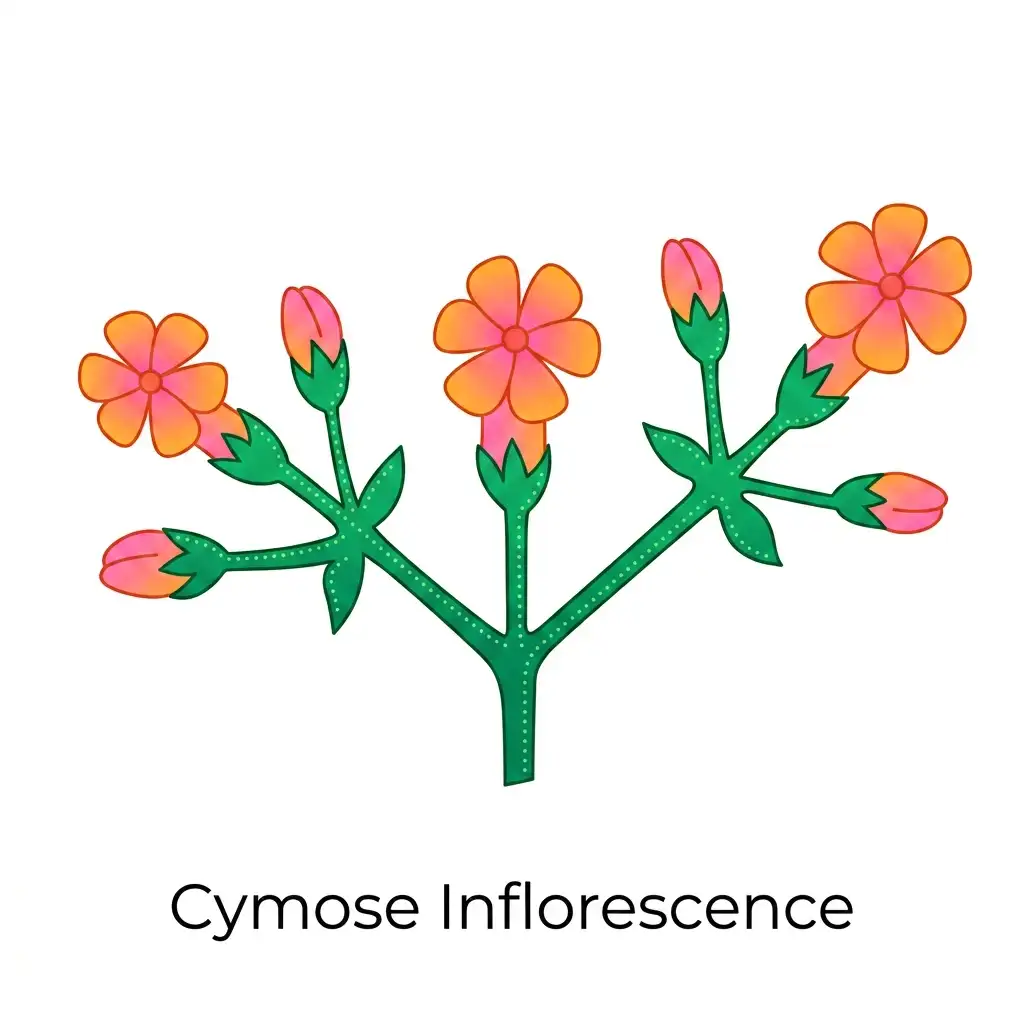
Cymose Inflorescence: The main axis terminates in a flower, which limits its growth, and the flowers are borne in a basipetal order.
🔬 Detailed Anatomical Description
In a cymose inflorescence, the apical meristem of the peduncle terminates in a flower, halting the main axis growth. Subsequent growth occurs via lateral buds, resulting in a basipetal (top-down) succession where older flowers are at the apex and younger buds are at the base. This is a crucial concept in Chapter 5 Morphology of Flowering Plants.
V. THE FLOWER
Definition: Reproductive unit in angiosperms; meant for sexual reproduction; a modified shoot
BASIC TERMINOLOGY
| TERM | DETAIL |
|---|---|
| Pedicel | Stalk of the flower |
| Thalamus / Receptacle | Swollen end of pedicel; all floral whorls arranged on it |
| Bract | Reduced leaf found at the base of pedicel |
| Bracteate | Flower with bracts |
| Ebracteate | Flower without bracts |
| Perianth | When calyx & corolla are not distinct (e.g., Lily) |
FOUR WHORLS (outer to inner)
| WHORL | IDENTITY | NATURE |
|---|---|---|
| Calyx (K) | Sepals | Accessory organ |
| Corolla (C) | Petals | Accessory organ |
| Androecium (A) | Stamens | Reproductive organ (male) |
| Gynoecium (G) | Carpels/Pistil | Reproductive organ (female) |
Parts of a Flower
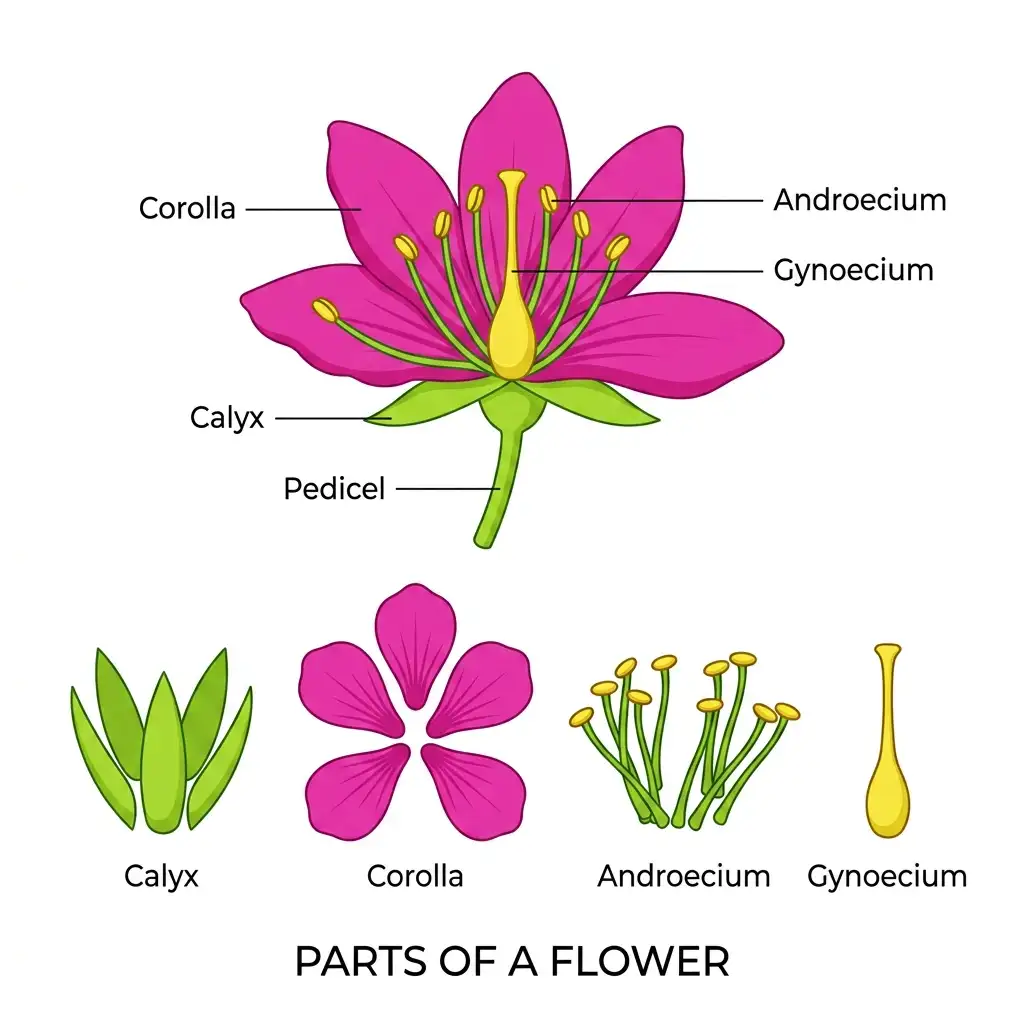
The four main whorls of a typical flower: Calyx (sepals), Corolla (petals), Androecium (stamens), and Gynoecium (carpel/pistil) supported by the pedicel.
🔬 Detailed Anatomical Description
A typical flower consists of four distinct whorls arranged on the swollen end of the stalk (pedicel) called the thalamus. The calyx and corolla are accessory organs, while the androecium (male reproductive unit of stamens) and gynoecium (female reproductive unit of carpels) are essential reproductive organs. This diagram is key for board exams.
SEXUALITY & MEROSITY
| FEATURE | DETAIL | EXAMPLES |
|---|---|---|
| Bisexual | Both androecium & gynoecium present | Most flowers |
| Unisexual | Only stamens OR only carpels | Cucumber, Maize, Papaya |
| Trimerous | Floral parts in multiples of 3 | Typical of monocots |
| Pentamerous | Floral parts in multiples of 5 | Typical of dicots |
A SYMMETRY OF FLOWER
| TYPE | DEFINITION | EXAMPLES |
|---|---|---|
| Actinomorphic (Radial) | Can be divided into two equal halves in any radial plane through centre | Mustard, Datura, Chilli ⭐ |
| Zygomorphic (Bilateral) | Can be divided into two similar halves only in one particular vertical plane | Pea, Gulmohar, Bean, Cassia ⭐ |
| Asymmetric (Irregular) | Cannot be divided into two similar halves by any vertical plane | Canna ⭐ |
NEET 2024, 2022, 2016, 2011: Know examples for each type — very frequently asked! NEET 2025: Pea is zygomorphic (bilateral). Mustard, Datura, Chilli, Petunia are actinomorphic (radial).
B POSITION OF OVARY (EXTREMELY HIGH YIELD)
| FLOWER TYPE | OVARY POSITION | DESCRIPTION | EXAMPLES |
|---|---|---|---|
| Hypogynous | Superior ovary ⭐ | Gynoecium on highest position; other parts below it | Mustard, China rose, Brinjal, Potato, Onion, Tulip |
| Perigynous | Half-inferior ovary ⭐ | Gynoecium in centre; other parts on rim of thalamus at same level | Plum, Rose, Peach |
| Epigynous | Inferior ovary ⭐ | Thalamus margin grows upward enclosing ovary completely; other parts above ovary | Guava, Cucumber, Ray florets of Sunflower |
NEET 2010–2024: This is among the MOST frequently tested topics! Plum & Rose = half-inferior (perigynous). Guava & ray florets of sunflower = inferior (epigynous). China rose = actinomorphic, hypogynous with twisted aestivation. NEET 2026 context: Solanaceae flowers are actinomorphic, bisexual with superior ovary.
Position of Floral Parts on Thalamus
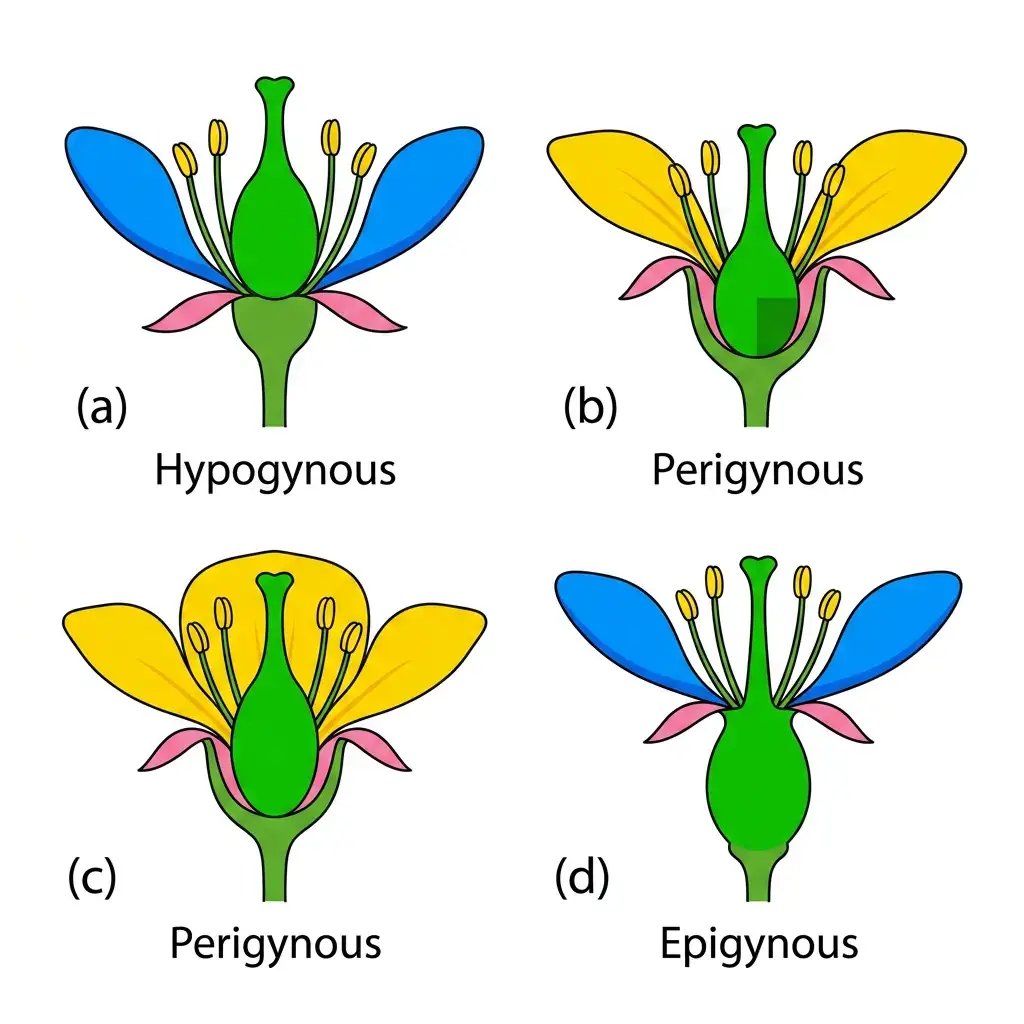
Classification of flowers based on the position of calyx, corolla, and androecium on the thalamus relative to the ovary.
🔬 Detailed Anatomical Description
Flowers are classified into three types based on thalamus position: (a) Hypogynous: Ovary is superior (e.g., Mustard, China rose); (b) & (c) Perigynous: Ovary is half-inferior (e.g., Plum, Rose, Peach); (d) Epigynous: Ovary is inferior (e.g., Guava, Cucumber, Ray florets of sunflower). Essential for understanding plant reproduction and anatomy.
C–D CALYX & COROLLA
| FEATURE | CALYX (OUTERMOST) | COROLLA |
|---|---|---|
| Composed of | Sepals | Petals |
| Colour | Generally green, leaf-like | Usually brightly coloured |
| Function | Protect flower in bud stage | Attract insects for pollination |
| United | Gamosepalous | Gamopetalous |
| Free | Polysepalous | Polypetalous |
E AESTIVATION (VERY HIGH YIELD)
Definition: Mode of arrangement of sepals or petals in a floral bud with respect to other members of the same whorl
| TYPE | DESCRIPTION | EXAMPLES |
|---|---|---|
| Valvate | Margins just touch without overlapping | Calotropis ⭐ |
| Twisted | One margin overlaps the next, and so on (in one direction) | China rose, Lady's finger, Cotton ⭐ |
| Imbricate | Margins overlap one another but not in any particular direction | Cassia, Gulmohar ⭐ |
| Vexillary / Papilionaceous | 5 petals: largest Standard (Vexillum) overlaps 2 lateral Wings which overlap 2 smallest anterior Keel petals | Pea, Bean (Fabaceae) ⭐ |
NEET 2014: Imbricate = margins overlap but NOT in any particular direction. NEET 2016: Standard petal of papilionaceous corolla = Vexillum. NEET 2010, 2024: China rose = twisted aestivation.
Types of Aestivation in Corolla
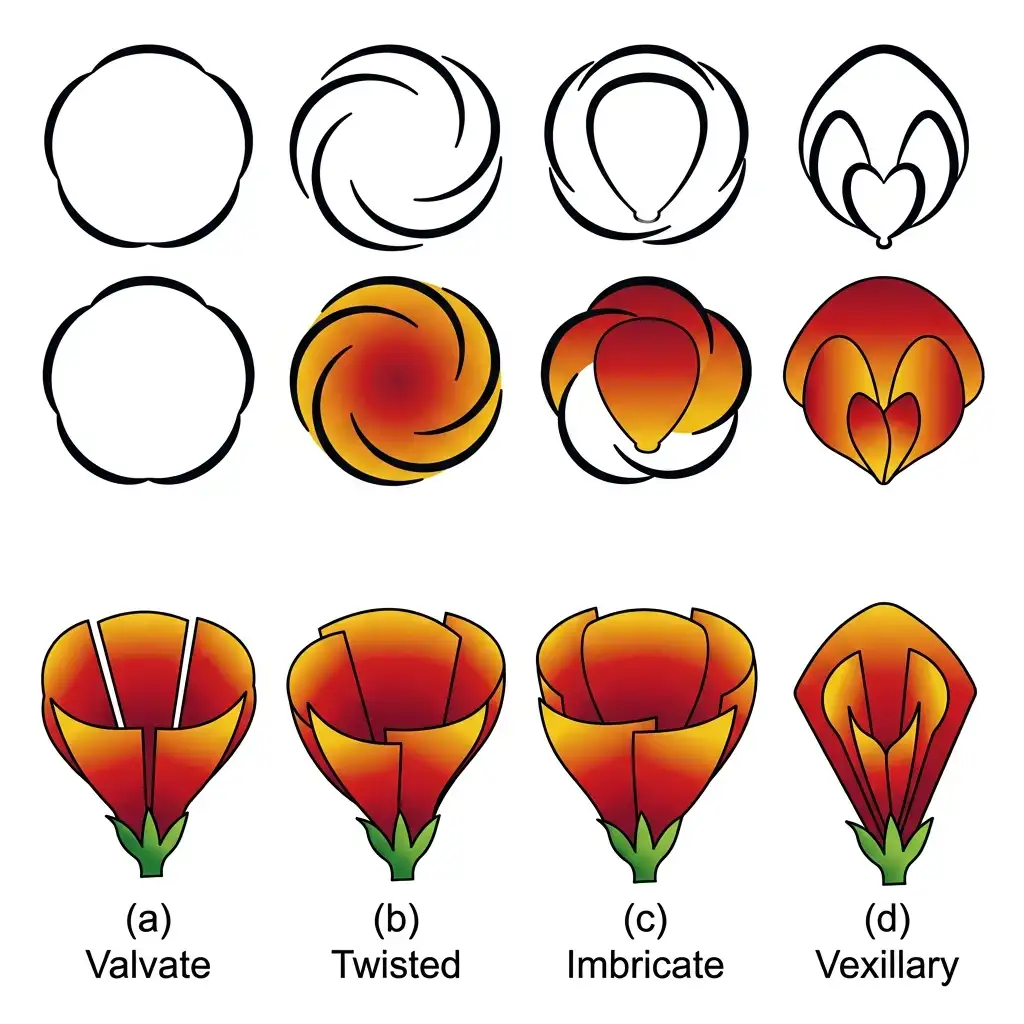
Types of Aestivation: The mode of arrangement of sepals or petals in a floral bud with respect to other members of the same whorl.
🔬 Detailed Anatomical Description
Aestivation patterns include: (a) Valvate: Sepals/petals meet at margins without overlapping (e.g., Calotropis); (b) Twisted: One margin overlaps the next (e.g., China rose, Cotton); (c) Imbricate: Overlapping is irregular (e.g., Cassia, Gulmohur); (d) Vexillary (Papilionaceous): Largest standard petal overlaps lateral wings which overlap the keel (e.g., Pea, Bean). Highly tested in NEET.
F ANDROECIUM (STAMENS)
Each stamen = Filament (stalk) + Anther (usually bilobed; each lobe has 2 pollen sacs)
STAMEN FUSION (AMONG THEMSELVES)
| CONDITION | DESCRIPTION | EXAMPLE |
|---|---|---|
| Polyandrous | Stamens remain free | — |
| Monoadelphous | United into one bundle | China rose ⭐ |
| Diadelphous | United into two bundles (typically 9+1) | Pea (Fabaceae) ⭐ |
| Polyadelphous | United into more than two bundles | Citrus ⭐ |
STAMEN ATTACHMENT (TO OTHER FLORAL PARTS)
| CONDITION | ATTACHED TO | EXAMPLE |
|---|---|---|
| Epipetalous | Petals | Brinjal ⭐ |
| Epiphyllous (Epitepalous) | Perianth (tepals) | Lily ⭐ |
OTHER FEATURES
| FEATURE | DETAIL | EXAMPLE |
|---|---|---|
| Variation in filament length | Stamens of different lengths within a flower | Salvia; Mustard (tetradynamous) |
| Staminode | Sterile stamen (non-functional) | — |
| Tetradynamous | 6 stamens: 2 short + 4 long (characteristic of Brassicaceae) | Mustard, Radish, Turnip ⭐ |
NEET 2017: Tetradynamous = characteristic of Brassicaceae. NEET 2016: Variation in filament length: SALVIA (not Salvinia — Salvinia is a pteridophyte!). NEET 2010, 2021, 2024: Monoadelphous = China rose; Diadelphous = Pea; Polyadelphous = Citrus. RE-NEET 2026 + NEET 2026: Solanaceae family characteristics: Flowers bisexual and actinomorphic; Calyx: five united sepals; Androecium: five epipetalous stamens; Ovary: superior.
G GYNOECIUM (FEMALE REPRODUCTIVE PART)
CARPEL = THREE PARTS
| PART | DETAIL |
|---|---|
| Stigma | Receptive surface for pollen grains (usually at tip of style) |
| Style | Elongated tube connecting ovary to stigma |
| Ovary | Enlarged basal part; bears one or more ovules attached to placenta |
CARPEL FUSION
| CONDITION | DESCRIPTION | EXAMPLES |
|---|---|---|
| Apocarpous | More than one carpel, all FREE | Lotus, Rose, Michelia |
| Syncarpous | More than one carpel, all FUSED | Mustard, Tomato, Papaver |
H PLACENTATION (VERY HIGH YIELD)
Definition: Arrangement of ovules within the ovary
| TYPE | DESCRIPTION | EXAMPLES |
|---|---|---|
| Marginal | Placenta forms ridge along ventral suture of ovary; ovules in two rows | Pea ⭐ |
| Axile | Placenta is axial in a multilocular ovary; ovules attached to central axis | China rose, Tomato, Lemon, Petunia ⭐ |
| Parietal | Ovules develop on inner wall of ovary or peripheral part; ovary one-chambered (may become two by false septum) | Mustard, Argemone ⭐ |
| Free central | Ovules on central axis; septa ABSENT | Dianthus, Primrose ⭐ |
| Basal | Placenta at base of ovary; single ovule attached; unilocular ovary | Sunflower, Marigold ⭐ |
NEET 2019: Parietal placentation = ovules on inner wall of ovary. NEET 2010: Unilocular ovary with single ovule = BASAL placentation. NEET 2024, NEET 2026: Marginal = Pea; Axile = China rose/Tomato/Lemon; Parietal = Mustard/Argemone; Free central = Dianthus/Primrose; Basal = Sunflower/Marigold.
Types of Placentation
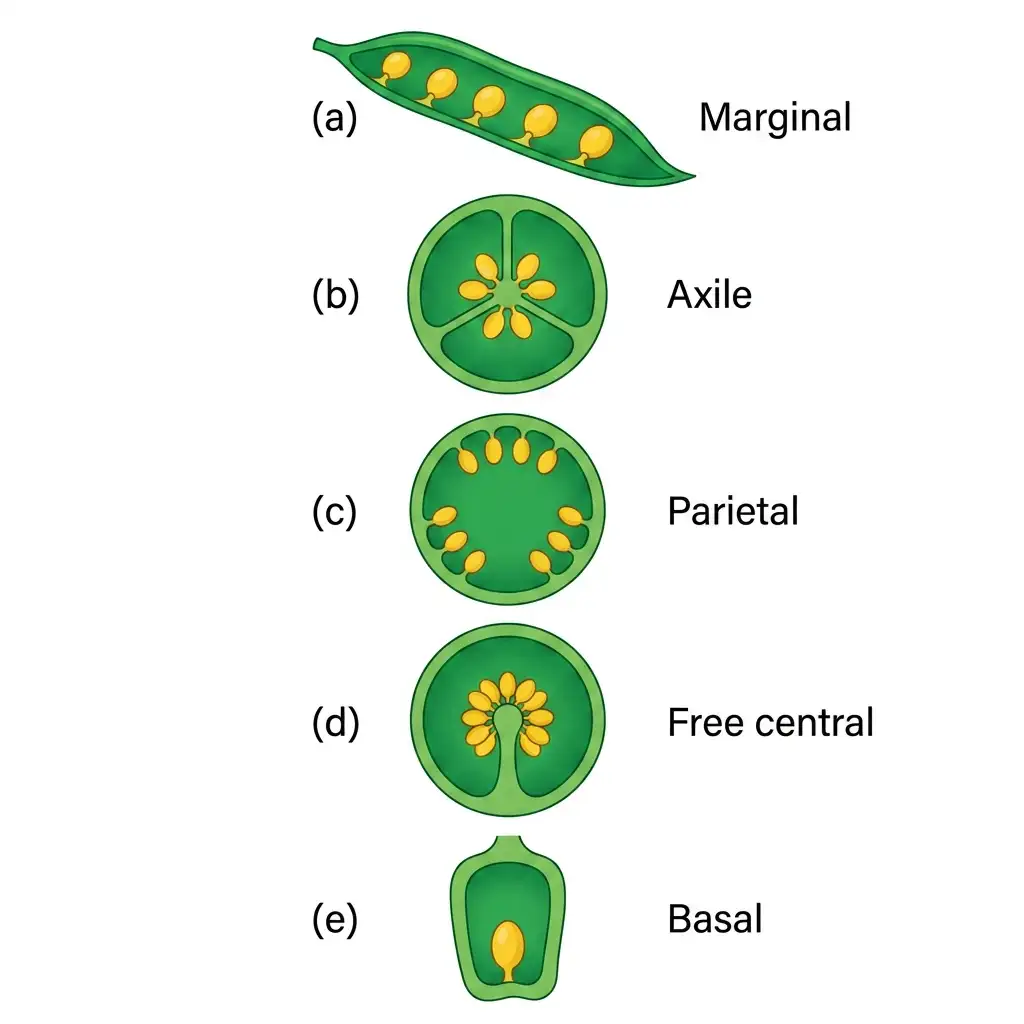
Types of Placentation: The distinct patterns of arrangement of ovules inside the ovary cavity.
🔬 Detailed Anatomical Description
Placentation patterns include: (a) Marginal: Placenta forms a ridge along ventral suture (e.g., Pea); (b) Axile: Multilocular ovary with central axis placenta (e.g., Tomato, China rose, Lemon); (c) Parietal: Cultivated along inner ovary walls (e.g., Mustard, Argemone); (d) Free Central: On central column with no walls (e.g., Primrose, Dianthus); (e) Basal: One ovule at base of chamber (e.g., Sunflower, Marigold).
VI. THE FRUIT
Definition: Mature or ripened ovary, developed after fertilisation
- Parthenocarpic fruit: Formed without fertilisation of the ovary
PERICARP (FRUIT WALL)
| LAYER | POSITION | DETAIL |
|---|---|---|
| Epicarp | Outer | Outermost layer |
| Mesocarp | Middle | Can be fleshy or fibrous |
| Endocarp | Inner | Can be stony or membranous |
Pericarp differentiation into three layers occurs when it is thick & fleshy.
DRUPE (Very High Yield)
Develops from monocarpellary superior ovary; one-seeded.
| DRUPE | EPICARP | MESOCARP | ENDOCARP |
|---|---|---|---|
| Mango | Thin outer skin | Fleshy, edible ⭐ | Stony hard |
| Coconut | Thin outer layer | Fibrous (used commercially) ⭐ | Hard shell |
NEET 2017, 2024: Mango & Coconut = Drupe; both from monocarpellary superior ovary, one-seeded. Mango edible part = mesocarp (fleshy). Coconut mesocarp = fibrous.
Parts of a Fruit (Mango and Coconut)
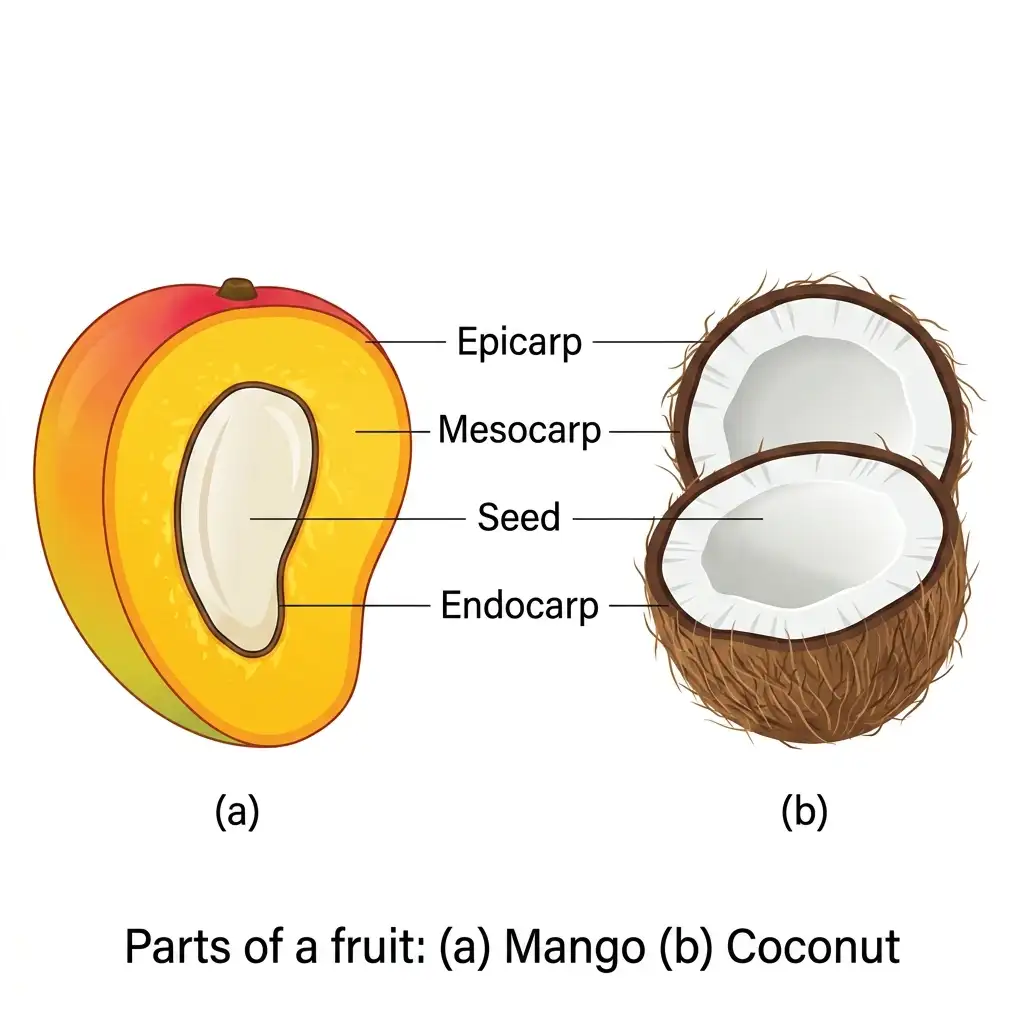
Morphological parts of a drupe fruit, showing the differentiation of the pericarp in mango (edible mesocarp) and coconut (fibrous mesocarp).
🔬 Detailed Anatomical Description
In mango and coconut, the fruit is a drupe, which develops from a monocarpellary superior ovary. The pericarp wall is differentiated into a thin outer epicarp, a middle mesocarp (fleshy and edible in mango; fibrous in coconut), and an inner stony hard endocarp enclosing a single seed. Perfect educational comparison.
AGGREGATE FRUIT
- Develops from multicarpellary, apocarpous gynoecium (each free carpel → fruitlet).
- ⭐ Example: Raspberry.
NEET 2014: Aggregate fruit = from multicarpellary APOCARPOUS gynoecium (not syncarpous!).
EDIBLE PARTS — QUICK RECALL
| FRUIT / PLANT | EDIBLE PART |
|---|---|
| Mango | Mesocarp (fleshy) |
| Coconut | Endosperm (white kernel) ⭐ |
| Tomato | Placenta + Pericarp (both edible) ⭐ |
NEET 2014: In Tomato — placenta AND pericarp are both edible portions. NEET 2017: Edible part of Coconut = Endosperm.
VII. THE SEED
Definition: Ovules after fertilisation develop into seeds
Seed = Seed coat + Embryo (radicle + embryonal axis + cotyledons)
| TYPE | COTYLEDONS | EXAMPLES |
|---|---|---|
| Monocotyledonous | One | Wheat, Maize |
| Dicotyledonous | Two | Gram, Pea |
A STRUCTURE OF DICOTYLEDONOUS SEED
| STRUCTURE | DETAIL |
|---|---|
| Seed coat | Outermost covering; two layers: outer = Testa, inner = Tegmen |
| Hilum | Scar on seed coat through which seed was attached to fruit |
| Micropyle | Small pore above hilum (for water & O₂ entry) |
| Embryo | Embryonal axis + two cotyledons |
| Cotyledons | Often fleshy & swollen (store food reserves, esp. in legumes) |
| Radicle | At one end of embryonal axis (forms root) ⭐ |
| Plumule | At other end (forms shoot) |
ENDOSPERM IN DICOTS
| TYPE | DETAIL | EXAMPLES |
|---|---|---|
| Endospermic (Albuminous) | Endosperm persists as food-storing tissue | Castor |
| Non-endospermic (Exalbuminous) | Endosperm completely consumed during embryo development | Bean, Gram, Pea |
NEET 2025: Non-albuminous (exalbuminous) seeds = Pea (endosperm completely consumed).
Structure of a Dicotyledonous Seed
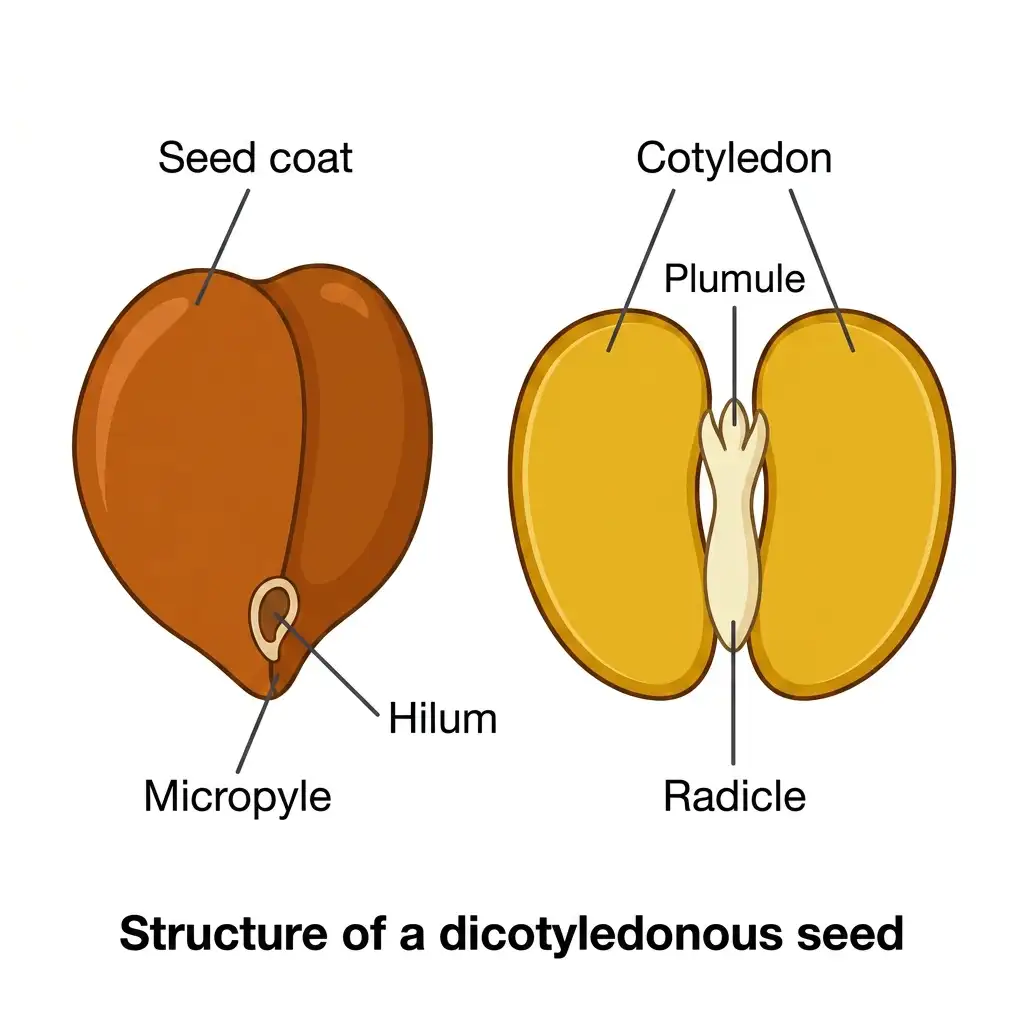
The anatomy of a typical dicot seed (e.g., gram), highlighting the protective seed coat, hilum scar, micropyle pore, and inner embryo with cotyledons, plumule, and radicle.
🔬 Detailed Anatomical Description
The outermost covering of a dicotyledonous seed is the seed coat, containing an outer testa and inner tegmen. The hilum is a scar where the seed was attached to the fruit wall, and the micropyle is a pore for water/oxygen entry. Inside, the embryo comprises an embryonal axis with a plumule (shoot-tip), radicle (root-tip), and two fleshy cotyledons stored with food reserves.
B STRUCTURE OF MONOCOTYLEDONOUS SEED
| STRUCTURE | DETAIL |
|---|---|
| Seed coat | Membranous; generally fused with fruit wall (pericarp) |
| Endosperm | Bulky; stores food |
| Aleurone layer ⭐ | Proteinaceous outer covering of endosperm; separates embryo from endosperm |
| Embryo | Small; situated in a groove at one end of endosperm |
| Scutellum ⭐ | One large, shield-shaped cotyledon |
| Coleoptile | Sheath enclosing plumule (shoot apex) |
| Coleorhiza | Sheath enclosing radicle (root) |
NEET 2010, 2025: Cotyledon of Maize = Scutellum. NEET 2014, 2025 context: Aleurone layer = proteinaceous layer; outer covering of endosperm in monocots. NEET 2024: Generally monocot seeds are endospermic but some (orchids) are non-endospermic. NEET 2013: Coconut = THICK seed coat (not thin like maize/gram).
Structure of a Monocotyledonous Seed
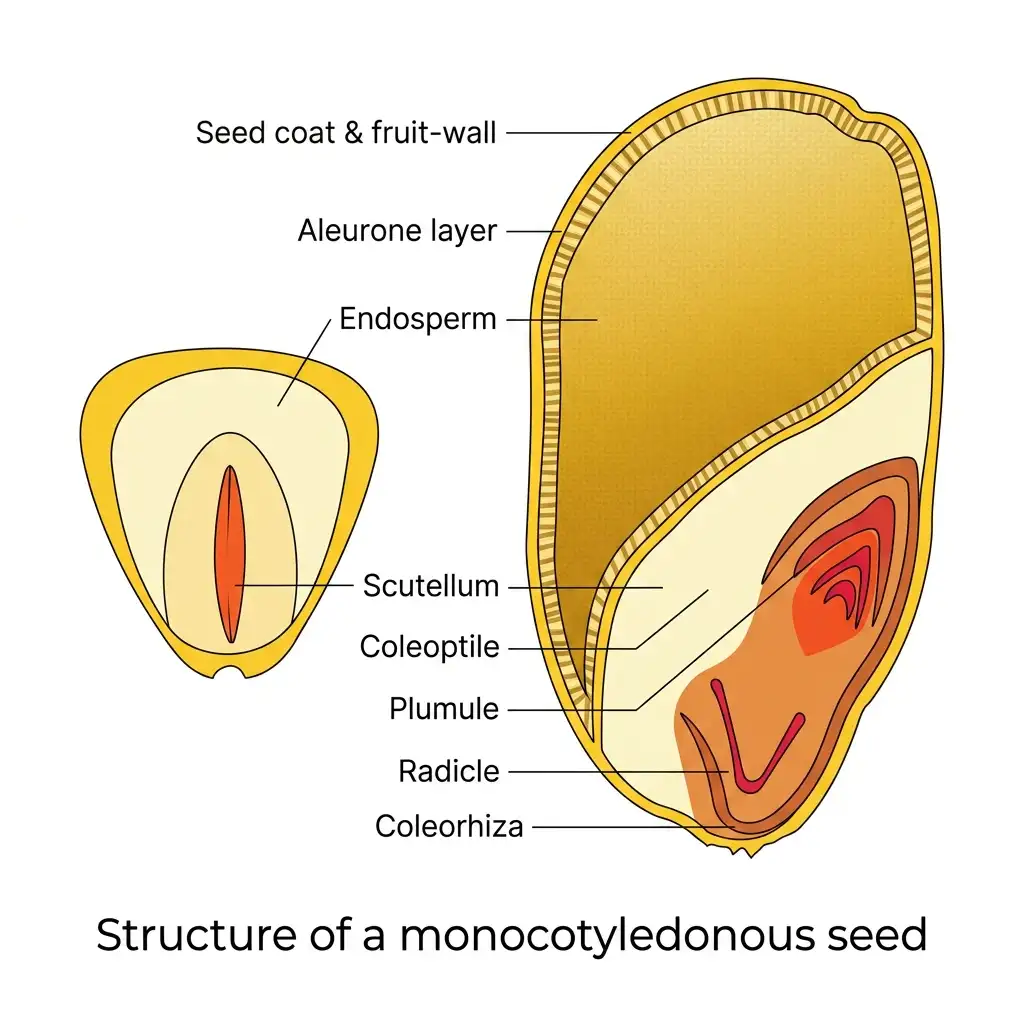
Detailed longitudinal section of a monocot seed (e.g., maize), showcasing the large endosperm, protein-rich aleurone layer, single cotyledon (scutellum), and protective sheaths: coleoptile and coleorhiza.
🔬 Detailed Anatomical Description
Monocotyledonous seeds (mostly endospermic) are characterized by a fused seed coat and fruit wall. The endosperm acts as a massive food storage tissue, bounded by a proteinaceous aleurone layer. The small embryo rests in an endosperm groove and contains one shield-shaped cotyledon (scutellum) and a short embryonal axis. The plumule is shielded by a coleoptile, and the radicle is shielded by a coleorhiza.
VIII. FLORAL FORMULA & SYMBOLS
| SYMBOL | MEANING |
|---|---|
| Br | Bracteate |
| K | Calyx |
| C | Corolla |
| P | Perianth (when calyx & corolla not distinct) |
| A | Androecium |
| G | Gynoecium |
| G with line above | Superior ovary |
| G with line below | Inferior ovary |
| Circle-plus (⊕) | Actinomorphic |
| % | Zygomorphic |
| ( ) around number | Fusion (united) |
| Line above symbol | Adhesion (attachment to another whorl) |
| Male symbol (♂) | Male |
| Female symbol (♀) | Female |
| Both symbol (⚥) | Bisexual |
Floral Diagram and Formula
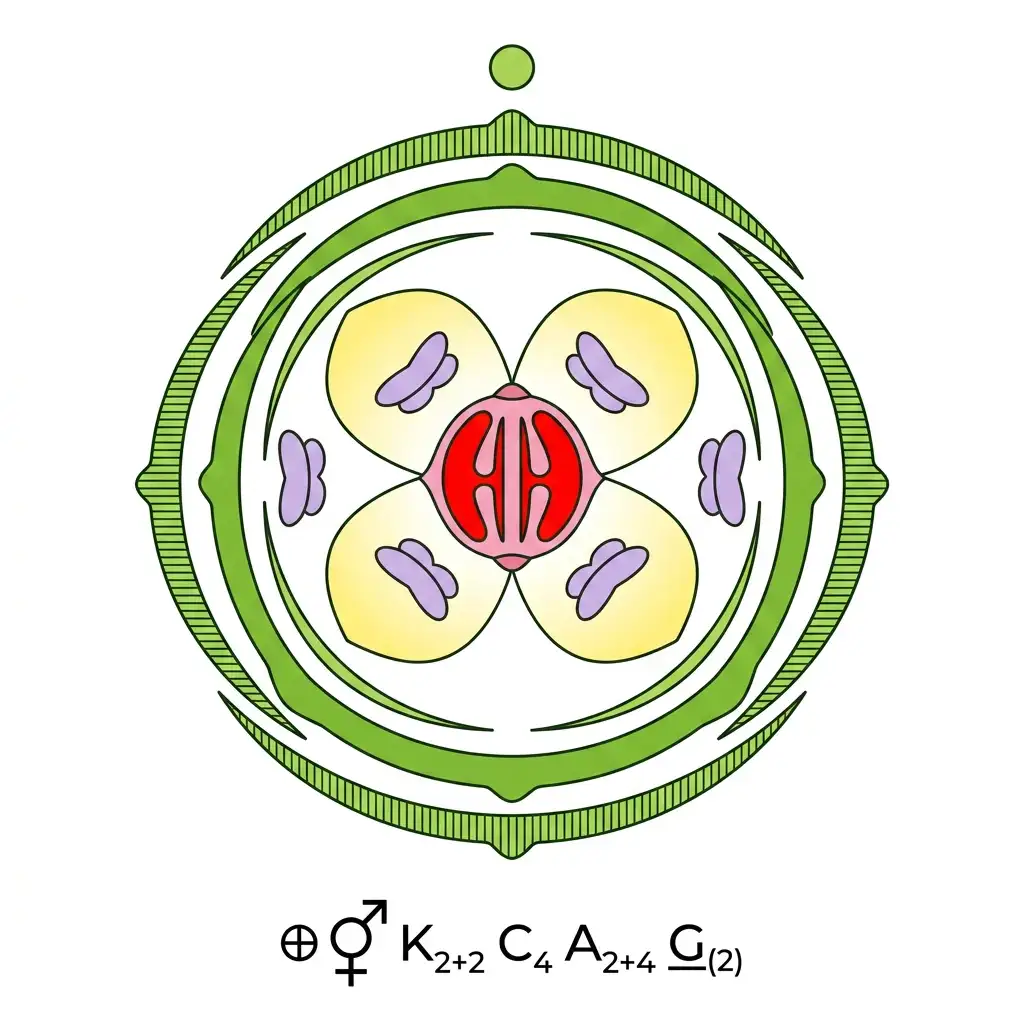
Symmetrical floral diagram and standard floral formula representing a typical mustard flower (Family Brassicaceae) with its complete floral layout.
🔬 Detailed Anatomical Description
A floral diagram is a schematic representation of a flower's cross-section, illustrating the number, arrangement, and relation of floral organs (calyx, corolla, androecium, gynoecium) relative to the mother axis (indicated by a top dot). The mustard formula: ⊕ ⚥ K(2+2) C4 A(2+4) G_(2) represents actinomorphic symmetry, bisexual organs, 2+2 sepals, 4 petals, tetradynamous stamens, and syncarpous superior ovary.
IX. IMPORTANT PLANT FAMILIES — MASTER COMPARISON
| FEATURE | FABACEAE (PEA FAMILY) | SOLANACEAE (POTATO FAMILY) | LILIACEAE (LILY FAMILY) | BRASSICACEAE (MUSTARD FAMILY) |
|---|---|---|---|---|
| Type | Dicot | Dicot | Monocot | Dicot |
| Stipules | Stipulate ⭐ | Exstipulate | Exstipulate | — |
| Inflorescence | Racemose | Cymose | Cymose (often umbellate) | Racemose |
| Symmetry | Zygomorphic (%) | Actinomorphic (⊕) | Actinomorphic (⊕) | Actinomorphic (⊕) |
| Calyx aestivation | Valvate / Imbricate | Valvate | — | — |
| Corolla / Perianth | Polypetalous | Gamopetalous | Perianth (tepals) | Polypetalous |
| Corolla aestivation | Vexillary (Papilionaceous) ⭐ | Valvate | Valvate (tepal) | — |
| Androecium | Diadelphous (9+1); dithecous ⭐ | 5 stamens, epipetalous | 6 stamens (3+3) | Tetradynamous (2+4) ⭐ |
| Gynoecium | Monocarpellary, unilocular, many ovules | Bicarpellary, syncarpous, superior, bilocular | Tricarpellary, syncarpous, superior | Bicarpellary, syncarpous, superior |
| Placentation | Marginal ⭐ | Axile ⭐ | Axile ⭐ | Parietal (false septum) |
| Fruit | Legume | Berry / Capsule | Rarely berry | Siliqua |
| Seeds | Non-endospermic ⭐ | Endospermic | Endospermic | — |
FLORAL FORMULAE
| FAMILY | FLORAL FORMULA |
|---|---|
| Fabaceae | % ⚥ K(5) C1+2+(2) A(9)+1 G₁ (superior) |
| Solanaceae | ⊕ ⚥ K(5) C(5) A5 G(₂) (superior) |
| Liliaceae | Br ⊕ ⚥ P(3+3) A3+3 G(₃) (superior) |
| Brassicaceae | ⊕ ⚥ K2+2 C4 A2+4 G(₂) (superior) |
ECONOMIC IMPORTANCE — SOLANACEAE
| USE | EXAMPLES |
|---|---|
| Food | Tomato, Brinjal, Potato |
| Spice | Chilli |
| Medicine | Belladonna, Ashwagandha |
| Fumigatory | Tobacco |
| Ornamental | Petunia |
KEY DISTINGUISHING FEATURES (For Quick MCQ Solving)
| IF YOU SEE THIS... | THINK THIS FAMILY... |
|---|---|
| Vexillary/Papilionaceous aestivation | Fabaceae |
| Diadelphous (9+1) stamens | Fabaceae |
| Marginal placentation | Fabaceae |
| Non-endospermic seeds + Legume fruit | Fabaceae |
| Zygomorphic + Monocarpellary | Fabaceae |
| Epipetalous stamens + Bicarpellary syncarpous | Solanaceae |
| Cymose + Gamopetalous + Berry/Capsule | Solanaceae |
| Tetradynamous (2+4) stamens | Brassicaceae |
| Tricarpellary + Perianth (tepals) | Liliaceae |
| Epiphyllous stamens | Liliaceae |
NEET 2023: Fabaceae = Diadelphous (9+1) stamens + dithecous anthers. NEET 2016: Liliaceae = Tricarpellary, syncarpous, superior ovary. NEET 2026, RE-NEET 2026: Solanaceae — actinomorphic + epipetalous stamens + superior ovary. Solanaceae = K(5) C(5) A5 G superior (actinomorphic, bisexual).
Solanum nigrum (Makoi) Plant Structure
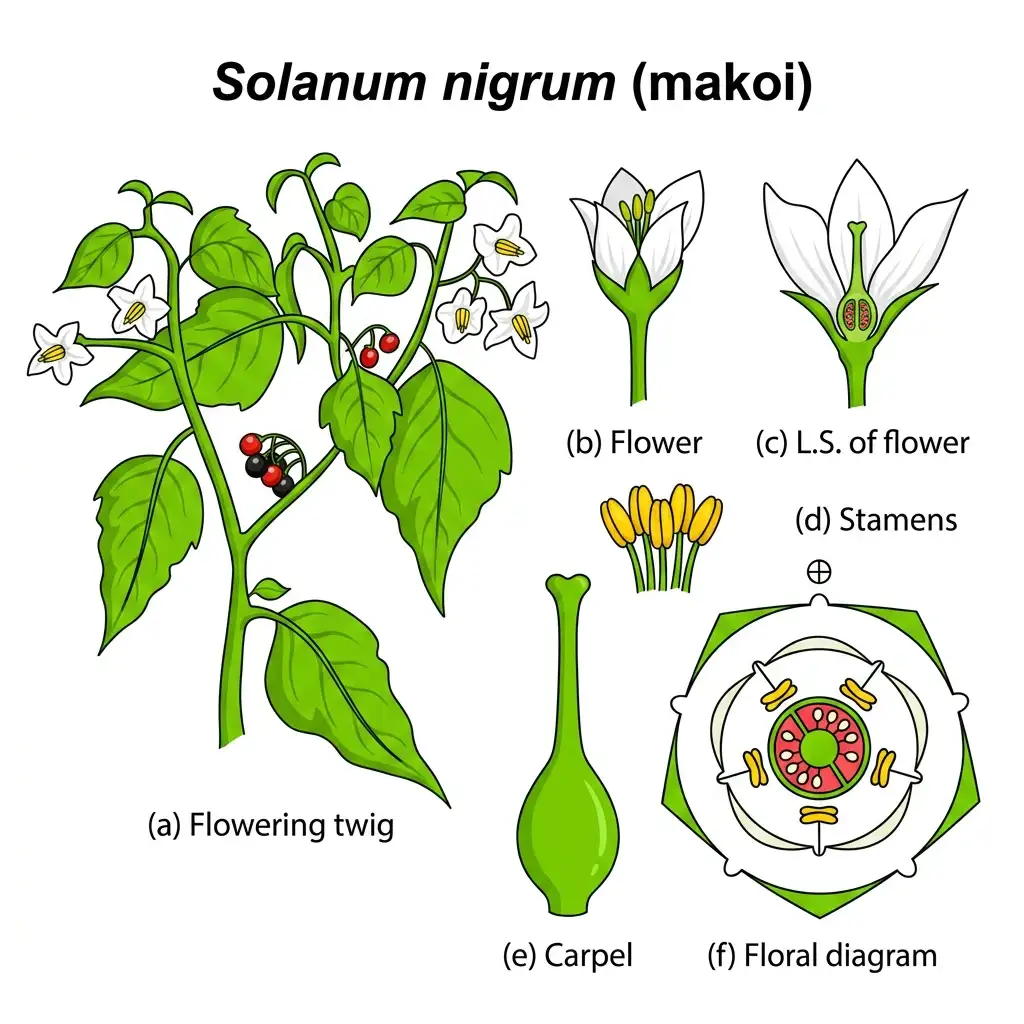
Comprehensive taxonomic analysis of Solanum nigrum (makoi) from the Solanaceae family, showing habit, flower structure, stamens, carpel, and floral diagram.
🔬 Detailed Anatomical Description
Solanum nigrum (makoi) serves as a classic textbook model for the Solanaceae family. This figure details: (a) Flowering twig (habit), (b) Flower showing five fused petals, (c) Longitudinal section showing epipetalous stamens and superior ovary, (d) Epipetalous stamens, (e) Carpel with bilocular ovary, and (f) Floral diagram with five calyx and five corolla members.
X. KATHERINE ESAU (1898-1997)
(Rarely appears in NEET)
| DETAIL | FACT |
|---|---|
| Born | 1898, Ukraine |
| Studied | Agriculture in Russia & Germany |
| Doctorate | 1931 in United States |
| Early discovery | Curly top virus spreads through phloem tissue |
| Major publications | Plant Anatomy (1954); Anatomy of Seed Plants (1960) — referred to as 'Webster's of plant biology' |
| Approach | Dynamic, developmental approach to plant structure |
| Honours | Elected to National Academy of Sciences (1957) — sixth woman to receive that honour |
| Medal | National Medal of Science from President George Bush (1989) |
| Legacy | 'Absolutely dominated' field of plant biology even at age 99 (remembered by Peter Raven) |
| Died | 1997 |
XI. RAPID REVISION — ALL EXAMPLES TABLE
| CATEGORY | EXAMPLES |
|---|---|
| Tap root system | Mustard |
| Fibrous root system | Wheat |
| Adventitious roots | Grass, Monstera, Banyan tree |
| Modified tap root (food) | Carrot, Turnip |
| Modified adventitious root | Sweet potato |
| Prop roots (support) | Banyan tree |
| Stilt roots (support) | Maize, Sugarcane |
| Pneumatophores | Rhizophora (halophyte, swampy areas) |
| Underground stem — Tuber | Potato |
| Underground stem — Rhizome | Ginger, Turmeric |
| Underground stem — Corm | Zaminkand, Colocasia |
| Stem tendril | Cucumber, Pumpkin, Watermelon, Grapevine |
| Stem thorn | Citrus, Bougainvillea |
| Phylloclade | Opuntia (flat), Euphorbia (cylindrical) |
| Offset | Pistia, Eichhornia |
| Sucker | Banana, Pineapple, Chrysanthemum |
| Runner | Grass, Strawberry |
| Leaf tendril | Pea |
| Leaf spine | Cacti, Opuntia |
| Fleshy leaves (food) | Onion, Garlic |
| Phyllode | Australian Acacia |
| Insect trap (leaf) | Nepenthes (Pitcher plant), Venus flytrap |
| Pinnately compound leaf | Neem |
| Palmately compound leaf | Silk cotton |
| Alternate phyllotaxy | China rose, Mustard, Sunflower |
| Opposite phyllotaxy | Calotropis, Guava |
| Whorled phyllotaxy | Alstonia |
| Reticulate venation | Dicots (general) |
| Parallel venation | Monocots (general) |
| Cymose inflorescence | Solanum |
| Actinomorphic flowers | Mustard, Datura, Chilli |
| Zygomorphic flowers | Pea, Gulmohar, Bean, Cassia |
| Asymmetric flower | Canna |
| Hypogynous (superior) | Mustard, China rose, Brinjal, Potato, Onion, Tulip |
| Perigynous (half-inferior) | Plum, Rose, Peach |
| Epigynous (inferior) | Guava, Cucumber, Ray florets of Sunflower |
| Valvate aestivation | Calotropis |
| Twisted aestivation | China rose, Lady's finger, Cotton |
| Imbricate aestivation | Cassia, Gulmohar |
| Vexillary aestivation | Pea, Bean (Fabaceae) |
| Monoadelphous | China rose |
| Diadelphous (9+1) | Pea |
| Polyadelphous | Citrus |
| Epipetalous | Brinjal |
| Epiphyllous | Lily |
| Tetradynamous (2+4) | Mustard (Brassicaceae) |
| Staminode | Sterile stamen |
| Apocarpous gynoecium | Lotus, Rose, Michelia |
| Syncarpous gynoecium | Mustard, Tomato, Papaver |
| Marginal placentation | Pea |
| Axile placentation | China rose, Tomato, Lemon, Petunia |
| Parietal placentation | Mustard, Argemone |
| Free central placentation | Dianthus, Primrose |
| Basal placentation | Sunflower, Marigold |
| Drupe fruit | Mango, Coconut |
| Aggregate fruit | Raspberry (from apocarpous gynoecium) |
| Scutellum (monocot) | Maize |
| Aleurone layer | Maize (monocot seed) |
| Thin seed coat | Maize, Gram, Groundnut |
| Thick seed coat | Coconut |
| Endospermic dicot seed | Castor |
| Non-endospermic dicot | Bean, Gram, Pea |
| Non-endospermic monocot | Orchids |
XII. COMMON EXAM TRAPS — QUICK REFERENCE
| TRAP / QUESTION | CORRECT ANSWER |
|---|---|
| Potato is a root or stem? | STEM (underground tuber) |
| Sweet potato — root or stem? | ROOT (modified adventitious root) |
| Ginger — root or stem? | STEM (underground rhizome) |
| Opuntia spine — leaf or stem? | LEAF (modified into spine) |
| Opuntia flat green part? | STEM (phylloclade) |
| Bougainvillea thorn? | STEM (modified axillary bud) |
| Pea tendril — leaf or stem? | LEAF |
| Cucumber tendril? | STEM |
| Phyllode — leaf or stem? | PETIOLE (part of leaf) |
| Phylloclade — leaf or stem? | STEM |
| Pitcher (Nepenthes)? | LEAF |
| Plum ovary — superior or inferior? | HALF-INFERIOR (perigynous) |
| China rose aestivation? | TWISTED (not valvate) |
| Calotropis aestivation? | VALVATE |
| Salvia or Salvinia for stamen length variation? | SALVIA (Salvinia is a pteridophyte!) |
| Monocot seeds always endospermic? | NO — orchids are non-endospermic |
| Coconut seed coat? | THICK (not thin like maize/gram) |
| Tomato edible part? | Both PLACENTA & PERICARP are edible |
| Aggregate fruit from syncarpous or apocarpous? | APOCARPOUS (free carpels → separate fruitlets) |
- RE-NEET 2026 / reinforced: Sweet potato = modified adventitious root (not stem/tuber). Potato = underground stem modification (tuber with eyes).
- RE-NEET 2026 / NEET 2026: Pneumatophores occur in halophytes (e.g., Rhizophora) in swampy/marshy areas; grow vertically upward to get O₂.
- RE-NEET 2026: Phyllotaxy is the pattern of arrangement of leaves on the stem or branch.
- NEET 2025: Pea is zygomorphic (bilateral). Mustard, Datura, Chilli, Petunia are actinomorphic (radial).
- NEET 2026 context / reinforced: Solanaceae flowers are actinomorphic, bisexual with superior ovary. Formula = ⊕ ⚥ K(5) C(5) A5 G(₂̄) — superior ovary.
- NEET 2026: Placentation matches — Marginal = Pea; Axile = Lemon/China rose/Tomato; Parietal = Mustard; Basal = Marigold.
- NEET 2025: Scutellum = cotyledon of monocot seed (Maize); Non-albuminous (exalbuminous) seeds = Pea.
- NEET 2025 context: Aleurone layer = proteinaceous outer covering of endosperm in monocot seeds.