I. INTRODUCTION & EARLY EXPERIMENTS
A BASICS
| FEATURE | DETAIL |
|---|---|
| Photosynthesis | Physico-chemical process by which green plants use light energy to drive synthesis of organic compounds ⭐ |
| Autotrophs | Green plants = autotrophs (synthesise their own food) ⭐ |
| Heterotrophs | All other organisms dependent on green plants ⭐ |
| Importance | (1) Primary source of all food on Earth; (2) Responsible for release of O₂ into atmosphere ⭐ |
| Half-leaf experiment | Shows that CO₂ is required for photosynthesis (KOH absorbs CO₂) ⭐ |
B KEY SCIENTISTS & EXPERIMENTS
| SCIENTIST | CONTRIBUTION |
|---|---|
| Joseph Priestley (1770) | Proposed concept of gaseous exchange by plants; bell jar experiment — mint plant restored air damaged by candle/mouse; discovered oxygen (1774) ⭐⭐ |
| Jan Ingenhousz | Showed importance of sunlight and green colour; green parts release O₂ only in bright sunlight ⭐⭐ |
| Julius von Sachs | Provided evidence for production of glucose; glucose usually stored as starch; green substance (chlorophyll) located in chloroplasts ⭐⭐ |
| T.W. Engelmann | First action spectrum of photosynthesis; used prism + green alga Cladophora + aerobic bacteria; bacteria accumulated in blue and red light regions ⭐⭐ |
| Cornelius van Niel | Studied purple & green sulphur bacteria; demonstrated O₂ evolved comes from H₂O, NOT from CO₂ ⭐⭐⭐ |
RE-NEET 2026 (reinforced): Correct historical sequence is Role of air by Priestley (1770) → O₂ release by Ingenhousz → Glucose production by von Sachs → Absorption spectra by Engelmann.
NEET 2014, 2026 (reinforced): Anoxygenic photosynthesis in Rhodospirillum (purple non-sulfur bacterium) — does NOT release O₂. O₂ evolved in green plants comes from H₂O, NOT CO₂!
Van Niel's General Equation ⭐⭐
Correct Overall Equation ⭐⭐
Priestley's Bell Jar Experiment
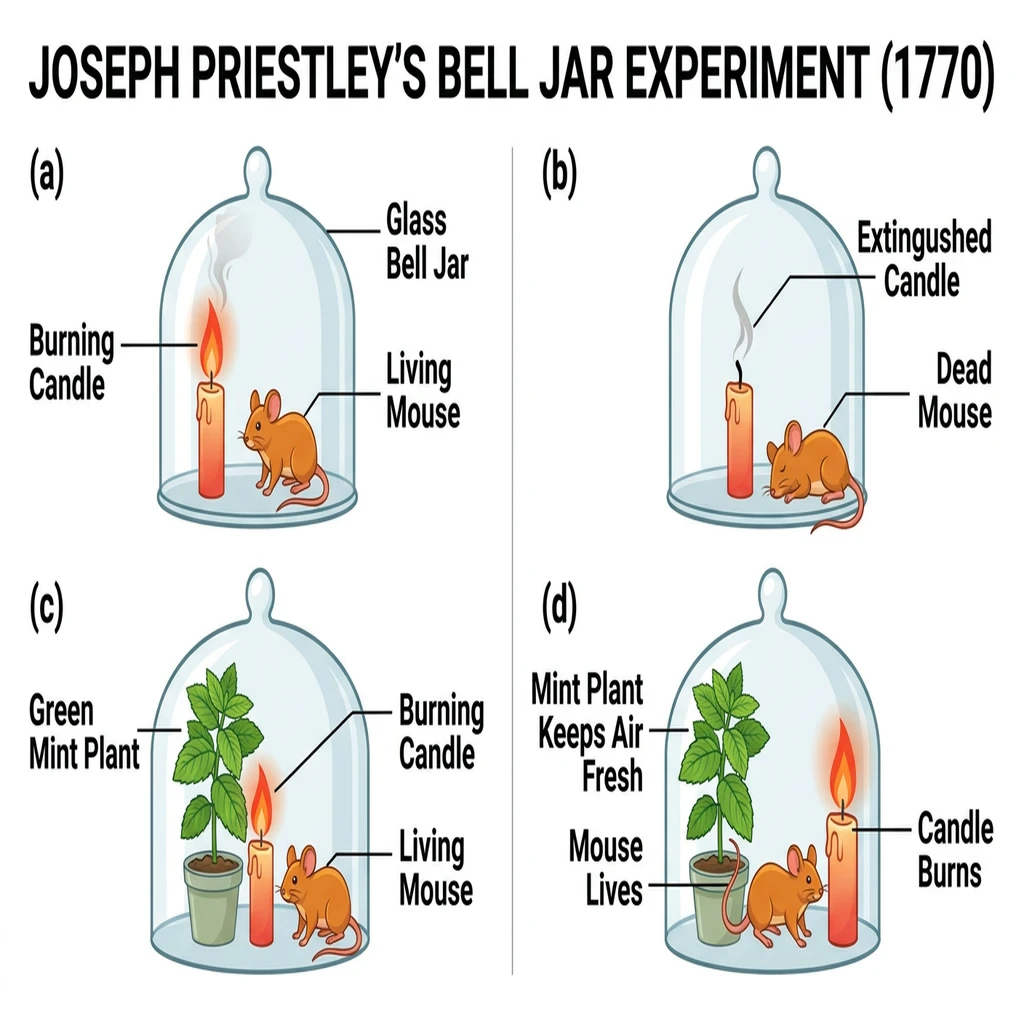
Priestley's Experiment: Demonstrates how plants restore oxygen to the air, allowing a candle to burn and a mouse to live.
🔬 Detailed Biochemical & Structural Description
Joseph Priestley's landmark 1770 experiment revealed the role of air in plant growth. (a) A burning candle and mouse in a closed bell jar soon suffocate/extinguish. (b) The candle goes out and the mouse dies. (c) Placing a mint plant inside restores the air. (d) Both the mouse survives and the candle continues to burn, demonstrating that plants release oxygen during photosynthesis.
II. WHERE DOES PHOTOSYNTHESIS TAKE PLACE?
A CHLOROPLAST — DIVISION OF LABOUR
| FEATURE | DETAIL |
|---|---|
| In leaves | Mesophyll cells have large number of chloroplasts ⭐ |
| Chloroplast alignment | Along walls of mesophyll cells for optimum light ⭐ |
| Membranous system | Responsible for trapping light energy + synthesis of ATP and NADPH ⭐⭐ |
| Stroma | Site for dark reaction (enzymatic reactions that synthesise sugar → starch) ⭐⭐ |
| PART | CONTAINS | REACTION |
|---|---|---|
| Grana thylakoid (membrane) | Both PS I and PS II ⭐⭐ | Light reactions (both cyclic and non-cyclic) ⭐ |
| Stroma lamellae | PS I only (LACK PS II and NADP reductase) ⭐⭐⭐ | Only cyclic photophosphorylation ⭐⭐ |
| Stroma (matrix) | Calvin cycle enzymes | Dark reactions (Calvin cycle) ⭐⭐ |
NEET 2015, 2021, 2023, 2026 (reinforced): Division of labour in chloroplast — grana thylakoids for light reaction; stroma for dark reaction. Stroma lamellae lack PS II and NADP reductase → perform ONLY cyclic photophosphorylation!
B LIGHT REACTIONS vs DARK REACTIONS
| FEATURE | LIGHT REACTIONS | DARK REACTIONS |
|---|---|---|
| Also called | Photochemical reactions | Carbon reactions / Biosynthetic phase |
| Light dependence | Directly light-driven | NOT directly light-driven but depend on ATP, NADPH |
| Location | Grana thylakoid membranes | Stroma |
Anatomy of a Chloroplast
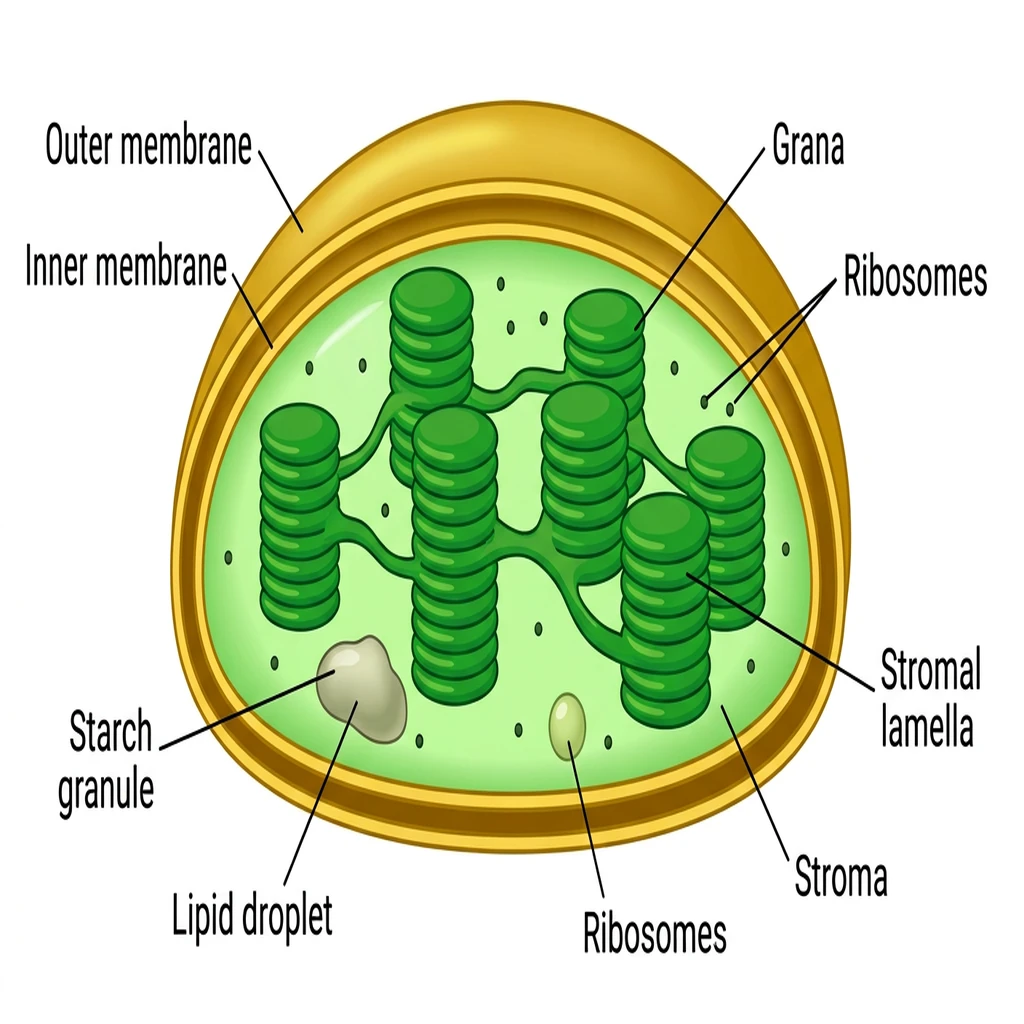
Structure of Chloroplast: A double-membraned organelle containing thylakoid grana, stroma fluid, and stromal lamellae.
🔬 Detailed Biochemical & Structural Description
The chloroplast is the site of photosynthesis in green plants. It features: (1) Double membrane (outer and inner); (2) Stroma: The fluid matrix where dark reactions (Calvin cycle) take place; (3) Grana: Stacks of thylakoids where light reactions (ATP & NADPH synthesis) occur; (4) Stromal lamellae: Flat tubes connecting different grana; (5) Starch granules and lipid droplets.
III. PIGMENTS IN PHOTOSYNTHESIS
A FOUR LEAF PIGMENTS (PAPER CHROMATOGRAPHY)
| PIGMENT | COLOUR ON CHROMATOGRAM |
|---|---|
| Chlorophyll a | Bright or Blue-green ⭐⭐ |
| Chlorophyll b | Yellow-green ⭐ |
| Xanthophylls | Yellow ⭐ |
| Carotenoids | Yellow to Yellow-orange ⭐ |
NEET 2023, 2025, 2026 (reinforced): Know chromatogram colours of all four pigments: Chl a = bright/blue-green, Chl b = yellow-green, Xanthophyll = yellow, Carotenoid = yellow to yellow-orange.
B PIGMENT ROLES
| FEATURE | DETAIL |
|---|---|
| Pigments | Substances that have ability to absorb light at specific wavelengths ⭐ |
| Maximum photosynthesis | In blue and red regions of the spectrum ⭐⭐ |
| Chlorophyll a | Major/Chief pigment responsible for trapping light ⭐⭐ |
| Accessory pigments | Chlorophyll b, Xanthophylls, Carotenoids ⭐⭐ |
| Accessory pigment roles | (1) Absorb light → transfer energy to Chl a; (2) Enable wider range of wavelengths; (3) Protect Chl a from photo-oxidation ⭐⭐⭐ |
NEET 2019, 2026 (reinforced): Most photosynthesis in blue and red regions of spectrum; Chl a is the chief reaction centre pigment.
C ADDITIONAL PIGMENT FACTS
| FEATURE | DETAIL |
|---|---|
| Anthocyanins | Water-soluble pigments found in plant cell vacuoles ⭐ |
| Phytochrome | Chemically classified as a chromoprotein ⭐ |
| Most abundant plant pigment | Chlorophyll ⭐ |
NEET 2016: Anthocyanins = water-soluble; Phytochrome = chromoprotein.
D EMERSON'S EFFECT
| FEATURE | DETAIL |
|---|---|
| Emerson's Enhancement Effect | 'Red drop' experiments instrumental in discovery of two photosystems operating simultaneously ⭐ |
NEET 2016: Emerson's effect → discovery of two photosystems.
Absorption & Action Spectra of Photosynthesis
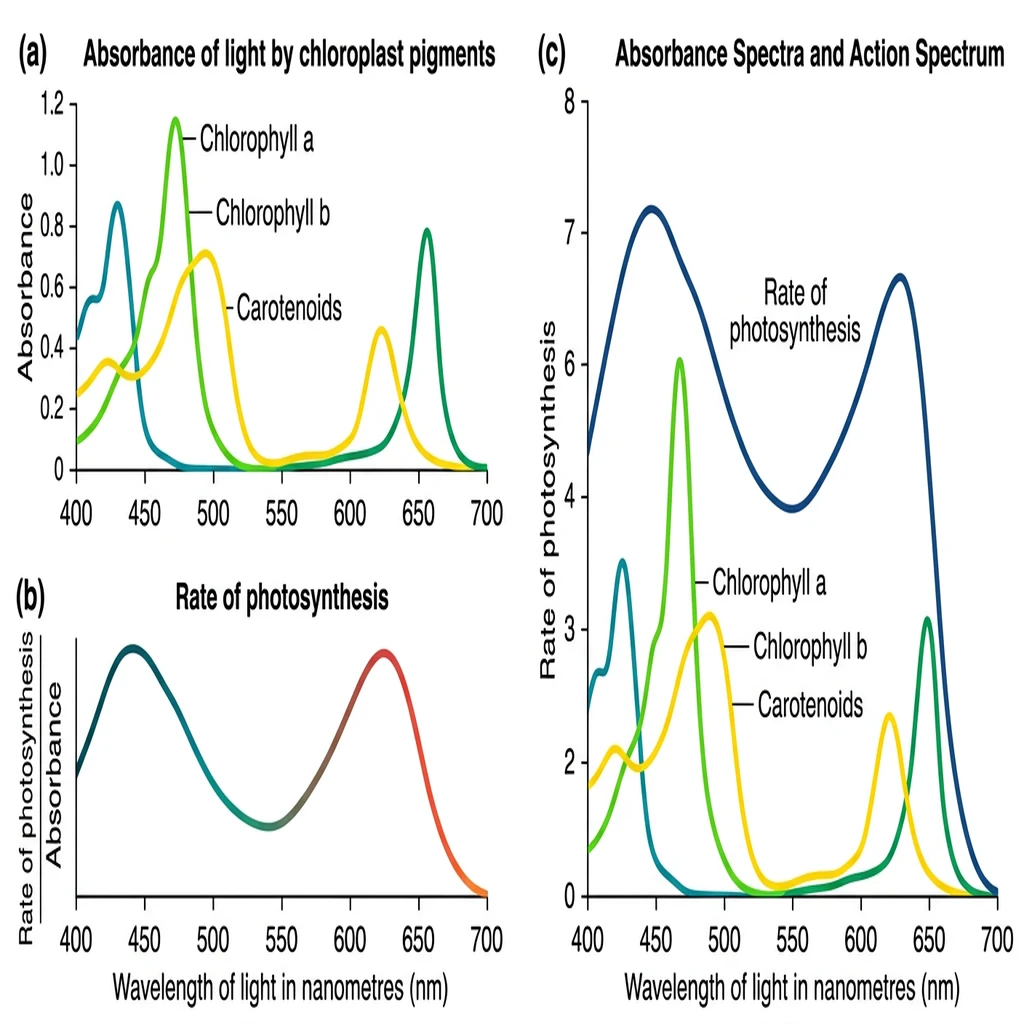
Photosynthetic Spectra: Graphs plotting (a) absorption of chlorophyll a, b, and carotenoids, (b) action spectrum, and (c) superimposed view.
🔬 Detailed Biochemical & Structural Description
The rate of photosynthesis corresponds closely to the absorption profiles of pigments. (a) Absorption Spectrum: Plots light absorbed by chlorophyll a, chlorophyll b, and carotenoids across wavelengths (400-700 nm). (b) Action Spectrum: Plots rate of photosynthesis measured by oxygen release. (c) Superimposed: Confirms that photosynthesis peaks in blue and red light regions, where chlorophyll a absorption is maximum.
IV. PHOTOSYSTEMS
A STRUCTURE OF PHOTOSYSTEM
| FEATURE | DETAIL |
|---|---|
| Photosystem | One molecule of Chl a (reaction centre) + Antennae molecules (light harvesting complex, LHC) ⭐⭐ |
| LHC | Made of hundreds of pigment molecules bound to proteins ⭐ |
| Antennae | All pigments (except one Chl a) → help absorb different wavelengths → funnel energy to reaction centre ⭐ |
| Reaction centre | Single Chl a molecule ⭐ |
B PS I vs PS II
| FEATURE | PS I | PS II |
|---|---|---|
| Reaction centre | Chl a 700 (P700) ⭐⭐ | Chl a 680 (P680) ⭐⭐ |
| Absorption peak | 700 nm ⭐ | 680 nm ⭐ |
| Named in sequence of | Discovery (NOT functional sequence) ⭐ | — |
| Functional sequence | PS II functions FIRST, then PS I ⭐ | — |
| Primary electron acceptor | Fe-S protein (Iron-Sulphur protein) ⭐⭐ | Pheophytin ⭐⭐ |
NEET 2023, RE-NEET 2026 (reinforced): PS I = P700 (Chl a with absorption peak at 700 nm); PS II = P680. Primary electron acceptors: PS I = Fe-S protein; PS II = Pheophytin.
The Light Harvesting Complex (LHC)
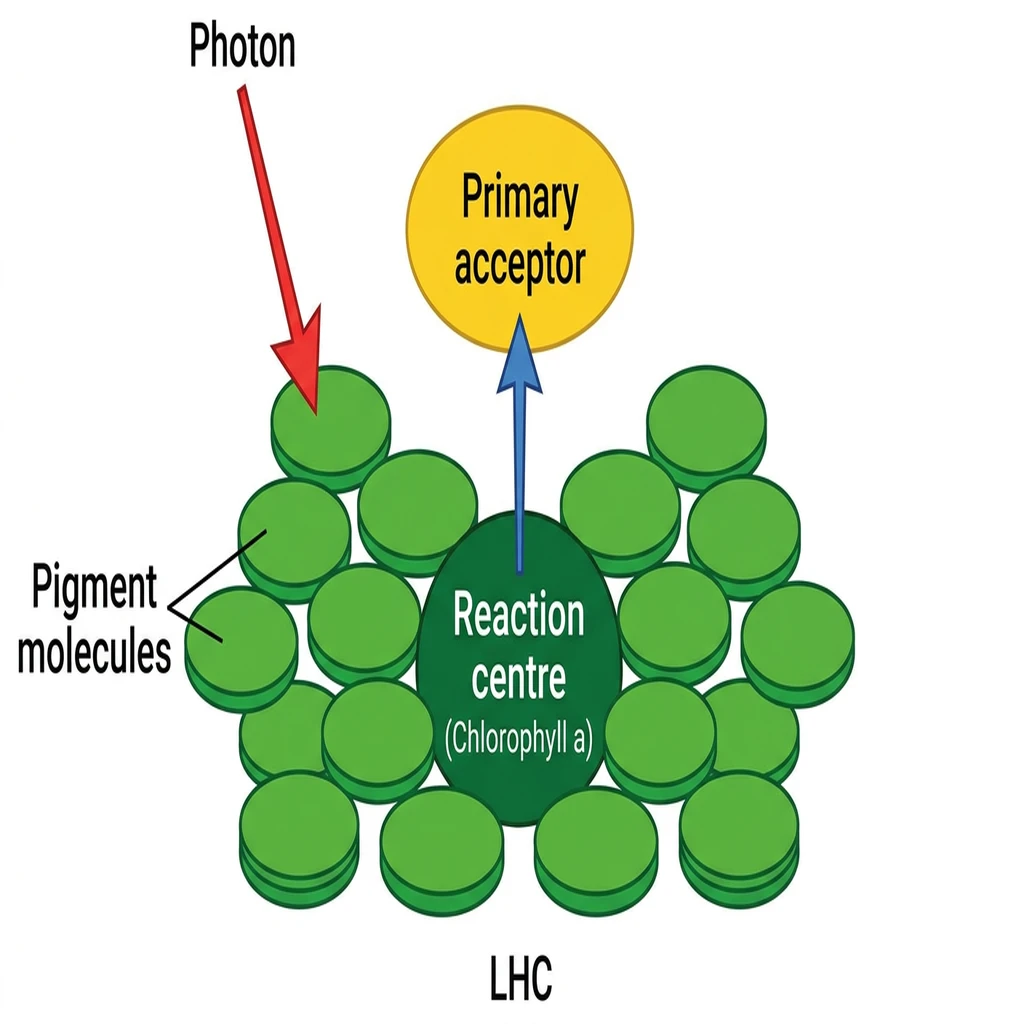
Light Harvesting Complex: Antenna pigments absorb photons and transfer energy to the central chlorophyll a reaction center.
🔬 Detailed Biochemical & Structural Description
The Light Harvesting Complex (LHC) or antenna is made up of hundreds of pigment molecules bound to proteins. These accessory pigments (chlorophyll b, xanthophylls, carotenoids) absorb light of different wavelengths and channel the energy via resonance transfer to a single central 'Reaction Centre' composed of chlorophyll a, which then ejects electrons to a primary acceptor.
V. LIGHT REACTION — ELECTRON TRANSPORT
A LIGHT REACTION OVERVIEW
| FEATURE | DETAIL |
|---|---|
| Includes | Light absorption, water splitting, O₂ release, formation of ATP and NADPH ⭐ |
| Strictly requires | Light, H₂O, Chlorophyll ⭐⭐ |
| Does NOT require | CO₂ (CO₂ is for dark reaction!) ⭐⭐ |
| Products | ATP, NADPH + H⁺, O₂ ⭐⭐ |
| NOT a product | NADH (NADH is a product of respiration, NOT photosynthesis!) ⭐ |
| Gas diffusing out | O₂ diffuses out of chloroplast ⭐ |
NEET 2018, 2024: Light reaction products = ATP, NADPH, O₂; CO₂ NOT required for light reaction. O₂ is the only product that diffuses out of chloroplast!
B NON-CYCLIC PHOTOPHOSPHORYLATION (Z-SCHEME)
| FEATURE | DETAIL |
|---|---|
| Name | Z-scheme (due to characteristic shape on redox potential scale) ⭐⭐ |
| Photosystems | Both PS II and PS I (in series: PS II first → then PS I) ⭐ |
| Products | ATP + NADPH + H⁺ ⭐⭐ |
| Occurs in | Grana thylakoid membranes ⭐ |
Z-Scheme Electron Flow ⭐⭐⭐
| STEP | DETAIL |
|---|---|
| 1 | PS II absorbs 680 nm red light → electrons excited → jump to higher orbit ⭐ |
| 2 | Excited electrons picked up by primary acceptor (Pheophytin) ⭐ |
| 3 | Electrons pass through ETC (cytochromes) → downhill (on redox scale) ⭐ |
| 4 | Plastoquinone transfers electrons from PS II to Cyt b₆f complex ⭐⭐ |
| 5 | Electrons passed to PS I ⭐ |
| 6 | PS I absorbs 700 nm → electrons excited again → transferred to Fe-S protein ⭐ |
| 7 | Electrons moved downhill → reduce NADP⁺ to NADPH + H⁺ ⭐ |
NEET 2020: Plastoquinone transfers electrons from PS II to Cyt b₆f complex. Electrons lost from PS II are continuously replaced by electrons from water splitting.
Z-Scheme of Light Reaction
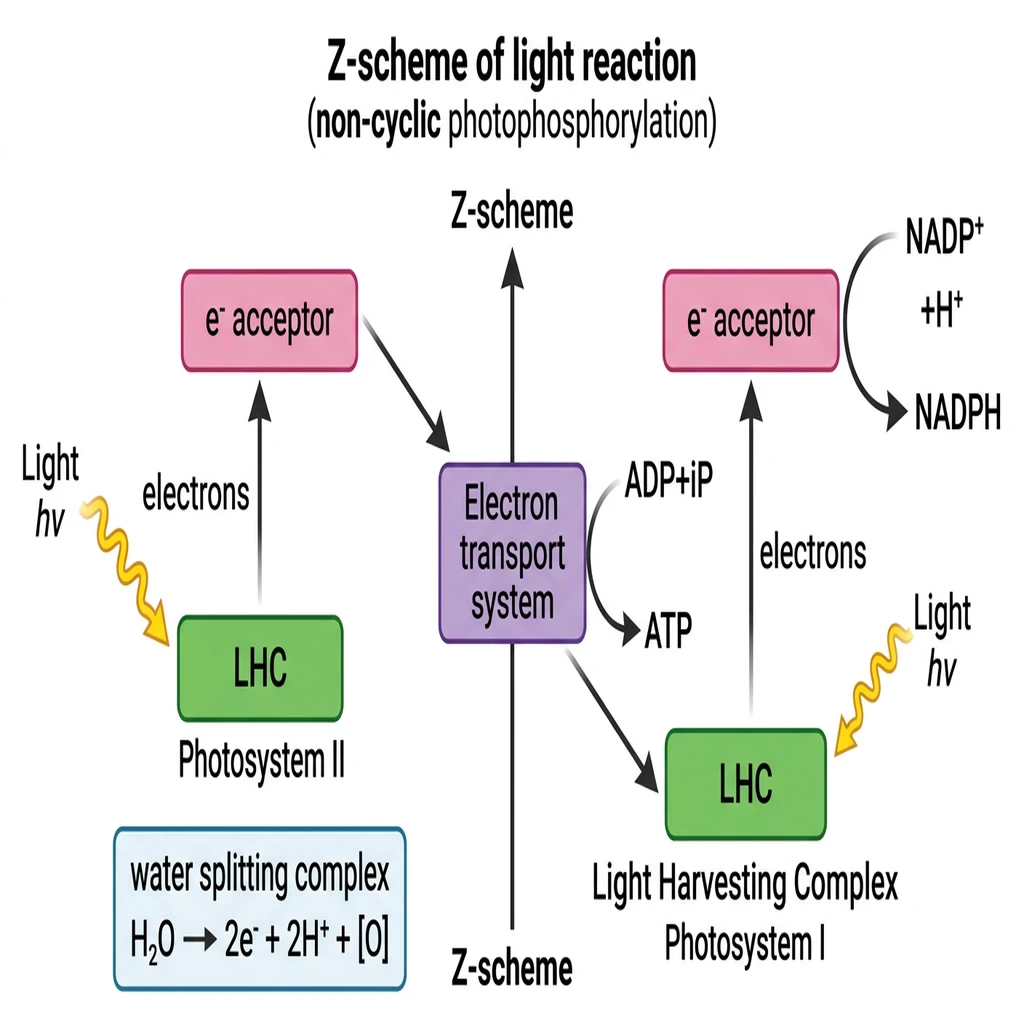
The Z-Scheme: Non-cyclic photophosphorylation pathway showing PS II, PS I, electron transport, and ATP/NADPH synthesis.
🔬 Detailed Biochemical & Structural Description
The light reaction of photosynthesis proceeds via the Z-Scheme (non-cyclic photophosphorylation): (1) Photosystem II (P680) absorbs light and ejects electrons, which are replaced by splitting H2O into protons, oxygen, and electrons. (2) Electrons travel down an electron transport system (ETS) to synthesize ATP. (3) Electrons reach Photosystem I (P700), are excited again by light, and are used to reduce NADP+ to NADPH.
C WATER SPLITTING (PHOTOLYSIS OF WATER)
| FEATURE | DETAIL |
|---|---|
| Associated with | PS II ⭐⭐ |
| Location | Inner side (lumen) of the thylakoid membrane ⭐⭐ |
| Reaction | 2H₂O → 4H⁺ + O₂ + 4e⁻ ⭐⭐ |
| Products | H⁺ (protons), O₂ (net product), electrons (replace those lost from PS II) ⭐ |
| Where H⁺ and O₂ released | In the lumen (inner side of thylakoid) ⭐ |
NEET 2022, 2026 (reinforced): Water splitting complex is associated with PS II (not PS I!) on the inner side (lumen) of the thylakoid membrane.
D CYCLIC PHOTOPHOSPHORYLATION
| FEATURE | DETAIL |
|---|---|
| Only PS I is functional | ⭐⭐ |
| Electron flow | Electron circulated back within PS I complex through ETC ⭐ |
| Does NOT pass to | NADP⁺ ⭐ |
| Product | ATP ONLY (NO NADPH + H⁺) ⭐⭐⭐ |
| Location | Stroma lamellae ⭐⭐ |
| Occurs when | Only light of wavelengths beyond 680 nm available ⭐ |
| Why needed | To meet extra ATP requirement of Calvin cycle (3 ATP : 2 NADPH ratio) ⭐ |
NEET 2021: Cyclic photophosphorylation → ATP only (no NADPH, no O₂!).
Cyclic Photophosphorylation
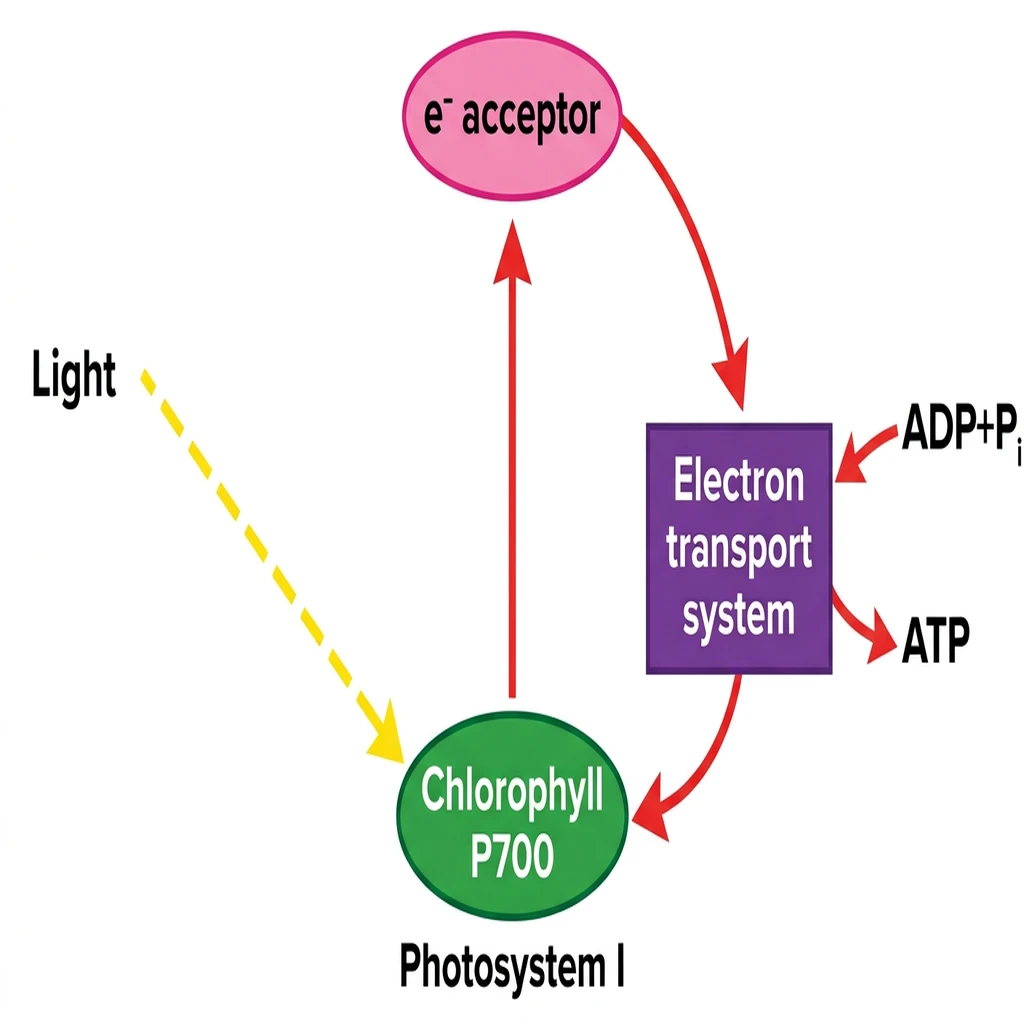
Cyclic Photophosphorylation: Closed-loop electron flow within Photosystem I (P700) producing ATP but no NADPH.
🔬 Detailed Biochemical & Structural Description
Cyclic photophosphorylation occurs only in the stromal lamellae membranes (which lack PS II and NADP reductase). When only light of wavelengths beyond 680 nm is available, electrons ejected from the Photosystem I reaction center (P700) are not passed to NADP+, but are instead looped back through the electron transport system (ETS) to P700, synthesizing ATP in a closed loop.
E CYCLIC vs NON-CYCLIC — COMPARISON
| FEATURE | CYCLIC | NON-CYCLIC |
|---|---|---|
| Photosystems | PS I only ⭐ | Both PS I and PS II ⭐ |
| Electron flow | Cyclic (back to PS I) ⭐ | Non-cyclic (H₂O → PS II → PS I → NADP⁺) ⭐ |
| Products | ATP only ⭐ | ATP + NADPH + H⁺ ⭐ |
| O₂ evolution | NO ⭐ | YES (from water splitting) ⭐ |
| Location | Stroma lamellae ⭐ | Grana thylakoid ⭐ |
| Z-scheme | No | Yes ⭐ |
VI. CHEMIOSMOTIC HYPOTHESIS
A OVERVIEW
| FEATURE | DETAIL |
|---|---|
| Proposed by | Peter Mitchell ⭐⭐ |
| Explains | Mechanism of ATP synthesis in chloroplasts (photophosphorylation) AND mitochondria (oxidative phosphorylation) ⭐ |
| Core principle | ATP synthesis linked to development of a proton gradient across a membrane ⭐⭐ |
NEET 2012, 2026 (reinforced): Chemiosmotic hypothesis — Peter Mitchell; ATP synthesis in chloroplast occurs through chemiosmosis linked to proton gradient across membrane.
B REQUIREMENTS FOR CHEMIOSMOSIS
| REQUIREMENT | DETAIL |
|---|---|
| 1 | A membrane ⭐ |
| 2 | A proton pump ⭐ |
| 3 | A proton gradient ⭐ |
| 4 | ATP synthase (ATPase) ⭐ |
NEET 2023: Chemiosmosis requires — membrane, proton pump, proton gradient, ATP synthase.
C PROTON GRADIENT CREATION IN CHLOROPLAST
Three Sources of Proton Accumulation in Lumen ⭐⭐
| SOURCE | DETAIL |
|---|---|
| 1 | Water splitting on inner side of membrane → H⁺ released into lumen ⭐ |
| 2 | Electron transport through photosystems → protons transported across membrane (stroma → lumen) ⭐ |
| 3 | NADP reductase (on stroma side) uses electrons + removes H⁺ from stroma → reduces NADP⁺ to NADPH + H⁺ ⭐ |
| RESULT | DETAIL |
|---|---|
| In lumen | Protons accumulate → low pH ⭐⭐ |
| In stroma | Protons decrease → higher pH ⭐ |
| Gradient | Created across thylakoid membrane ⭐ |
NEET 2016, 2022: Proton accumulation → lumen (low pH); highest H⁺ in lumen of thylakoid.
D ATP SYNTHESIS
| FEATURE | DETAIL |
|---|---|
| ATP synthase structure | Two parts: CF₀ (embedded in thylakoid membrane = transmembrane channel) + CF₁ (protrudes on stroma side) ⭐⭐ |
| CF₀ function | Facilitated diffusion of protons across membrane (lumen → stroma) ⭐ |
| CF₁ function | Conformational change → synthesises ATP ⭐ |
| Energy source | Breakdown of proton gradient (NOT electron gradient!) ⭐⭐ |
| Direction of proton flow | Lumen → Stroma (through CF₀ channel) ⭐ |
NEET 2022: ATP synthesised by breakdown of PROTON gradient (not electron gradient — TRAP!).
E CHLOROPLAST vs MITOCHONDRIA — PROTON ACCUMULATION
| FEATURE | CHLOROPLAST | MITOCHONDRIA |
|---|---|---|
| Proton accumulation | Inside membrane (thylakoid lumen) ⭐ | Intermembrane space ⭐ |
Chemiosmotic ATP Synthesis
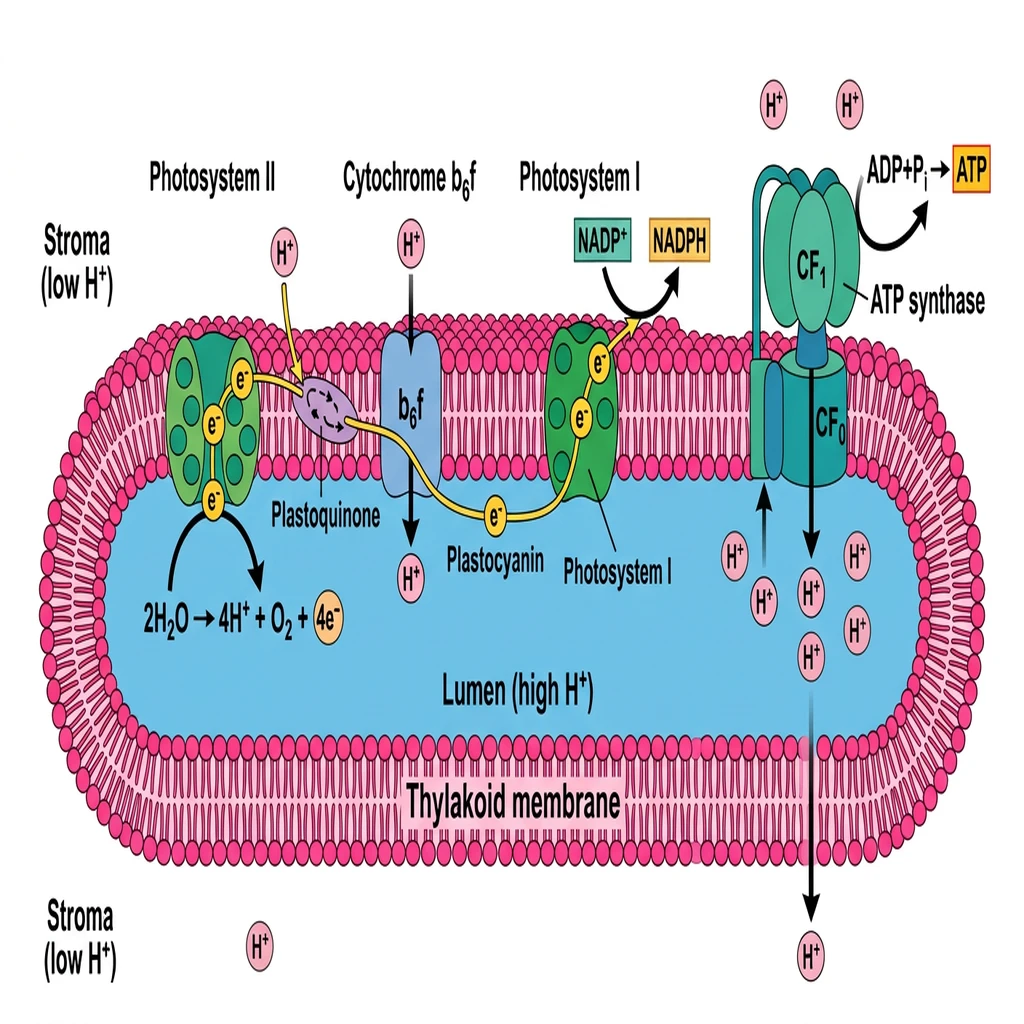
Chemiosmotic Hypothesis: Proton gradient accumulation inside the thylakoid lumen driving ATP synthesis via CF0-CF1 ATP synthase.
🔬 Detailed Biochemical & Structural Description
Peter Mitchell's chemiosmotic hypothesis explains ATP synthesis: (1) Protons (H+) accumulate in the thylakoid lumen due to water splitting and plastoquinone pumping. (2) This creates a high electrochemical proton gradient. (3) Protons diffuse down the gradient back to the stroma through the channel of CF0 of the ATP synthase enzyme. (4) The passage drives conformational changes in CF1, synthesizing ATP from ADP and Pi.
VII. CALVIN CYCLE (C3 PATHWAY / DARK REACTION)
A OVERVIEW
| FEATURE | DETAIL |
|---|---|
| Discovered by | Melvin Calvin (used ¹⁴C radioactive carbon in algal photosynthesis) ⭐⭐ |
| Nobel Prize | 1961 ⭐ |
| Also called | C₃ cycle / Calvin cycle / Carbon fixation cycle ⭐ |
| Occurs in | ALL photosynthetic plants (C₃, C₄, and CAM plants) ⭐⭐⭐ |
| Location | Stroma of chloroplast ⭐⭐ |
| Requires | CO₂, ATP, NADPH ⭐⭐ |
| Does NOT directly require | Light (but depends on light reaction products) ⭐ |
NEET 2024: Dark reaction requires CO₂, ATP, NADPH. It occurs in ALL photosynthetic plants (including C₄ plants!).
B THREE STAGES OF CALVIN CYCLE
| STAGE | DETAIL |
|---|---|
| 1. Carboxylation | Most crucial step ⭐⭐; CO₂ fixed into stable organic intermediate; RuBP + CO₂ → 2 × 3-PGA (catalysed by RuBisCO / RuBP carboxylase-oxygenase) ⭐⭐ |
| 2. Reduction | Series of reactions forming glucose; uses 2 ATP (phosphorylation) + 2 NADPH (reduction) per CO₂ molecule fixed ⭐⭐ |
| 3. Regeneration | CO₂ acceptor RuBP regenerated; requires 1 ATP for phosphorylation ⭐ |
NEET 2024, 2026 (reinforced): Three stages — Carboxylation → Reduction → Regeneration. Enzyme for carboxylation in Calvin cycle is RuBP carboxylase-oxygenase (RuBisCO).
NEET 2025: RuBisCO catalyses carboxylation of RuBP - not photolysis of water, and has higher affinity for CO₂ than O₂ under normal conditions.
C ENERGY REQUIREMENT (HIGH-YIELD MATH)
| PER | ATP | NADPH |
|---|---|---|
| 1 CO₂ molecule | 3 ATP ⭐⭐ | 2 NADPH ⭐⭐ |
| 1 Glucose (6 turns) | 18 ATP ⭐⭐⭐ | 12 NADPH ⭐⭐⭐ |
NEET 2023, 2026 (reinforced): Per CO₂ = 3 ATP + 2 NADPH; One glucose through Calvin requires 18 ATP and 12 NADPH (6 turns).
RE-NEET 2026: Three glucose formation requires 18 turns of the Calvin cycle (3 × 6 = 18 turns!).
Calvin Cycle — In and Out ⭐⭐
| IN | OUT |
|---|---|
| 6 CO₂ | 1 Glucose |
| 18 ATP | 18 ADP |
| 12 NADPH | 12 NADP⁺ |
D CO₂ ACCEPTORS & FIRST PRODUCTS
| FEATURE | C₃ PATHWAY | C₄ PATHWAY |
|---|---|---|
| Primary CO₂ acceptor | RuBP (5-carbon ketose sugar) ⭐⭐ | PEP (Phosphoenolpyruvate, 3-carbon) ⭐⭐ |
| First CO₂ fixation product | PGA (3-Phosphoglyceric acid, 3C) ⭐⭐ | OAA (Oxaloacetic acid, 4C) ⭐⭐ |
| Enzyme | RuBisCO ⭐ | PEPcase (PEP carboxylase) ⭐ |
NEET 2017, 2021, 2022: C₃ = RuBP acceptor (5C), PGA product (3C); C₄ = PEP acceptor (3C), OAA product (4C).
The Calvin Cycle (C3 Pathway)
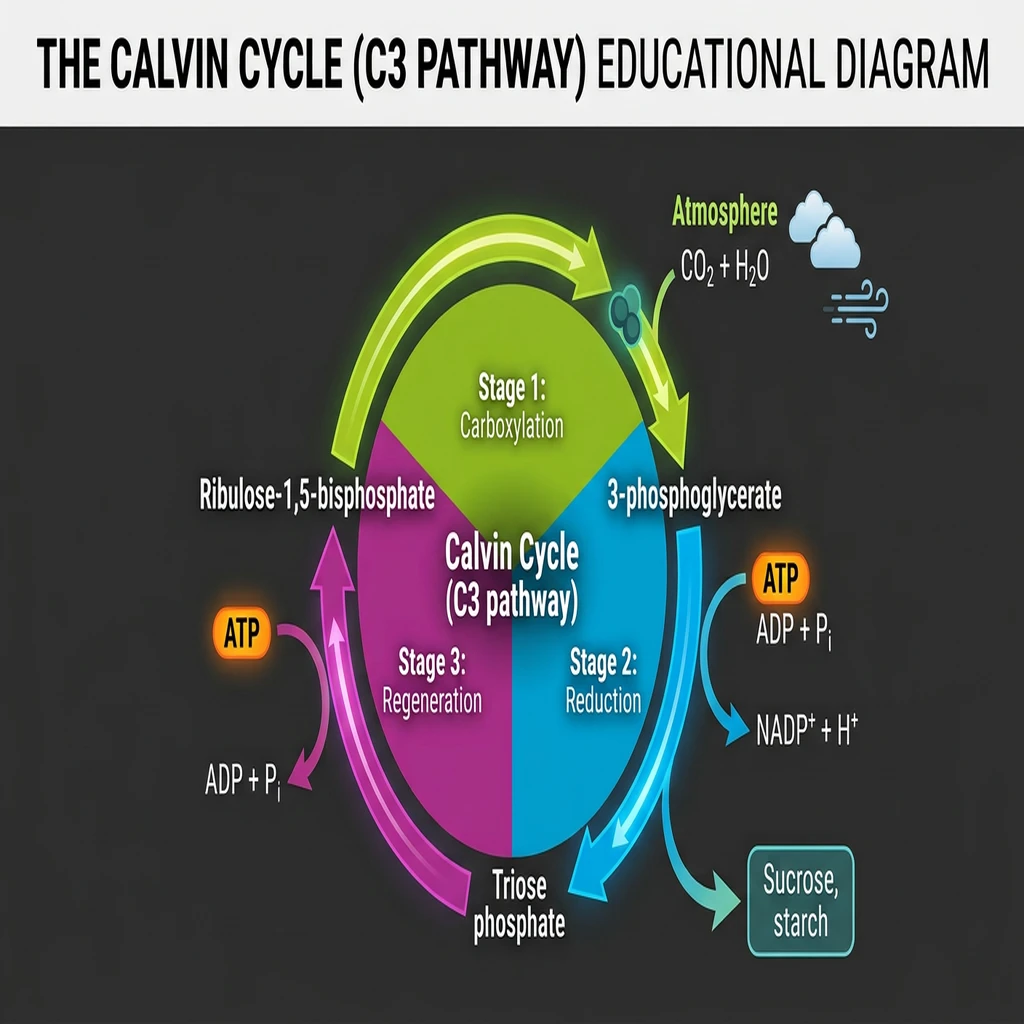
The Calvin Cycle: Symmetrical circular pathway showing carboxylation, reduction (sucrose synthesis), and RuBP regeneration phases.
🔬 Detailed Biochemical & Structural Description
The dark reaction (C3 cycle) proceeds in three major phases in the stroma: (1) Carboxylation: CO2 is fixed by enzyme RuBisCO to form 3-phosphoglycerate using Ribulose-1,5-bisphosphate (RuBP). (2) Reduction: Phosphoglycerate is reduced to triose phosphates to yield glucose/sucrose at the expense of ATP and NADPH. (3) Regeneration: RuBP is regenerated using ATP so the cycle can continue.
VIII. C4 PATHWAY (HATCH AND SLACK PATHWAY)
A OVERVIEW
| FEATURE | DETAIL |
|---|---|
| Adapted to | Dry tropical regions ⭐ |
| Leaf anatomy | Kranz anatomy ⭐⭐⭐ |
| First CO₂ fixation product | OAA (4C) — hence called C₄ pathway ⭐ |
| Main biosynthetic pathway | Still use Calvin cycle (C₃ pathway) in bundle sheath cells ⭐ |
| Named | Hatch and Slack Pathway ⭐ |
| Examples | Maize, Sorghum ⭐⭐ |
NEET 2026 (reinforced): Kranz anatomy is characteristic of C₄ plants, C₃ plants do not exhibit it. C₄ plants use C₃ pathway as main biosynthetic pathway in bundle sheath cells!
B KRANZ ANATOMY
| FEATURE | DETAIL |
|---|---|
| "Kranz" means | "Wreath" (reflection of cell arrangement) ⭐ |
| Bundle sheath cells | Particularly large cells around vascular bundles ⭐⭐ |
Characteristics of Bundle Sheath Cells ⭐⭐⭐
| FEATURE | DETAIL |
|---|---|
| 1 | Large number of chloroplasts ⭐ |
| 2 | Thick walls impervious to gaseous exchange ⭐ |
| 3 | No intercellular spaces ⭐ |
| Enzyme present | RuBisCO (but LACK PEPcase) ⭐⭐ |
| Calvin cycle occurs | HERE (in bundle sheath cells of C₄ plants) ⭐⭐ |
NEET 2022: Bundle sheath cells — large number of chloroplasts; thick walls; no intercellular spaces.
C C₄ PATHWAY — STEPS
| STEP | LOCATION | DETAIL |
|---|---|---|
| 1 | Mesophyll cells | CO₂ fixed by PEPcase → PEP + CO₂ → OAA (4C) ⭐ |
| 2 | Mesophyll cells | OAA converted to malic acid (4C) or aspartic acid (4C) ⭐⭐ |
| 3 | Transport | C₄ acids transported to bundle sheath cells ⭐ |
| 4 | Bundle sheath cells | C₄ acids broken down → release CO₂ + 3C molecule ⭐ |
| 5 | Bundle sheath cells | Released CO₂ enters Calvin cycle (via RuBisCO) ⭐ |
| 6 | Transport | 3C molecule back to mesophyll → converted to PEP → cycle completes ⭐ |
NEET 2022: CO₂ transported as malic acid/aspartic acid from mesophyll to bundle sheath cells.
D C₃ vs C₄ — ENZYME DISTRIBUTION
| FEATURE | MESOPHYLL CELLS | BUNDLE SHEATH CELLS |
|---|---|---|
| PEPcase | PRESENT ⭐ | ABSENT ⭐ |
| RuBisCO | ABSENT ⭐⭐ | PRESENT ⭐⭐ |
| Calvin cycle | NOT here (in C₄ plants) | HERE ⭐ |
| Initial carboxylation | HERE | — |
NEET 2020, 2022: Mesophyll cells LACK RuBisCO in C₄ plants; use PEPcase instead!
E C₄ PLANT ADVANTAGES
| FEATURE | DETAIL |
|---|---|
| No photorespiration | ⭐⭐ |
| Higher productivity | Better biomass production ⭐ |
| Tolerance to higher temperatures | ⭐⭐ |
| Response to high light | ⭐ |
| Better water/nitrogen use efficiency | ⭐ |
NEET 2016, 2023, 2024: C₄ plants — no photorespiration; higher productivity; higher temperature tolerance.
The Hatch and Slack Pathway (C4 Cycle)
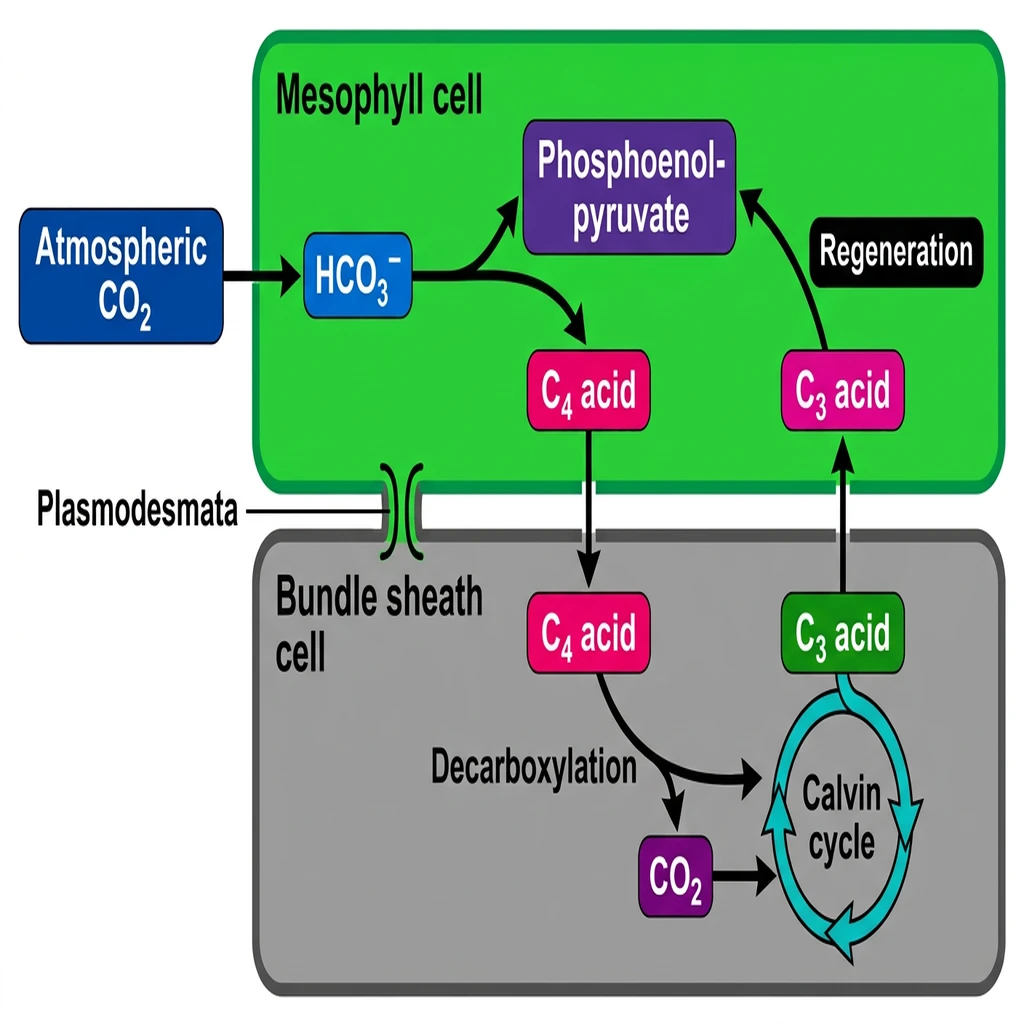
Hatch-Slack Pathway: C4 photosynthesis showing CO2 fixation in mesophyll cells and decarboxylation in bundle sheath cells.
🔬 Detailed Biochemical & Structural Description
C4 plants (like maize, sorghum) avoid photorespiration using Kranz anatomy. (1) Mesophyll Cell: CO2 is fixed as HCO3- by PEP carboxylase to form oxaloacetic acid (C4 acid), which is transported. (2) Bundle Sheath Cell: The C4 acid undergoes decarboxylation to release CO2, which enters the Calvin cycle (RuBisCO is highly active here). The resulting C3 acid is transported back to regenerate phosphoenolpyruvate.
IX. PHOTORESPIRATION
A OVERVIEW
| FEATURE | DETAIL |
|---|---|
| Occurs in | C₃ plants ⭐⭐ |
| Does NOT occur in | C₄ plants ⭐⭐⭐ |
| Cause | O₂ binds to RuBisCO instead of CO₂ ⭐⭐ |
| Result | Decreased CO₂ fixation ⭐ |
NEET 2026 (reinforced): Photorespiration does not occur in C₄ plants under normal conditions, it occurs in C₃ plants.
B RuBisCO — DUAL ACTIVITY
| FEATURE | DETAIL |
|---|---|
| Full name | Ribulose bisphosphate Carboxylase-Oxygenase ⭐ |
| Status | Most abundant enzyme in the world ⭐⭐ |
| Active site binds | Both CO₂ and O₂ ⭐⭐ |
| Binding | Competitive ⭐ |
| Greater affinity for | CO₂ (when CO₂ : O₂ ratio is nearly equal) ⭐ |
| What determines binding | Relative concentration of O₂ and CO₂ ⭐ |
| Substrate | RuBP (5-carbon) ⭐ |
NEET 2020, 2023: RuBisCO = most abundant enzyme; bifunctional (carboxylase + oxygenase); substrate = RuBP (5C).
C PHOTORESPIRATION REACTION
| FEATURE | DETAIL |
|---|---|
| When O₂ binds to RuBisCO | RuBP → 1 molecule PGA (3C) + 1 molecule Phosphoglycolate (2C) ⭐⭐⭐ |
| No synthesis of | Sugars, ATP, or NADPH ⭐⭐ |
| Results in | Release of CO₂ with utilisation of ATP ⭐ |
| Status | Wasteful process ⭐⭐ |
| Biological function | NOT known ⭐ |
NEET 2020, 2024, RE-NEET 2026 (reinforced): In photorespiration RuBP + O₂ forms 3-Phosphoglycerate (PGA, 3C) and 2-Phosphoglycolate (2C). It forms phosphoglycolate and produces no ATP and no NADPH (wasteful!).
D WHY C₄ PLANTS LACK PHOTORESPIRATION
| FEATURE | DETAIL |
|---|---|
| C₄ plants have | Mechanism that increases CO₂ concentration at enzyme (RuBisCO) site in bundle sheath cells ⭐⭐ |
| How | C₄ acid from mesophyll broken down in bundle sheath → releases CO₂ → increases intracellular CO₂ ⭐ |
| Result | RuBisCO functions as carboxylase → minimises oxygenase activity ⭐ |
| Major difference C₃ vs C₄ | Photorespiration ⭐⭐ |
NEET 2012, 2016: C₄ plants lack photorespiration; they pump CO₂ as C₄ acids to bundle sheath.
X. FACTORS AFFECTING PHOTOSYNTHESIS
A INTERNAL (PLANT) FACTORS
| FACTOR | DETAIL |
|---|---|
| Number, size, age, orientation of leaves | ⭐ |
| Mesophyll cells & Chloroplasts | ⭐ |
| Internal CO₂ concentration | ⭐ |
| Amount of chlorophyll | ⭐ |
| Dependent on | Genetic predisposition and growth of plant ⭐ |
B EXTERNAL FACTORS
| FACTOR | DETAIL |
|---|---|
| Sunlight | ⭐ |
| Temperature | ⭐ |
| CO₂ concentration | ⭐ |
| Water | ⭐ |
C LAW OF LIMITING FACTORS
| FEATURE | DETAIL |
|---|---|
| Proposed by | Blackman (1905) ⭐⭐ |
| Law | If a chemical process is affected by more than one factor, its rate will be determined by the factor nearest to its minimal value ⭐⭐ |
| At any point | Rate determined by factor available at sub-optimal levels ⭐ |
| CO₂ | Major limiting factor for photosynthesis ⭐⭐ |
NEET 2017: Blackman's Law of Limiting Factors (1905). CO₂ is the major limiting factor in nature.
D LIGHT
| FEATURE | DETAIL |
|---|---|
| At low intensity | Linear relationship between light and CO₂ fixation rate ⭐ |
| At higher intensity | Rate does not show further increase → other factors become limiting ⭐ |
| Light saturation | Occurs at 10% of full sunlight ⭐⭐ |
| In nature | Light is rarely a limiting factor (except shade/dense forest plants) ⭐ |
| Beyond a point | Excess light → breakdown of chlorophyll → decrease in photosynthesis ⭐ |
NEET 2017: Light saturation at 10% full sunlight.
Factors Affecting Photosynthesis (Light Curve)
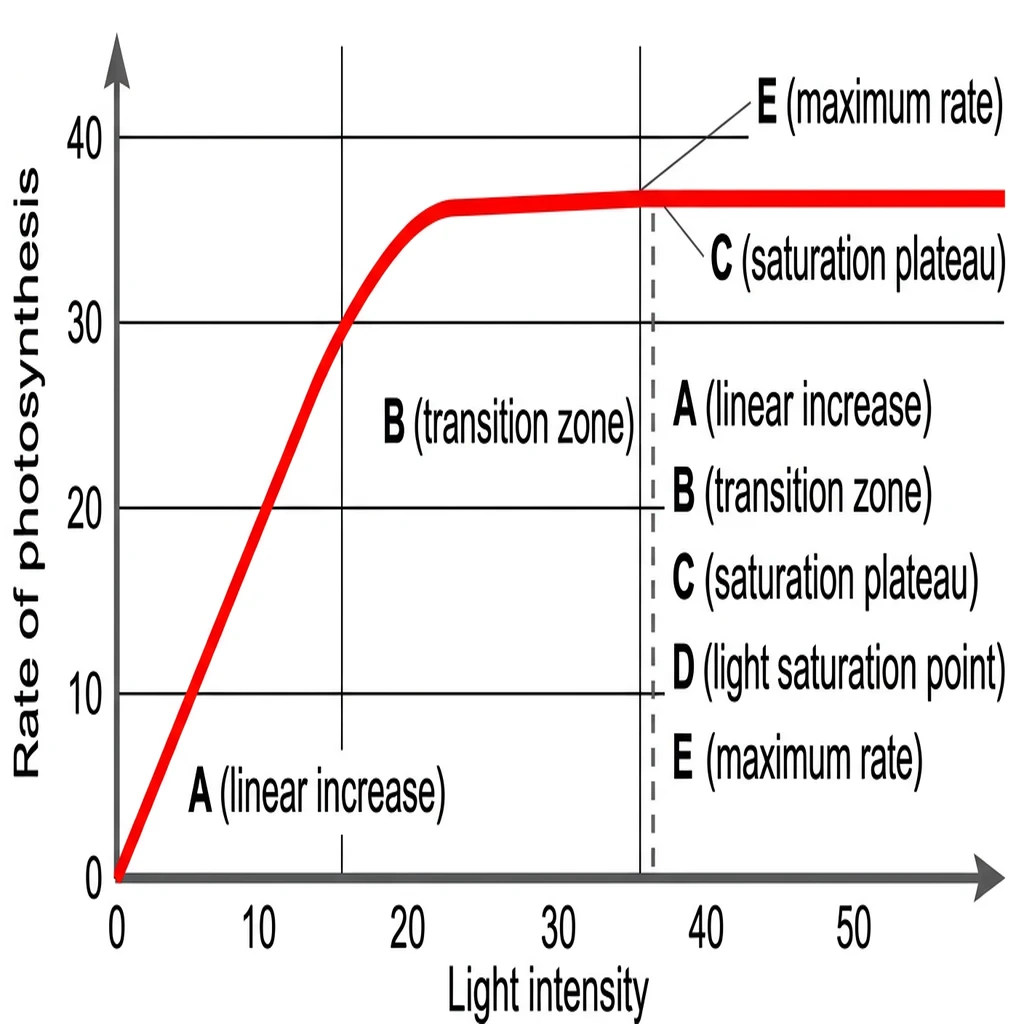
Light Intensity Curve: Sigmoid graph plotting rate of photosynthesis against light intensity, highlighting regions A, B, C, and D.
🔬 Detailed Biochemical & Structural Description
Blackman's Law of Limiting Factors regulates photosynthesis rates. The light intensity graph reveals: (A) Linear increase: Light is the limiting factor at low intensities; (B) Transition zone; (C) Saturation plateau: Other factors (e.g., CO2 concentration, temperature) become limiting; (D) Light saturation point (usually 10% of full sunlight); (E) Maximum rate of photosynthesis.
E CARBON DIOXIDE CONCENTRATION
| FEATURE | DETAIL |
|---|---|
| CO₂ in atmosphere | 0.03–0.04% ⭐ |
| Increase up to | 0.05% can increase CO₂ fixation rate ⭐ |
| Beyond 0.05% | Can become damaging over longer periods ⭐ |
| PLANT | CO₂ SATURATION |
|---|---|
| C₄ plants | At about 360 µlL⁻¹ ⭐ |
| C₃ plants | Saturation only beyond 450 µlL⁻¹ ⭐ |
| KEY FACT | DETAIL |
|---|---|
| Current CO₂ levels | Limiting to C₃ plants ⭐⭐ |
| C₃ plants respond to | Higher CO₂ → increased photosynthesis → higher productivity ⭐ |
| Greenhouse crops | Tomatoes, Bell peppers grown in CO₂-enriched atmosphere → higher yields ⭐⭐ |
NEET 2017: C₄ saturation at 360 µlL⁻¹; C₃ beyond 450 µlL⁻¹; greenhouse crops = tomatoes, bell peppers.
F TEMPERATURE
| FEATURE | DETAIL |
|---|---|
| Dark reactions | Enzymatic → temperature controlled ⭐ |
| Light reactions | Also temperature sensitive but affected to lesser extent ⭐ |
| C₄ plants | Respond to higher temperatures → higher rate of photosynthesis ⭐⭐ |
| C₃ plants | Much lower temperature optimum ⭐ |
| Tropical plants | Higher temperature optimum than temperate plants ⭐ |
NEET 2017: C₄ plants = higher temperature optimum; C₃ = lower temperature optimum.
G WATER
| FEATURE | DETAIL |
|---|---|
| Water stress effect 1 | Stomata close → reducing CO₂ availability ⭐⭐ |
| Water stress effect 2 | Leaves wilt → reducing surface area and metabolic activity ⭐ |
| Direct effect | Water is a reactant in light reaction, but effect is more indirect (through stomatal closure and wilting) ⭐ |
XI. RAPID REVISION — KEY COMPARISON TABLES
TABLE 1: Key Scientists ⭐⭐⭐
| SCIENTIST | CONTRIBUTION |
|---|---|
| Joseph Priestley | Bell jar experiment; gaseous exchange; discovered O₂ |
| Jan Ingenhousz | Importance of sunlight & green colour |
| Julius von Sachs | Glucose production; stored as starch; chloroplasts |
| T.W. Engelmann | First action spectrum; Cladophora + aerobic bacteria; blue & red light |
| Cornelius van Niel | O₂ from H₂O (not CO₂); purple & green sulphur bacteria |
| Melvin Calvin | Calvin cycle; ¹⁴C; Nobel Prize 1961 |
| Peter Mitchell | Chemiosmotic hypothesis |
| Blackman (1905) | Law of Limiting Factors |
TABLE 2: Four Leaf Pigments ⭐⭐⭐
| PIGMENT | COLOUR | ROLE |
|---|---|---|
| Chlorophyll a | Bright/Blue-green | Major pigment (reaction centre) |
| Chlorophyll b | Yellow-green | Accessory pigment |
| Xanthophylls | Yellow | Accessory pigment |
| Carotenoids | Yellow to Yellow-orange | Accessory; photo-protection |
TABLE 3: PS I vs PS II ⭐⭐⭐
| FEATURE | PS I | PS II |
|---|---|---|
| Reaction centre | P700 | P680 |
| Absorption peak | 700 nm | 680 nm |
| Primary electron acceptor | Fe-S protein | Pheophytin |
| Water splitting | NO | YES (associated) |
| Found in | Grana thylakoid + Stroma lamellae | Grana thylakoid ONLY |
TABLE 4: Cyclic vs Non-Cyclic Photophosphorylation ⭐⭐⭐
| FEATURE | CYCLIC | NON-CYCLIC |
|---|---|---|
| Photosystems | PS I only | PS I + PS II |
| Products | ATP only | ATP + NADPH + H⁺ |
| O₂ evolution | No | Yes |
| Water splitting | No | Yes |
| Location | Stroma lamellae | Grana thylakoid |
| Z-scheme | No | Yes |
TABLE 5: Light Reaction vs Dark Reaction ⭐⭐⭐
| FEATURE | LIGHT REACTION | DARK REACTION |
|---|---|---|
| Location | Grana thylakoid membranes | Stroma |
| Light | Directly required | Not directly required |
| Requires | Light, H₂O, Chlorophyll | CO₂, ATP, NADPH |
| Products | ATP, NADPH, O₂ | Glucose (sugar) |
| Temperature sensitivity | Less | More (enzymatic) |
TABLE 6: Calvin Cycle Energy Math ⭐⭐⭐
| FOR | ATP | NADPH |
|---|---|---|
| 1 CO₂ | 3 | 2 |
| 1 Glucose (6 CO₂) | 18 | 12 |
| Turns for 1 Glucose | 6 | — |
TABLE 7: C₃ vs C₄ Plants ⭐⭐⭐
| FEATURE | C₃ PLANTS | C₄ PLANTS |
|---|---|---|
| Primary CO₂ acceptor | RuBP (5C) | PEP (3C) |
| First CO₂ product | PGA (3C) | OAA (4C) |
| Carboxylation enzyme | RuBisCO | PEPcase |
| Calvin cycle in | Mesophyll cells | Bundle sheath cells |
| Kranz anatomy | Absent | Present |
| Photorespiration | Present | Absent |
| CO₂ saturation | Beyond 450 µlL⁻¹ | ~360 µlL⁻¹ |
| Temperature optimum | Lower | Higher |
| Productivity | Lower | Higher |
| Examples | Most plants | Maize, Sorghum |
TABLE 8: Mesophyll vs Bundle Sheath Cells (C₄ Plants) ⭐⭐⭐
| FEATURE | MESOPHYLL CELLS | BUNDLE SHEATH CELLS |
|---|---|---|
| PEPcase | Present | Absent |
| RuBisCO | Absent | Present |
| Initial CO₂ fixation | Here (OAA formed) | — |
| Calvin cycle | NOT here | HERE |
| CO₂ transported as | Malic acid / Aspartic acid → | Received here → broken down → CO₂ released |
TABLE 9: Chemiosmosis — Requirements ⭐⭐⭐
| REQUIREMENT |
|---|
| 1. Membrane |
| 2. Proton pump |
| 3. Proton gradient |
| 4. ATP synthase |
TABLE 10: Photorespiration ⭐⭐⭐
| FEATURE | DETAIL |
|---|---|
| Occurs in | C₃ plants |
| Does NOT occur in | C₄ plants |
| Cause | O₂ binds to RuBisCO |
| Reaction | RuBP + O₂ → PGA (3C) + Phosphoglycolate (2C) |
| No synthesis of | Sugars, ATP, NADPH |
| Status | Wasteful |
TABLE 11: Key Numbers — Quick Reference ⭐⭐⭐
| PARAMETER | VALUE |
|---|---|
| PS I reaction centre | P700 (700 nm) |
| PS II reaction centre | P680 (680 nm) |
| Primary acceptor PS I | Fe-S protein |
| Primary acceptor PS II | Pheophytin |
| ATP + NADPH per CO₂ | 3 ATP + 2 NADPH |
| ATP + NADPH per Glucose | 18 ATP + 12 NADPH |
| Turns per Glucose | 6 |
| O₂ from | Water (not CO₂) |
| Water splitting location | Inner side (lumen) of thylakoid |
| Proton accumulation | Thylakoid lumen (low pH) |
| Light saturation | 10% full sunlight |
| CO₂ in atmosphere | 0.03–0.04% |
| CO₂ increase effective up to | 0.05% |
| C₄ CO₂ saturation | ~360 µlL⁻¹ |
| C₃ CO₂ saturation | Beyond 450 µlL⁻¹ |
| Law of Limiting Factors | Blackman (1905) |
| Calvin cycle Nobel Prize | Melvin Calvin (1961) |
| Chemiosmotic hypothesis | Peter Mitchell |
| Greenhouse crops | Tomatoes, Bell peppers |
| C₄ plant examples | Maize, Sorghum |
| Water splitting reaction | 2H₂O → 4H⁺ + O₂ + 4e⁻ |
| Photorespiration products | PGA (3C) + Phosphoglycolate (2C) |
XII. COMMON EXAM TRAPS — QUICK REFERENCE
NEET 2025, 2026 & RE-NEET 2026 REINFORCED TRAPS
CONSOLIDATED PYQ Q&A TABLE
| TRAP / QUESTION | CORRECT ANSWER |
|---|---|
| Photosynthesis is what type of process? | Physico-chemical process ⭐ |
| Half-leaf experiment shows? | CO₂ is required for photosynthesis ⭐ |
| Priestley's contribution? | Bell jar experiment; gaseous exchange; plants restore air ⭐ |
| Ingenhousz showed? | Importance of sunlight and green colour; O₂ only from green parts in bright sunlight ⭐ |
| Von Sachs' evidence? | Glucose production; stored as starch; chloroplasts ⭐ |
| Engelmann used? | Cladophora (green alga) + aerobic bacteria; first action spectrum ⭐ |
| Bacteria accumulated in which regions? | Blue and red light ⭐ |
| O₂ evolved comes from? | H₂O (NOT CO₂) ⭐⭐ |
| Who proved O₂ from H₂O? | Cornelius van Niel ⭐ |
| Anoxygenic photosynthesis in? | Rhodospirillum (purple non-sulfur bacterium) ⭐ |
| Division of labour in chloroplast? | Grana thylakoid = light reaction; Stroma = dark reaction ⭐ |
| Grana thylakoid has? | Both PS I and PS II ⭐ |
| Stroma lamellae has? | PS I only (LACK PS II and NADP reductase) ⭐⭐ |
| Stroma lamellae — which photophosphorylation? | ONLY cyclic ⭐ |
| Chl a colour? | Bright/Blue-green ⭐ |
| Chl b colour? | Yellow-green ⭐ |
| Xanthophylls colour? | Yellow ⭐ |
| Carotenoids colour? | Yellow to Yellow-orange ⭐ |
| Most photosynthesis in which spectral regions? | Blue and Red ⭐ |
| Major/Chief pigment? | Chlorophyll a ⭐ |
| Accessory pigments protect Chl a from? | Photo-oxidation ⭐ |
| Anthocyanins are? | Water-soluble; in vacuoles ⭐ |
| Phytochrome is? | Chromoprotein ⭐ |
| Emerson's effect? | Discovery of two photosystems ⭐ |
| PS I reaction centre? | P700 (Chl a 700 nm) ⭐ |
| PS II reaction centre? | P680 (Chl a 680 nm) ⭐ |
| Named in sequence of? | Discovery (NOT functional order) ⭐ |
| Functional order? | PS II first → PS I ⭐ |
| Primary electron acceptor PS I? | Fe-S protein ⭐ |
| Primary electron acceptor PS II? | Pheophytin ⭐ |
| Light reaction requires? | Light, H₂O, Chlorophyll ⭐ |
| Light reaction does NOT require? | CO₂ ⭐⭐ |
| Light reaction products? | ATP, NADPH + H⁺, O₂ ⭐ |
| NADH is product of photosynthesis? | NO (NADH = respiration; NADPH = photosynthesis) ⭐ |
| Gas diffusing out of chloroplast? | O₂ ⭐ |
| Non-cyclic = ? | Z-scheme ⭐ |
| Plastoquinone transfers electrons from? | PS II to Cyt b₆f complex ⭐ |
| Water splitting associated with? | PS II ⭐ |
| Water splitting location? | Inner side (lumen) of thylakoid membrane ⭐ |
| Water splitting reaction? | 2H₂O → 4H⁺ + O₂ + 4e⁻ ⭐ |
| Cyclic — PS? | PS I only ⭐ |
| Cyclic product? | ATP only (no NADPH) ⭐⭐ |
| Cyclic location? | Stroma lamellae ⭐ |
| Chemiosmotic hypothesis by? | Peter Mitchell ⭐ |
| ATP synthesis linked to? | Proton gradient across membrane ⭐ |
| Chemiosmosis requires? | Membrane, Proton pump, Proton gradient, ATP synthase ⭐ |
| Proton accumulation in chloroplast? | Thylakoid lumen (low pH) ⭐ |
| ATP synthase parts? | CF₀ (transmembrane channel) + CF₁ (stroma side) ⭐ |
| ATP synthesis energy from? | Breakdown of PROTON gradient (NOT electron gradient!) ⭐⭐ |
| Proton flow for ATP? | Lumen → Stroma (through CF₀) ⭐ |
| Calvin cycle by? | Melvin Calvin (¹⁴C) ⭐ |
| Calvin cycle occurs in? | ALL photosynthetic plants (C₃, C₄, CAM) ⭐⭐ |
| Calvin cycle location? | Stroma ⭐ |
| Calvin cycle requires? | CO₂, ATP, NADPH ⭐ |
| Three stages? | Carboxylation → Reduction → Regeneration ⭐ |
| Most crucial step? | Carboxylation ⭐ |
| Carboxylation reaction? | RuBP + CO₂ → 2 × PGA (by RuBisCO) ⭐ |
| ATP per CO₂? | 3 ⭐ |
| NADPH per CO₂? | 2 ⭐ |
| ATP per Glucose? | 18 ⭐⭐ |
| NADPH per Glucose? | 12 ⭐⭐ |
| Turns per Glucose? | 6 ⭐ |
| C₃ primary CO₂ acceptor? | RuBP (5C) ⭐ |
| C₃ first product? | PGA (3C) ⭐ |
| C₄ primary CO₂ acceptor? | PEP (3C) ⭐ |
| C₄ first product? | OAA (4C) ⭐ |
| C₄ plants adapted to? | Dry tropical regions ⭐ |
| Kranz anatomy = ? | Large bundle sheath cells around vascular bundles ⭐ |
| Bundle sheath characteristics? | Large chloroplasts, thick walls, no intercellular spaces ⭐ |
| In C₄ — PEPcase in? | Mesophyll cells ⭐ |
| In C₄ — RuBisCO in? | Bundle sheath cells ⭐ |
| Mesophyll cells lack? | RuBisCO (in C₄ plants) ⭐ |
| CO₂ transported as? | Malic acid (4C) or Aspartic acid (4C) ⭐ |
| Calvin cycle in C₄? | Bundle sheath cells ⭐ |
| C₄ examples? | Maize, Sorghum ⭐ |
| RuBisCO is? | Most abundant enzyme ⭐ |
| RuBisCO binds? | Both CO₂ and O₂ (competitive) ⭐ |
| Photorespiration reaction? | RuBP + O₂ → PGA (3C) + Phosphoglycolate (2C) ⭐ |
| Photorespiration produces? | NO sugars, NO ATP, NO NADPH (wasteful) ⭐ |
| Photorespiration occurs in? | C₃ plants ⭐ |
| Does NOT occur in? | C₄ plants ⭐⭐ |
| Why C₄ lacks photorespiration? | They increase CO₂ in bundle sheath → RuBisCO = carboxylase ⭐ |
| Major difference C₃ vs C₄? | Photorespiration ⭐ |
| Law of Limiting Factors by? | Blackman (1905) ⭐ |
| CO₂ is? | Major limiting factor for photosynthesis ⭐ |
| Light saturation at? | 10% of full sunlight ⭐ |
| Light rarely limiting in? | Nature (except shade/dense forest plants) ⭐ |
| CO₂ saturation — C₄? | ~360 µlL⁻¹ ⭐ |
| CO₂ saturation — C₃? | Beyond 450 µlL⁻¹ ⭐ |
| Current CO₂ levels limiting to? | C₃ plants ⭐ |
| Greenhouse crops? | Tomatoes, Bell peppers ⭐ |
| Dark reactions are? | Enzymatic → temperature controlled ⭐ |
| C₄ plants respond to? | Higher temperatures ⭐ |
| C₃ plants have? | Much lower temperature optimum ⭐ |
| Water stress effect 1? | Stomata close → ↓ CO₂ availability ⭐ |
| Water stress effect 2? | Leaves wilt → ↓ surface area & metabolic activity ⭐ |