I. SYSTEMS OF CLASSIFICATION
| SYSTEM | GIVEN BY | BASIS | DETAILS |
|---|---|---|---|
| Artificial | Linnaeus | Vegetative & sexual characters given equal weightage | Not acceptable — vegetative characters more easily affected by environment ⭐ |
| Natural | George Bentham & Joseph Dalton Hooker | Natural affinities among organisms | Considers external + internal features (ultrastructure, anatomy, embryology, phytochemistry) ⭐ |
| Phylogenetic | — | Evolutionary relationships | Presently accepted; organisms in same taxa have common ancestor ⭐ |
ADDITIONAL MODERN TOOLS
| METHOD | BASIS | DETAIL |
|---|---|---|
| Numerical taxonomy | All observable characteristics | Each character given equal importance; hundreds of characters; uses computers |
| Cytotaxonomy | Cytological information | Chromosome number, structure, behaviour |
| Chemotaxonomy | Chemical constituents of plants | Resolves confusions in classification |
II. ALGAE
A GENERAL FEATURES
| FEATURE | DETAIL |
|---|---|
| Nature | Chlorophyll-bearing, simple, thalloid, autotrophic |
| Habitat | Largely aquatic (freshwater & marine); also on moist stones, soils, wood; in lichens; on animals (sloth bear) |
| Form & size | Highly variable: Colonial (Volvox), Filamentous (Ulothrix, Spirogyra), Massive bodies (kelps) |
| CO₂ fixation | At least half of total CO₂ fixation on earth is by algae ⭐ |
| Primary producers | Paramount importance as primary producers → basis of food cycles of all aquatic animals |
B REPRODUCTION IN ALGAE
SEXUAL — FUSION OF GAMETES
| TYPE | GAMETE FEATURES | EXAMPLES |
|---|---|---|
| Isogamous | Flagellated & similar in size | Ulothrix ⭐ |
| Isogamous | Non-flagellated & similar in size | Spirogyra ⭐ |
| Anisogamous | Dissimilar in size | Eudorina ⭐ |
| Oogamous | Large, non-motile female + small, motile male gamete | Volvox, Fucus ⭐ |
NEET 2013, 2014: Isogamous = similar-sized gametes (Ulothrix — flagellated; Spirogyra — non-flagellated). NEET 2013: Oogamous = male gamete smaller & motile; female gamete larger & non-motile.
C ECONOMIC IMPORTANCE OF ALGAE
| USE | DETAIL | EXAMPLES |
|---|---|---|
| Food | ~70 species of marine algae | Porphyra, Laminaria, Sargassum |
| Hydrocolloids | Water-holding substances | Algin (brown algae), Carrageen (red algae) |
| Agar | Growing microbes; ice-creams & jellies | Gelidium & Gracilaria (red algae) ⭐ |
| Food supplement | Protein-rich unicellular | Chlorella, Spirulina ⭐ (Chlorella for space travellers) |
| Oxygen | Increase dissolved O₂ | Photosynthesis |
D THREE CLASSES OF ALGAE — MASTER COMPARISON
| FEATURE | CHLOROPHYCEAE (GREEN ALGAE) | PHAEOPHYCEAE (BROWN ALGAE) | RHODOPHYCEAE (RED ALGAE) |
|---|---|---|---|
| Dominant pigments | Chl a, b | Chl a, c + Fucoxanthin ⭐ | Chl a, d + r-Phycoerythrin ⭐ |
| Colour | Grass-green | Olive green → brown shades | Red |
| Stored food | Starch (+ oil droplets) | Mannitol & Laminarin ⭐ | Floridean starch (similar to amylopectin & glycogen) ⭐ |
| Cell wall | Inner cellulose + outer pectose | Cellulose + gelatinous algin | Cellulose + pectin + polysulphate esters |
| Flagella | 2-8, equal, apical | 2, unequal, lateral ⭐ | ABSENT at all stages ⭐⭐ |
| Habitat | Freshwater, brackish, saltwater | Primarily marine ⭐ | Majority marine; some freshwater; found at great depths |
| Asexual spores | Flagellated zoospores | Biflagellate zoospores (pear-shaped) | NON-MOTILE spores ⭐ |
| Sexual repro | Iso-, aniso- or oogamous | Iso-, aniso- or oogamous; gametes pyriform | OOGAMOUS ⭐; gametes non-motile ⭐ |
| Examples | Chlamydomonas, Volvox, Ulothrix, Spirogyra, Chara | Ectocarpus, Dictyota, Laminaria, Sargassum, Fucus | Polysiphonia, Porphyra, Gracilaria, Gelidium |
NEET 2022, 2026 context: Ulothrix (green algae) stores STARCH (NOT mannitol). Mannitol is characteristic of brown algae only!
NEET 2018, 2026 (reinforced): Polysiphonia (red algae) has no motile gametes or flagella at any stage. NEET 2022, 2023: Brown algae pigments = Chl a, c + Fucoxanthin.
Algae Representatives
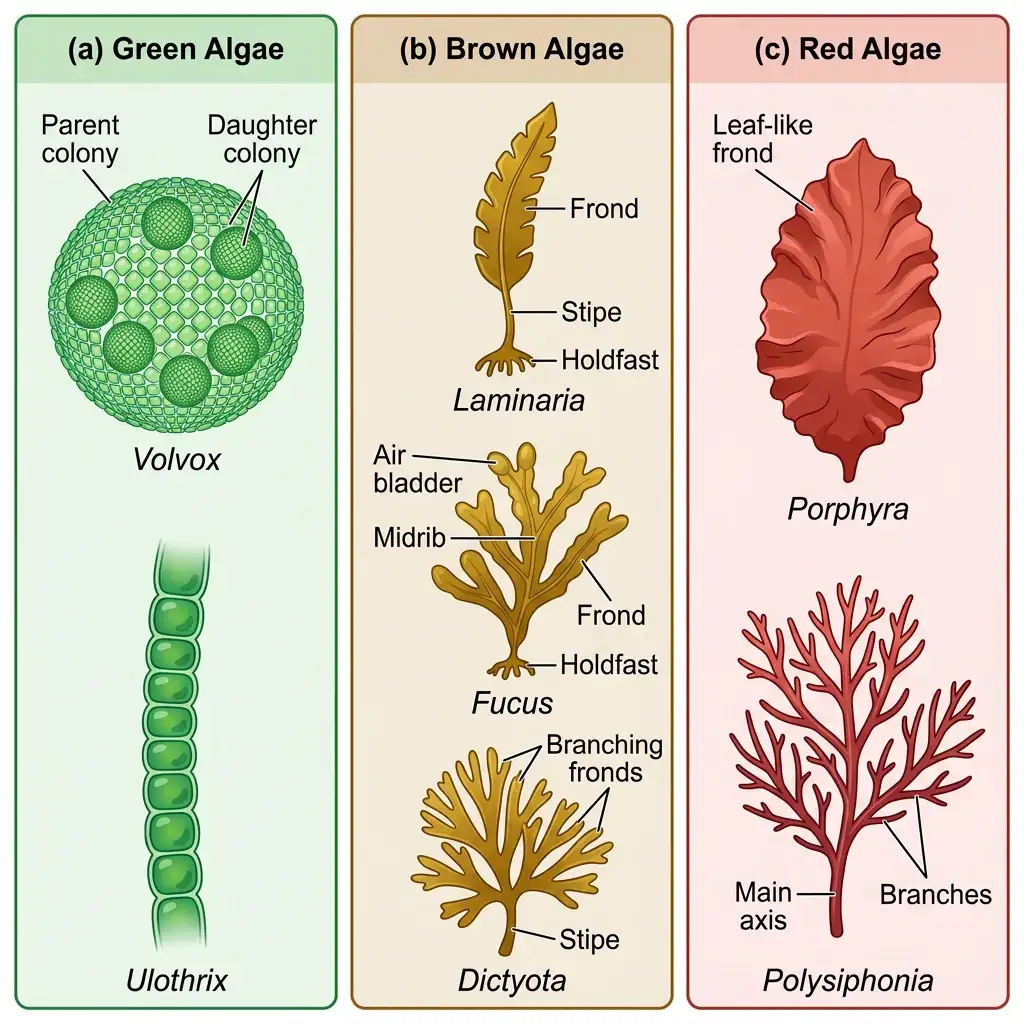
Diversity in Algae: Compares green (Chlorophyceae), brown (Phaeophyceae), and red (Rhodophyceae) algae structures.
🔬 Detailed Anatomical Description
Algae are simple, thalloid, autotrophic eukaryotic organisms classified into Chlorophyceae (green algae), Phaeophyceae (brown algae), and Rhodophyceae (red algae). Key examples include: (a) Volvox forming spherical colonies, and Ulothrix containing unbranched filaments; (b) Laminaria (brown frond, stipe, holdfast), Fucus (air bladders, midrib), and Dictyota (dichotomously branched); (c) Porphyra (flat thallus) and Polysiphonia (branched filaments).
III. BRYOPHYTES
A GENERAL FEATURES
| FEATURE | DETAIL |
|---|---|
| Also called | 'Amphibians of the plant kingdom' ⭐⭐ — live in soil but need water for sexual reproduction |
| Habitat | Moist, shaded areas in hills; damp, humid localities; banks of streams |
| Embryo | First plant group with embryo ⭐ |
| Plant body | More differentiated than algae; thallus-like; attached by rhizoids |
| True organs | Lack true roots, stems, leaves |
| Main plant body | Haploid → produces gametes → called GAMETOPHYTE ⭐⭐ |
| Male sex organ | Antheridium → biflagellate antherozoids |
| Female sex organ | Archegonium (flask-shaped) → single egg |
| Sporophyte | Not free-living; attached to & nourished by gametophyte ⭐ |
B ECOLOGICAL & ECONOMIC IMPORTANCE
- ⭐ Mosses + Lichens = first organisms to colonise rocks → decompose rocks → make substrate for higher plants
- Mosses form dense mats on soil → reduce impact of falling rain → prevent soil erosion
- ⭐ Sphagnum = peat formation → peat used as fuel and packing material (capacity to hold water)
C LIVERWORTS vs MOSSES — COMPARISON
| FEATURE | LIVERWORTS | MOSSES |
|---|---|---|
| Plant body | Thalloid; dorsiventral; closely appressed to substrate | Upright, slender axes bearing spirally arranged leaves |
| Rhizoids | Unicellular ⭐ | Multicellular (branched) ⭐ |
| Asexual repro | Fragmentation OR gemmae ⭐ | Fragmentation & budding in secondary protonema |
| Gemmae | Green, multicellular, asexual buds in gemma cups ⭐ | — |
| Gametophyte stages | Single thalloid stage | Two stages: (1) Protonema → (2) Leafy stage ⭐⭐ |
| Protonema | — | Develops directly from spore; creeping, green, branched, filamentous ⭐ |
| Sporophyte dependence | Totally dependent on gametophyte | Partially dependent (semi-parasite) ⭐ |
| Examples | Marchantia ⭐ | Funaria, Polytrichum, Sphagnum ⭐ |
NEET 2021: Gemmae = green, multicellular, asexual buds in gemma cups (liverworts). NEET 2023: Protonema = first stage of moss gametophyte; develops directly from spore. NEET 2010: In Sphagnum, male & female gametophytes are independent & free-living.
Bryophytes Representatives
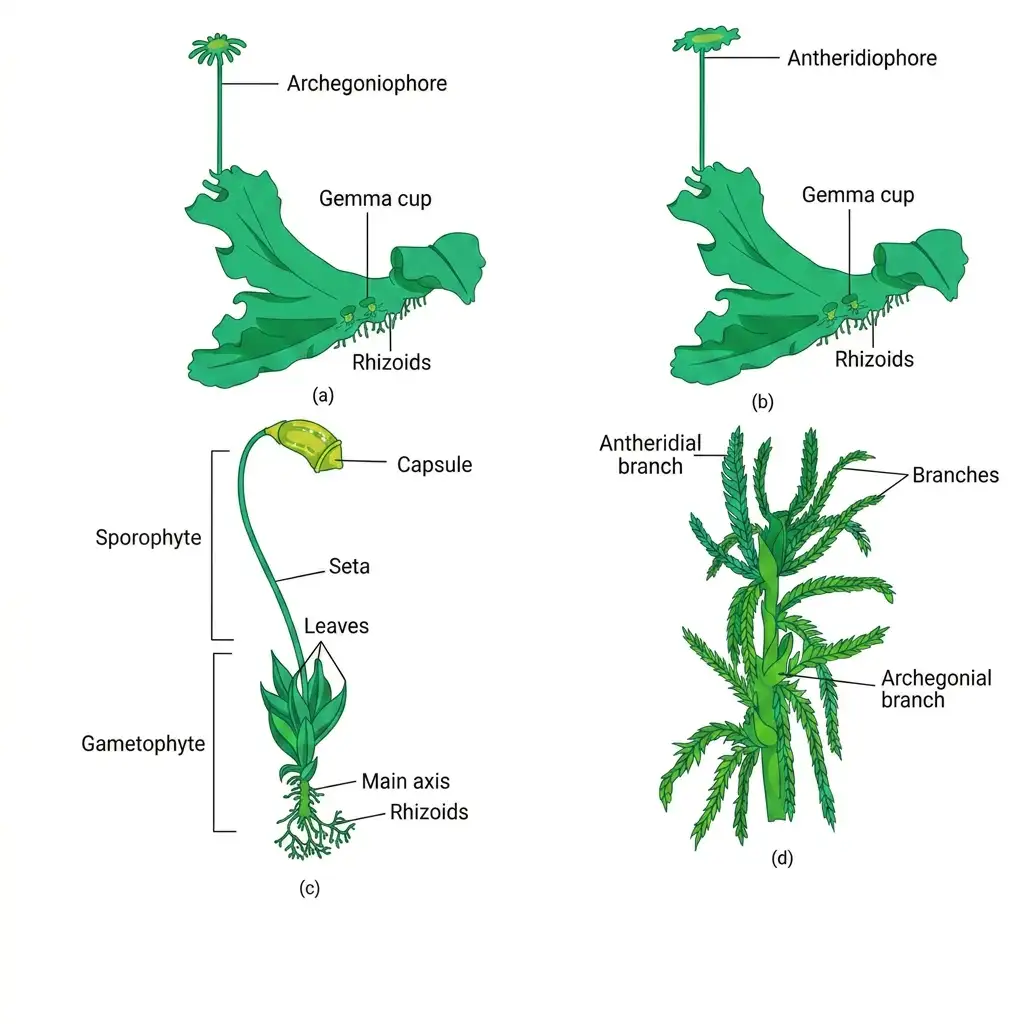
Structure of Bryophytes: Highlights Marchantia female and male thalli, Funaria gametophyte/sporophyte, and Sphagnum gametophyte.
🔬 Detailed Anatomical Description
Bryophytes are non-vascular plants including liverworts and mosses. (a) & (b) Marchantia: A liverwort with dorsiventral thalli containing gemma cups, rhizoids, and umbrella-like reproductive organs (archegoniophores in females; antheridiophores in males). (c) Funaria: A moss showing a leafy gametophyte supporting a sporophyte with a Seta stalk and Capsule. (d) Sphagnum: A moss showing distinct branches of gametophores forming dense peat bogs.
IV. PTERIDOPHYTES
A GENERAL FEATURES
| FEATURE | DETAIL |
|---|---|
| Includes | Horsetails & Ferns |
| Evolutionary significance | First terrestrial plants to possess vascular tissues (xylem & phloem) ⭐⭐ |
| Dominant phase | Sporophyte (main plant body) ⭐ |
| Main plant body | Differentiated into true root, stem & leaves with well-differentiated vascular tissues |
| Male gamete transfer | Requires water (like bryophytes) |
LEAVES IN PTERIDOPHYTES
| TYPE | SIZE | EXAMPLE |
|---|---|---|
| Microphylls | Small | Selaginella |
| Macrophylls | Large | Ferns |
SPORANGIA, SPOROPHYLLS & STROBILI
- Sporophylls may form distinct compact structures called strobili or cones.
- ⭐ Examples with strobili: Selaginella, Equisetum
GAMETOPHYTE (PROTHALLUS)
| FEATURE | DETAIL |
|---|---|
| Name | Prothallus ⭐ |
| Nature | Inconspicuous, small, multicellular, free-living, mostly photosynthetic, thalloid |
| Compared to bryophyte | Smaller and have smaller sex organs ⭐ |
E HOMOSPOROUS vs HETEROSPOROUS
| FEATURE | HOMOSPOROUS | HETEROSPOROUS |
|---|---|---|
| Spore types | All spores of similar kind | Two kinds: Macrospores (large) + Microspores (small) |
| Occurrence | Majority of pteridophytes | Selaginella & Salvinia ⭐⭐ |
WHICH GROUPS ARE HOMOSPOROUS / HETEROSPOROUS?
| GROUP | SPORE TYPE |
|---|---|
| Algae | Homosporous |
| Bryophytes | Homosporous |
| Pteridophytes | Mostly homosporous; some heterosporous (Selaginella, Salvinia) |
| Gymnosperms | Only heterosporous ⭐ |
| Angiosperms | Only heterosporous ⭐ |
NEET 2012: Origin of seed habit can be traced in heterosporous pteridophytes. NEET 2021, 2023: Majority of pteridophytes are homosporous; Selaginella & Salvinia are heterosporous.
FOUR CLASSES OF PTERIDOPHYTES
| CLASS | EXAMPLES |
|---|---|
| Psilopsida | Psilotum |
| Lycopsida | Selaginella, Lycopodium |
| Sphenopsida | Equisetum (Horsetails) |
| Pteropsida | Dryopteris, Pteris, Adiantum (Ferns) |
Pteridophytes Representatives
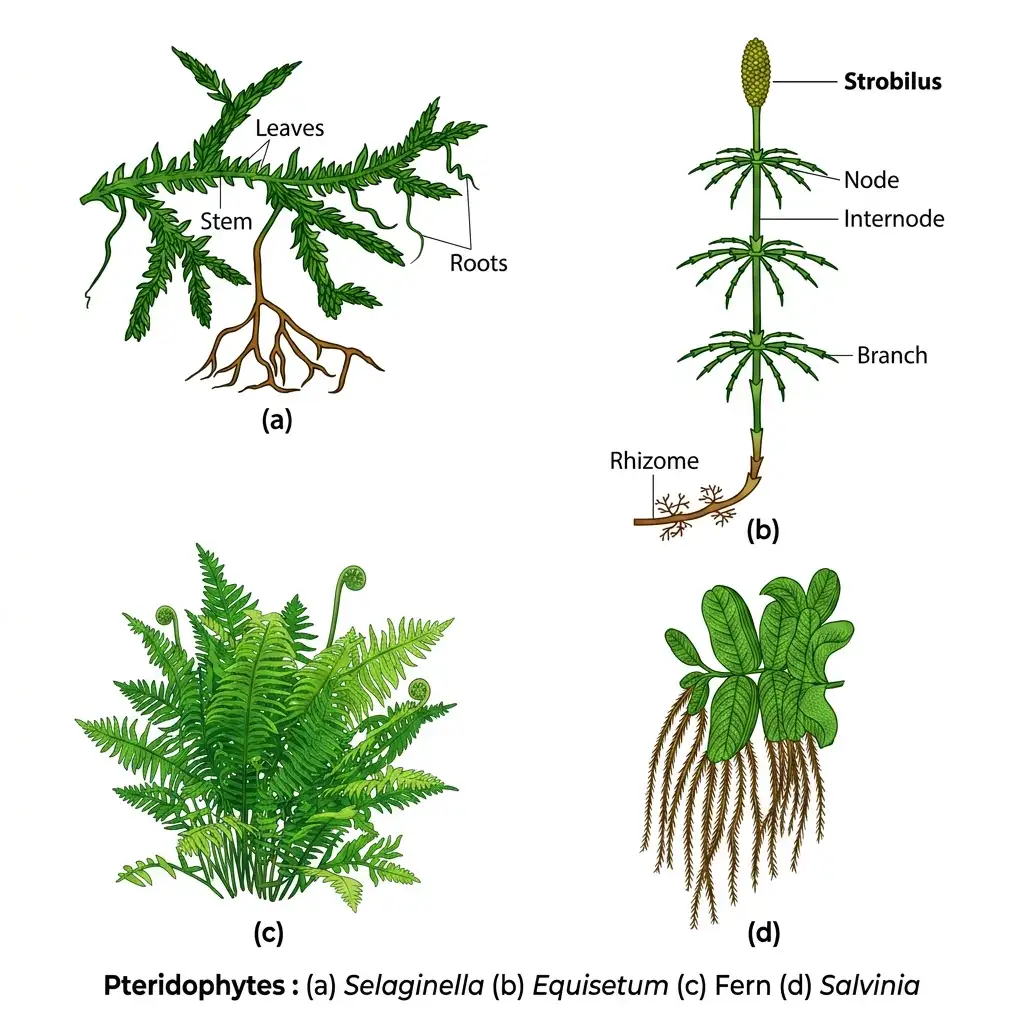
Kingdom Pteridophyta: Compares Selaginella, Equisetum, a Fern, and Salvinia, showcasing vascular seedless plant structures.
🔬 Detailed Anatomical Description
Pteridophytes are vascular plants reproducing via spores. (a) Selaginella: A microphyllous clubmoss showing small leaves on branching stems and roots. (b) Equisetum: Horsetail showing segmented stems with nodes/internodes, rhizome base, and fertile spore-bearing cones (strobili). (c) Ferns: Megaphyllous plants displaying large pinnate fronds. (d) Salvinia: A free-floating heterosporous water fern showing paired green leaves and root-like submerged structures.
V. GYMNOSPERMS
A GENERAL FEATURES
| FEATURE | DETAIL |
|---|---|
| Name meaning | Gymnos = Naked; Sperma = Seeds |
| Defining feature | Ovules not enclosed by ovary wall → seeds are NAKED ⭐⭐ |
| Tallest tree | Sequoia sempervirens (Giant coast redwood tree) ⭐ |
| Spore type | Heterosporous (microspores & megaspores) ⭐ |
| Gametophyte | Male & female gametophytes do NOT have independent free-living existence → remain within sporangia ⭐⭐ |
| Endosperm | HAPLOID (n) — formed BEFORE fertilisation ⭐ (cf. Angiosperms: 3n, after fertilisation) |
RE-NEET 2026: In gymnosperms, the male and female gametophytes remain within the sporangia, and seeds are not covered (both statements are correct).
NEET 2026: Pinus is a GYMNOSPERM = 'naked seed' (ovules lie exposed on the megasporophylls; not enclosed by an ovary wall).
B ROOTS
| TYPE | ASSOCIATION | EXAMPLE |
|---|---|---|
| Tap roots | Generally | — |
| Mycorrhizal roots | Fungal association | Pinus ⭐ |
| Coralloid roots | N₂-fixing cyanobacteria | Cycas ⭐ |
C STEMS
| FEATURE | CYCAS | PINUS & CEDRUS |
|---|---|---|
| Branching | Unbranched | Branched ⭐ |
D LEAVES — ADAPTATIONS
| ADAPTATION | DETAIL |
|---|---|
| Conifers | Needle-like leaves → reduce surface area ⭐ |
| Cuticle | Thick cuticle → reduces water loss |
| Stomata | Sunken stomata → help reduce water loss ⭐ |
| Cycas | Pinnate leaves; persist for a few years |
E CONES (STROBILI)
| CONE TYPE | BEARS | CONTAINS |
|---|---|---|
| Male (microsporangiate) | Microsporophylls + Microsporangia | Microspores → develop into pollen grains (= reduced male gametophyte) |
| Female (macrosporangiate) | Megasporophylls + Ovules | MMC → 4 megaspores → 1 develops into female gametophyte with 2+ archegonia |
MONOECIOUS vs DIOECIOUS
| FEATURE | EXAMPLE |
|---|---|
| Monoecious (male & female cones on same tree) | Pinus ⭐ |
| Dioecious (on different trees) | Cycas ⭐ |
F POLLINATION & FERTILISATION
| FEATURE | DETAIL |
|---|---|
| Pollen dispersal | By wind (anemophily) ⭐ — ONLY mode of spore dispersal in gymnosperms |
| Pollen grains | In Pinus: have WINGS ⭐ (aid wind dispersal; 'sulphur shower') |
| Pollen tube | Grows towards archegonia in ovule; discharges male gametes |
| Fertilisation | Zygote → embryo; Ovule → seed (naked, not covered) |
NEET 2017, 2018, 2023, 2026 (reinforced): A pollen tube IS formed in gymnosperms — statement saying 'pollen tube is not formed' is FALSE. Pinus is monoecious. Pinus has winged pollen grains (aid wind dispersal).
Gymnosperms Representatives
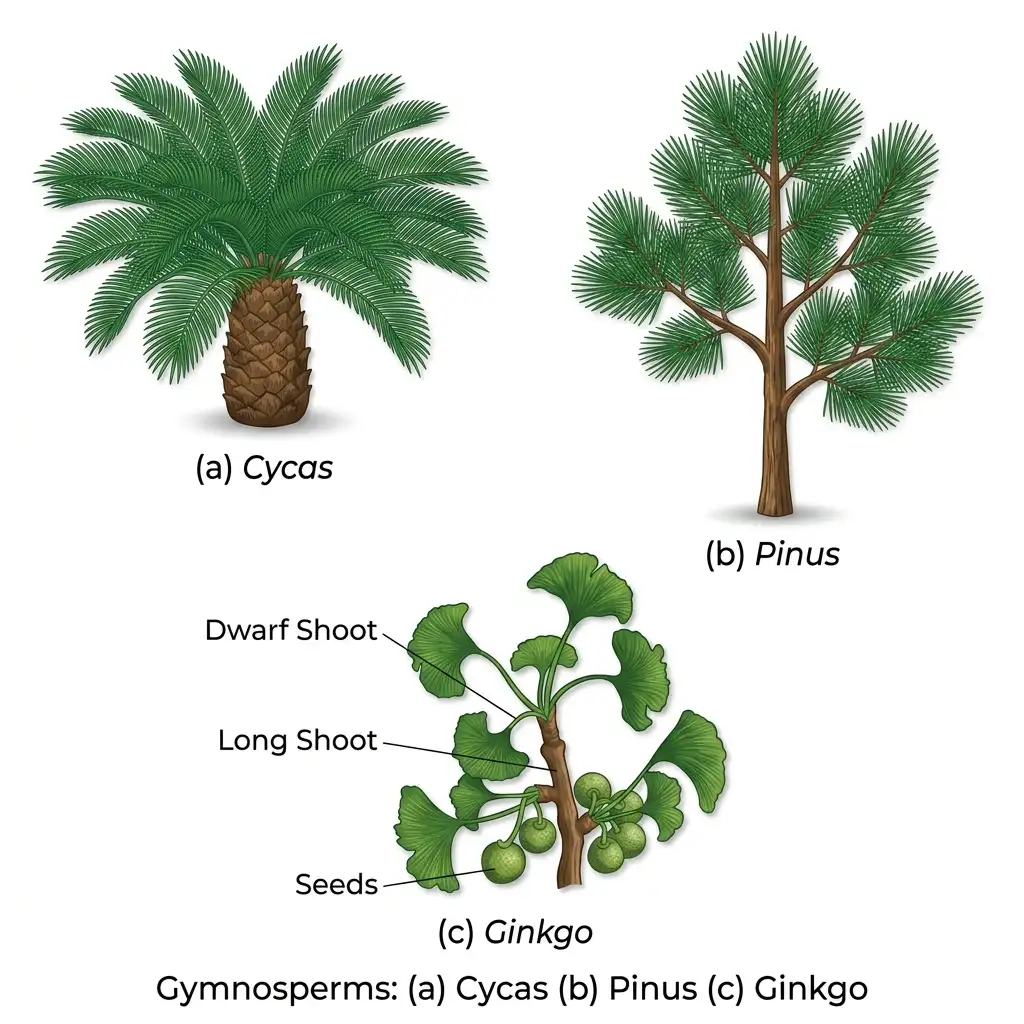
Morphology of Gymnosperms: Highlights cycas fronds, pine branches, and ginkgo biloba shoots and naked seeds.
🔬 Detailed Anatomical Description
Gymnosperms are vascular plants with naked, exposed seeds. (a) Cycas: A palm-like plant with unbranched woody stems and large pinnate leaves. (b) Pinus: A tall conifer tree with needle-like leaves grouped in bundles on shoots. (c) Ginkgo biloba: A living fossil tree displaying distinct long and dwarf shoots, fan-shaped leaves, and round, fleshy naked seeds. Essential study notes for Class 11 and NEET.
VI. ANGIOSPERMS (BRIEF)
| FEATURE | DETAIL |
|---|---|
| Defining feature | Ovules in flowers; seeds enclosed in fruits |
| Smallest | Wolffia |
| Tallest | Eucalyptus (over 100 m) |
| Two classes | Dicotyledons & Monocotyledons |
Angiosperms Representatives
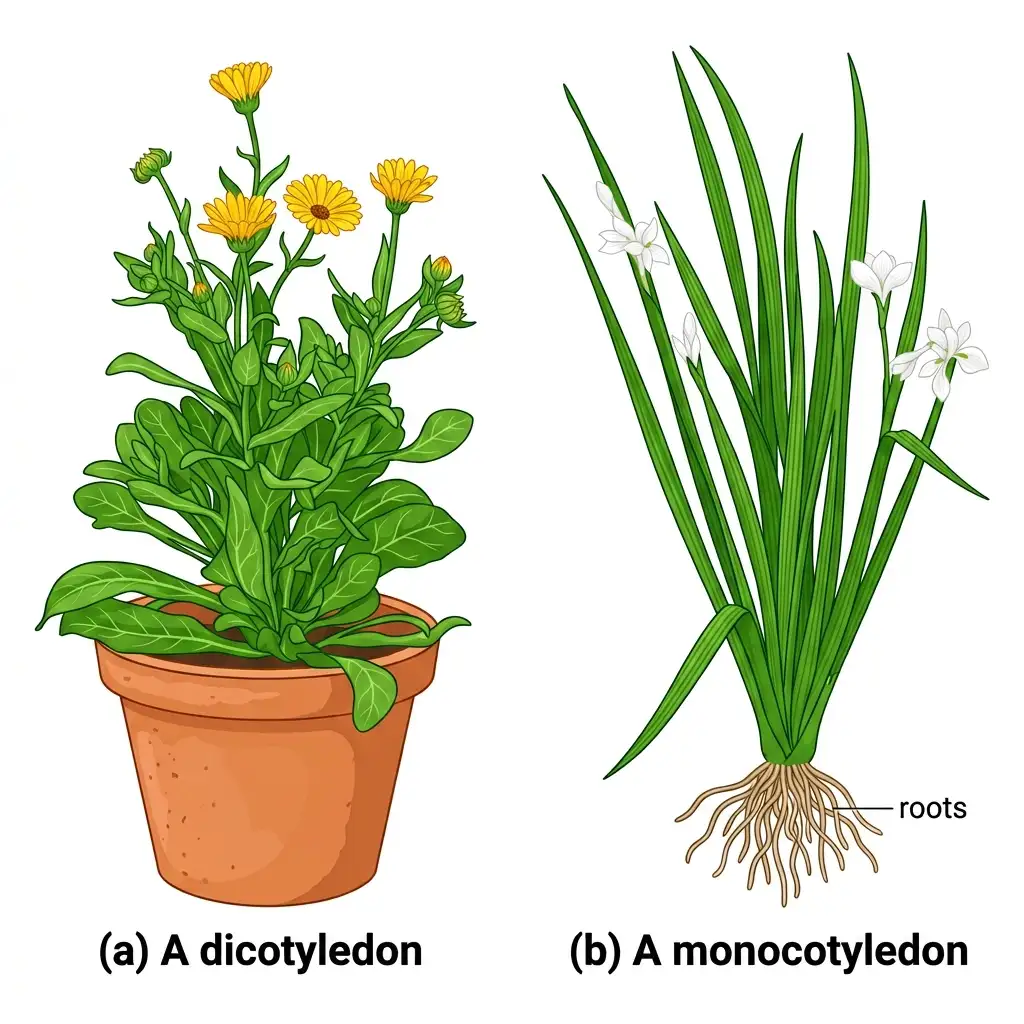
Classifying Angiosperms: Shows key structural differences between dicots (broad leaves, taproot) and monocots (narrow leaves).
🔬 Detailed Anatomical Description
Angiosperms are flowering plants where seeds are enclosed in fruits. They are divided into: (a) Dicotyledons: Plants whose seeds have two cotyledons, characterized by broad reticulate-veined leaves, taproot systems, and tetramerous/pentamerous flowers; (b) Monocotyledons: Plants whose seeds have a single cotyledon, characterized by narrow parallel-veined leaves, fibrous root systems, and trimerous flowers.
VII. PLANT LIFE CYCLES (VERY HIGH YIELD)
THREE TYPES OF LIFE CYCLES
| TYPE | DOMINANT PHASE | ZYGOTE BEHAVIOUR | EXAMPLES |
|---|---|---|---|
| Haplontic | Gametophyte (n) dominant & free-living; Sporophyte = only zygote | Zygotic meiosis | Most algae: Spirogyra, Chlamydomonas, Volvox ⭐ |
| Diplontic | Sporophyte (2n) dominant & free-living; Gametophyte reduced | Gametic meiosis | All seed-bearing plants (Gymno- & Angiosperms); alga Fucus ⭐ |
| Haplo-diplontic | Both phases multicellular | Alternation of generations | Bryophytes (gametophyte dominant), Pteridophytes (sporophyte dominant); Algae: Ectocarpus, Polysiphonia, Kelp ⭐ |
DETAILED COMPARISON — DOMINANT PHASE BY GROUP
| PLANT GROUP | DOMINANT PHASE | LIFE CYCLE TYPE |
|---|---|---|
| Most Algae | Gametophyte (n) | Haplontic |
| Fucus (alga) | Sporophyte (2n) | Diplontic ⭐ |
| Ectocarpus, Polysiphonia, Kelp (algae) | Both multicellular | Haplo-diplontic ⭐ |
| Bryophytes | Gametophyte (n) ⭐ | Haplo-diplontic |
| Pteridophytes | Sporophyte (2n) ⭐ | Haplo-diplontic |
| Gymnosperms | Sporophyte (2n) | Diplontic |
| Angiosperms | Sporophyte (2n) | Diplontic |
NEET 2017, 2022, 2026 context (reinforced): Volvox, Spirogyra, Chlamydomonas = haplontic. Fucus = diplontic (exception among algae). Ectocarpus, Polysiphonia, Kelp = haplo-diplontic algae.
VIII. SPOROPHYTE DEPENDENCE SUMMARY
| GROUP | SPOROPHYTE DEPENDENCE ON GAMETOPHYTE |
|---|---|
| Liverworts | Totally dependent |
| Mosses | Partially dependent (semi-parasite) ⭐ |
| Pteridophytes | Sporophyte is dominant & independent; gametophyte (prothallus) is free-living |
| Gymnosperms | Sporophyte dominant; gametophyte not free-living |
| Angiosperms | Sporophyte dominant; gametophyte highly reduced |
NEET 2026 context: In mosses, the sporophyte is partially dependent on the gametophyte (semi-parasite).
IX. RAPID REVISION — ALL EXAMPLES TABLE
| CATEGORY | EXAMPLES |
|---|---|
| Colonial algae | Volvox |
| Filamentous green algae | Ulothrix, Spirogyra |
| Green algae (Chlorophyceae) | Chlamydomonas, Volvox, Ulothrix, Spirogyra, Chara |
| Brown algae (Phaeophyceae) | Ectocarpus, Dictyota, Laminaria, Sargassum, Fucus |
| Red algae (Rhodophyceae) | Polysiphonia, Porphyra, Gracilaria, Gelidium |
| Protein-rich unicellular algae | Chlorella, Spirulina |
| Agar source | Gelidium, Gracilaria (red algae) |
| Algin source | Brown algae |
| Carrageen source | Red algae |
| Isogamous (flagellated) | Ulothrix |
| Isogamous (non-flagellated) | Spirogyra |
| Anisogamous | Eudorina |
| Oogamous | Volvox, Fucus |
| Liverwort | Marchantia |
| Mosses | Funaria, Polytrichum, Sphagnum |
| Peat formation | Sphagnum |
| Unicellular rhizoids | Liverworts |
| Multicellular rhizoids | Mosses |
| Pteridophytes — Psilopsida | Psilotum |
| Pteridophytes — Lycopsida | Selaginella, Lycopodium |
| Pteridophytes — Sphenopsida | Equisetum |
| Pteridophytes — Pteropsida | Dryopteris, Pteris, Adiantum |
| Heterosporous pteridophytes | Selaginella, Salvinia |
| Strobili in pteridophytes | Selaginella, Equisetum |
| Tallest gymnosperm | Sequoia sempervirens |
| Mycorrhizal roots | Pinus |
| Coralloid roots | Cycas |
| Monoecious gymnosperm | Pinus |
| Dioecious gymnosperm | Cycas |
| Winged pollen | Pinus |
| Haplontic algae | Spirogyra, Chlamydomonas, Volvox |
| Diplontic alga | Fucus |
| Haplo-diplontic algae | Ectocarpus, Polysiphonia, Kelp |
| Smallest angiosperm | Wolffia |
| Tallest angiosperm | Eucalyptus (over 100 m) |
X. COMMON EXAM TRAPS — QUICK REFERENCE
| TRAP | CORRECT ANSWER |
|---|---|
| Ulothrix stores mannitol? | No — green algae, stores STARCH. Mannitol = brown algae |
| Red algae have flagella? | No — absent at all stages |
| Amphibians of plant kingdom? | Bryophytes (not pteridophytes) |
| First vascular plants? | Pteridophytes (not bryophytes) |
| Dominant phase in bryophytes? | Gametophyte (haploid) |
| Dominant phase in pteridophytes? | Sporophyte (diploid) |
| All pteridophytes heterosporous? | No — majority homosporous; only Selaginella & Salvinia |
| Gymnosperms homosporous? | No — all are heterosporous |
| Gymnosperm endosperm ploidy? | Haploid (n) — before fertilisation |
| Angiosperm endosperm ploidy? | Triploid (3n) — after fertilisation |
| Gymnosperm gametophyte free-living? | No — remains within sporangia |
| Origin of seed habit? | Heterosporous pteridophytes |
| Protonema develops from? | Directly from spore (moss gametophyte first stage) |
| Liverwort sporophyte dependence? | Totally dependent |
| Moss sporophyte dependence? | Partially dependent (semi-parasite) |
| Pinus monoecious or dioecious? | Monoecious (Cycas = dioecious) |
| Pollen tube in gymnosperms? | YES — carries male gametes |
| Fucus life cycle? | Diplontic (exception among algae) |
| Volvox life cycle? | Haplontic |
| Ectocarpus life cycle? | Haplo-diplontic |
| Gemmae found in? | Liverworts (Marchantia) |
| Natural classification by? | George Bentham & J.D. Hooker |
| Artificial classification by? | Linnaeus |
| Floridean starch similar to? | Amylopectin & glycogen |
| Brown algae store food as? | Mannitol & laminarin |
| Algin from? | Brown algae |
| Agar from? | Red algae (Gelidium, Gracilaria) |
| Chlorella used by? | Space travellers (protein-rich) |
- RE-NEET 2026 trap: In gymnosperms, the male and female gametophytes remain within the sporangia, and seeds are not covered (both statements are correct).
- NEET 2026 trap: Pinus is a GYMNOSPERM = 'naked seed' (ovules lie exposed on the megasporophylls; not enclosed by an ovary wall).
- NEET 2026 / reinforced: Pinus is monoecious. Pinus has winged pollen grains (aid wind dispersal).
- NEET 2026 context / reinforced: Volvox, Spirogyra, Chlamydomonas = haplontic. Fucus = diplontic (exception among algae). Ectocarpus, Polysiphonia, Kelp = haplo-diplontic.
- NEET 2026 context: In mosses, the sporophyte is partially dependent on the gametophyte (semi-parasite).
- NEET 2026 context: Ulothrix (green algae) stores STARCH (not mannitol). Mannitol is characteristic of brown algae.
- NEET 2018 / reinforced: Polysiphonia (red algae) has no motile gametes or flagella at any stage.